Dive Brief:
- The U.S. Green Building Council released two resources organizations can use to plan and implement decarbonization efforts: a blueprint for reducing emissions and creating value in existing buildings and a corporate practice toolkit for high-performance buildings.
- The Decarbonization Blueprint draws from nearly 11,000 LEED-certified projects across 90 countries, representing 3.8 billion square feet of building space.
- Sarah Zaleski, USGBC chief products officer, says buildings are one of the most immediate levers available for carbon reduction. “The challenge isn’t awareness, it’s activation,” she said in a statement. “Building tenants, owners and operators are asking for higher performing buildings; what they need is a credible, structured pathway that connects ambition to action.”
Dive Insight:
The blueprint and toolkit come as the United Nations has released a report calling for urgent action to mitigate the effects of global temperatures exceeding 1.5 degrees Celsius above pre-industrial levels, a warming limit set by the Paris Agreement that has now become “a likely near-term outcome,” the council said.
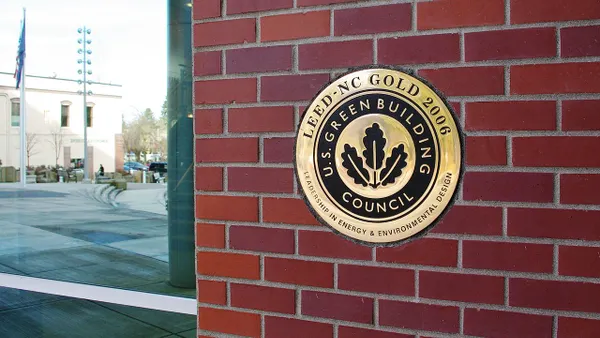
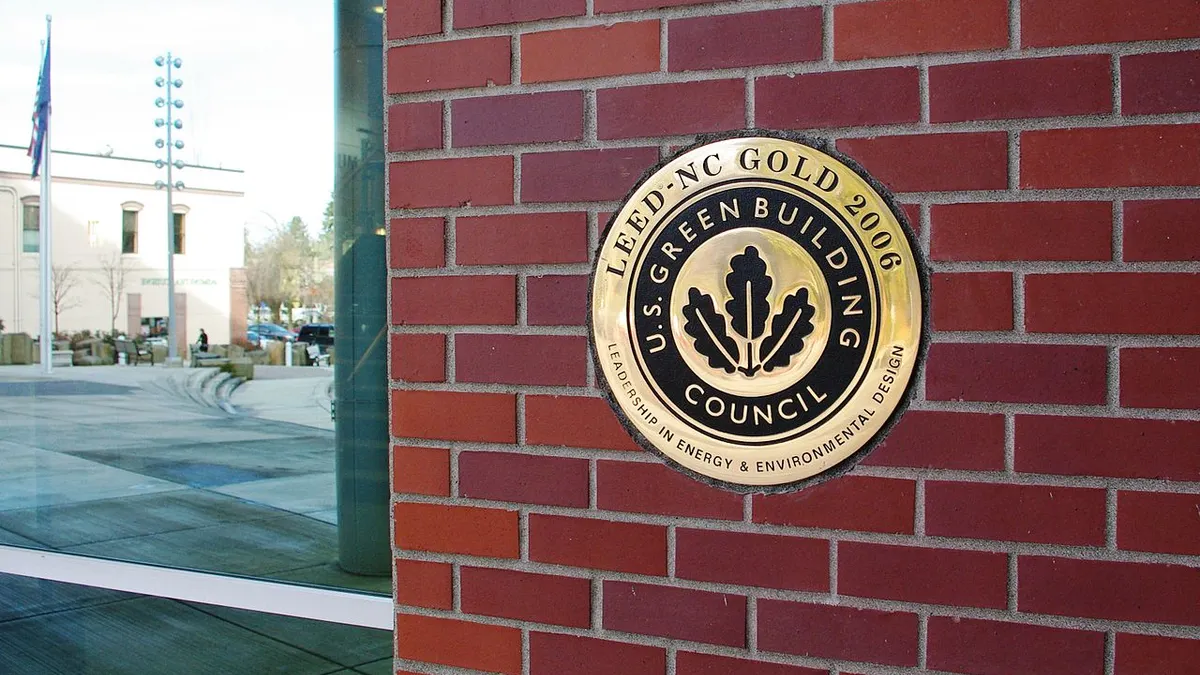
Leadership in Energy and Environmental Design, or LEED, certification is the world’s most widely used green building rating system, according to USGBC.
Based on an analysis of 10,980 projects certified under LEED for Building Operations and Maintenance, or LEED O+M, criteria, existing buildings have achieved an estimated 10.3 million metric tons of annual greenhouse gas emission savings and 81.8 million metric tons of cumulative reductions as of November 2025, according to USGBC, which administers the LEED rating.
Based on data available from 2,965 projects, LEED O+M projects save an average of 2.4 kilograms of CO2 emissions per square foot, or 26%, of GHG emissions annually compared to baseline, USGBC says.
Although higher certifications represent higher annual GHG emissions savings, projects certified at the lowest level still save 14% in emissions per year, according to the organization. Platinum-rated LEED O+M projects save on average 41% in emissions, with gold and silver saving 28% and 19%, respectively.
The blueprint looks at refrigerant management as an example of an effective decarbonization lever and how projects are using low-global warming potential refrigerants to reduce impacts of leakage, which USGBC calls a “critical, yet less frequently discussed component of decarbonization.”
For example, LEED v5 sets prerequisites for removal of refrigerant-containing equipment and managing leakage rate as well as tracking refrigerant inventory, recharge and leakage for 12 months. Operators can then receive a credit for meeting a targeted refrigerant leakage emissions ratio.
Transportation is another area where LEED-certified projects are cutting emissions. USGBC rewards credits for buildings that measure and reward reductions in commute emissions through occupant surveys and active management, provide rewards programs that reduce single-occupancy vehicle trips and implement on-site electric vehicle infrastructure.
“By integrating these levers into building operations, LEED O+M enables projects to address emissions beyond core building operations, reinforcing the role of existing buildings as active contributors to broader decarbonization and land-use outcomes,” USGBC said. Based on data available from LEED v4.1 O+M certified projects, these measures save an average of 43.8% of transportation emissions, per the report.
The report includes case studies of how building owners implemented deep energy retrofits to demonstrate the business case for large-scale decarbonization measures. One case study covers the Empire State Building, the first LEED v5 Platinum project in New York City that has reduced GHG emissions 59% since 2007 and helped the building achieve a 9.6% reduction in energy consumption relative to its baseline.
The Corporate Practice Toolkit for High-Performance Buildings provides guides on corporate policy and procurement that USGBC says can help organizations establish guidelines to support decision-making. The guides cover capital planning, site selection, design, construction, operation and maintenance.
Corporate sustainability leads and building professionals can use the toolkit to set policies, identify strategies and utilize sample language to scale action toward decarbonization and resilience goals, USGBC said.