
The U.S. Department of Labor’s Occupational Safety and Health Administration proposed a rule on April 6 that would remove a ladder-safety deadline from the agency’s walking-working surfaces standard and provide companies greater flexibility in compliance.
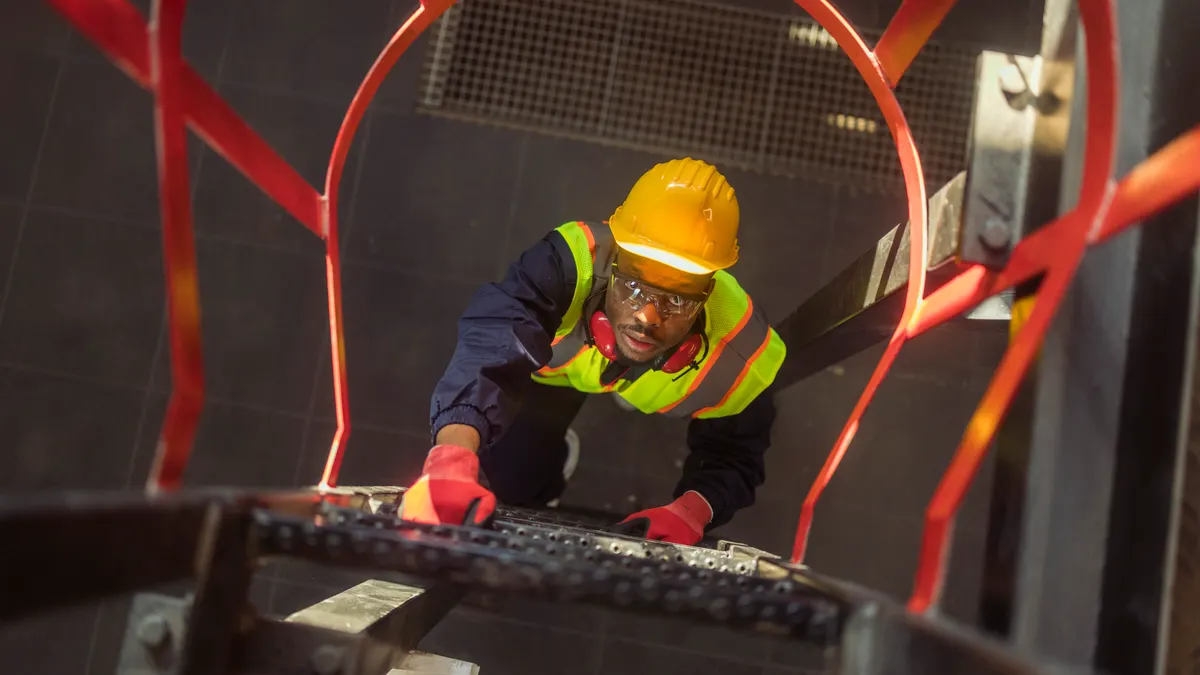
The current requirement, finalized during the final year of the Obama administration, mandated that companies equip fixed ladders that extend more than 24 feet with safety or personal fall arrest systems, giving employers until Nov. 17, 2036, to comply.
The proposed rule would remove the 2036 deadline and allow companies to upgrade their ladders at the end of their service lives to reduce costs.
The required equipment, which consists of a body harness, anchor and connector, is used to suspend a worker in the event of a fall from a walking-working surface, according to OSHA’s website. Connections could also include a lanyard, deceleration device, lifeline or a combination of these equipment pieces.
The current standard also bans cages, which are barriers that encircle or nearly enclose a ladder’s climbing space. Wells, which are complete enclosures around a fixed ladder attached to a wall, are also prohibited. OSHA said in the 2016 rule that there is “wide recognition in general industry that cages and wells neither prevent workers from falling off ladders nor protect them from injury when a fall occurs.”
Furthermore, the current standard requires companies to set up a personal fall arrest or ladder safety system on new fixed ladders. OSHA’s proposal did not change this mandate.
In addition to manufacturing, other industries affected by the rule include waste, mining and logging, wholesale, retail, transportation, warehousing and utilities, and any workplace with walking-working surfaces, which include horizontal and vertical surfaces such as floors, stairs and roofs.
Trade groups petition rule repeal
The rule comes almost a year after the American Fuel and Petrochemical Manufacturers, American Chemistry Council and American Petroleum Institute sent a petition to OSHA, asking the agency to initiate the deregulation of ladder safety requirements under the Walking-Working Surfaces standard.
The three trade groups requested that OSHA consider repealing the rule and allow companies to continue using their existing fixed ladders, cages and wells, as this had been the standard “for decades before the 2016 amendment,” according to the petition dated July 28, 2025.
Alternatively, the trade groups requested that the agency modify the standard to exempt companies with fixed ladders installed before a specified date, such as the date OSHA published the final rule. They also asked that OSHA allow companies to add the safety systems only on new or modified fixed ladders after the rule went into effect.
The Walking-Working Surfaces rule was established in 1971 and has undergone various modifications over the years, according to the proposal on the Federal Register. The regulation’s current version went into effect in January 2017, according to OSHA’s website. At the time the rule became effective, OSHA estimated that companies would save $614.5 million in fall-prevention costs for fatalities and injuries and would incur about $310 million in implementation costs.
The rule came after U.S. Bureau of Labor Statistics data from 1992 to 2004 showed an average of 300 fatal falls per year, 71% of which were from falls to a lower level, according to the 2016 rule in the Federal Register. BLS data also showed 299,404 non-fatal falls that resulted in lost-workday injuries.
OSHA examined fall casualties from 2006 to 2012 in industries covered by the regulation on the BLS’ Census of Fatal Occupational Injuries data. The manufacturing and transportation sectors accounted for 9.6% and 7.1% of the fatal falls, respectively.
The manufacturing industry saw 355 workplace fatalities in 2024, according to BLS data released Feb. 19. Moreover, the industry recorded 52 casualties due to falls, trips and slips, a 10.4% drop from 2023.
Economic compliance costs
OSHA estimated in 2016 that the yearly compliance costs were $305 million, and $161.6 million for entities with fewer than 20 employees.
The agency also estimated that full compliance with the ladder safety standard would prevent an additional 5,842 lost-workday injuries and 29 fatalities per year.
“Although better compliance with existing safety standards may prevent some of these incidents, research and analyses conducted by OSHA found that many preventable injuries and fatalities would continue to occur even if employers were complying fully with the existing standards, the agency said in the 2016 version of the rule.
AFPM, ACC and API argued in their petition letter that if their members were forced to comply with the requirements, it would affect more than 22,000 ladders and cost over $1.2 billion, per their member survey data. The survey represents over one-third of the petroleum refineries and a small fraction of other chemical manufacturing facilities across the country.
“Just among the petroleum refineries, we could extrapolate a cost of more than $3 billion across the refining industry in the United States,” the trade groups said in the joint letter. “The cost in time is also enormous. It will take years, and millions of working hours, to perform the work necessary to come into compliance with the ladder safety/personal fall arrest protection requirements, detracting from our members’ ability to deliver the energy needed to power our nation.”
The trade groups also factored in other associated compliance costs, including inspecting and maintaining safety equipment, which can be affected by weather conditions and wear and tear, leading to replacements. Companies will also have to shoulder costs to train employees and contractors.
“If our members must implement the ladder safety/personal fall arrest system requirements, their resources available to address more urgent safety projects — including those that produce a clear safety benefit — may be reduced, the trade groups said.
OSHA has opened a comment period on the proposed rule. One comment from the CFR Compliance Group pushes back on the proposal, saying that the regulation “should stand as written.”
“The standard was developed to ensure the safety of those climbing these structures and working at heights,” CFR said. “This is truly a matter of life and death in many cases, and we owe it to our workers to provide as much protection as we can.”
Stakeholders have until June 5 to submit comments.