Dive Brief:
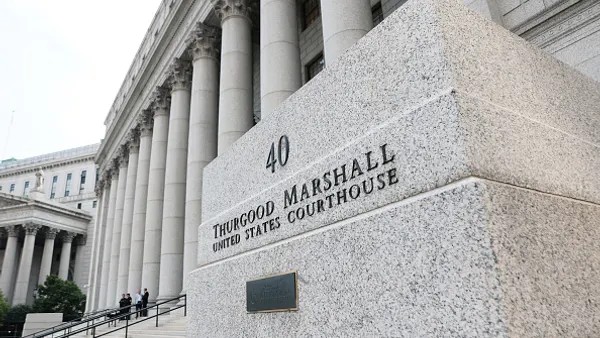
- The Administrative Office of the U.S. Courts is preparing to assume management of some federal courthouses, hiring staff and developing criteria for selecting up to 10 federal judicial districts for a proposed pilot program, Judge Robert J. Conrad Jr., director of the AO, said Sept. 17 in an update on judiciary initiatives. The preparations come before Congress has authorized the transfer.
- The bipartisan Judicial Space and Facilities Management Effectiveness Act, S. 5194, introduced July 30, would allow the judiciary to take control of courthouse facilities in as many as 10 judicial districts as a first step toward potentially assuming broader real property authority from the U.S. General Services Administration. The bill was referred to the Senate Environment and Public Works Committee on July 30 and has not advanced since then.
- GSA opposes transferring the authority despite struggling for money to keep its portfolio of federal properties maintained and renovated. Administrator Edward Forst argued in a written response to the bill that the Judiciary has a history of planning courthouses that are larger and more expensive than necessary and that Congress should instead allow GSA to make repairs of up to $75 million without prior congressional approval. The current threshold is $3.96 million.
Dive Insight:
The judiciary's preparations signal that it is laying the groundwork to move quickly if Congress approves the legislation.
“We are moving forward with a sense of urgency and focus,” Conrad said.
The judiciary is also working to build internal support for “this transformational initiative,” Conrad said.
The preparations are contingent on Congress approving S. 5194. The bipartisan bill, introduced by Sens. Dick Durbin, D-Ill., John Boozman, R-Ark., and Kevin Cramer, R-N.D., was referred to the Senate Environment and Public Works Committee on the same day it was introduced, where it remains.
Approval of the bill isn’t a slam dunk. According to GovTrack.US, the bill has a 13% chance of getting past committee and 8% chance of being enacted. GovTrack also notes that only 11% of bills made it past committee and only about 2% were enacted in 2021–2023.
The measure would transfer jurisdiction, custody and control of courthouse facilities in up to 10 federal judicial districts from GSA to the judiciary. The pilot is intended to give the judiciary an opportunity to demonstrate its ability to manage the properties before Congress considers a broader transfer of authority.
The Judiciary has sought real property authority since 1989, but the push has intensified as court officials have blamed GSA for deteriorating courthouse conditions and an estimated $8.3 billion repair backlog. Court officials have cited failing elevators, water damage, mold, Legionella contamination and other problems at federal courthouses.
GSA has pushed back strongly against the proposal.
The agency pointed to a Government Accountability Office report that found changes the judiciary made to its courthouse design standards would increase the size of future courthouses by an estimated 6% and construction costs by about 12% on average. GAO also found that the judiciary did not fully collaborate with GSA and other stakeholders when revising the standards.
GSA has also cited the Hugo L. Black U.S. Courthouse in Birmingham, Alabama — which, GSA says is the only courthouse still maintained by the judiciary following an earlier real property pilot — as evidence against expanding the judiciary's authority. GSA said an assessment found safety and accessibility deficiencies and maintenance practices that shortened the useful life of building systems.
“GSA is the best building manager in the federal government, and we're proud to support America's courts by extending our expertise to their facilities,” Forst said.
Rather than transferring courthouse management, Forst wants Congress to give GSA greater authority to use money from the Federal Buildings Fund for repairs without obtaining project-by-project congressional approval.
GSA currently must seek congressional approval for projects costing more than $3.96 million. Forst wants that threshold increased to $75 million, arguing that the existing process delays repairs and drives up costs.
GSA says it faces a nearly $50 billion maintenance backlog across its portfolio and is seeking $10 billion for critical repairs to 103 federal buildings between fiscal years 2028 and 2034.
Neither the Senate Environmental and Public Works Committee, Sen. Durbin's office nor Sen. Boozman's office immediately responded to a request for comment. GSA declined to provide a comment on the record.