Dive Brief:
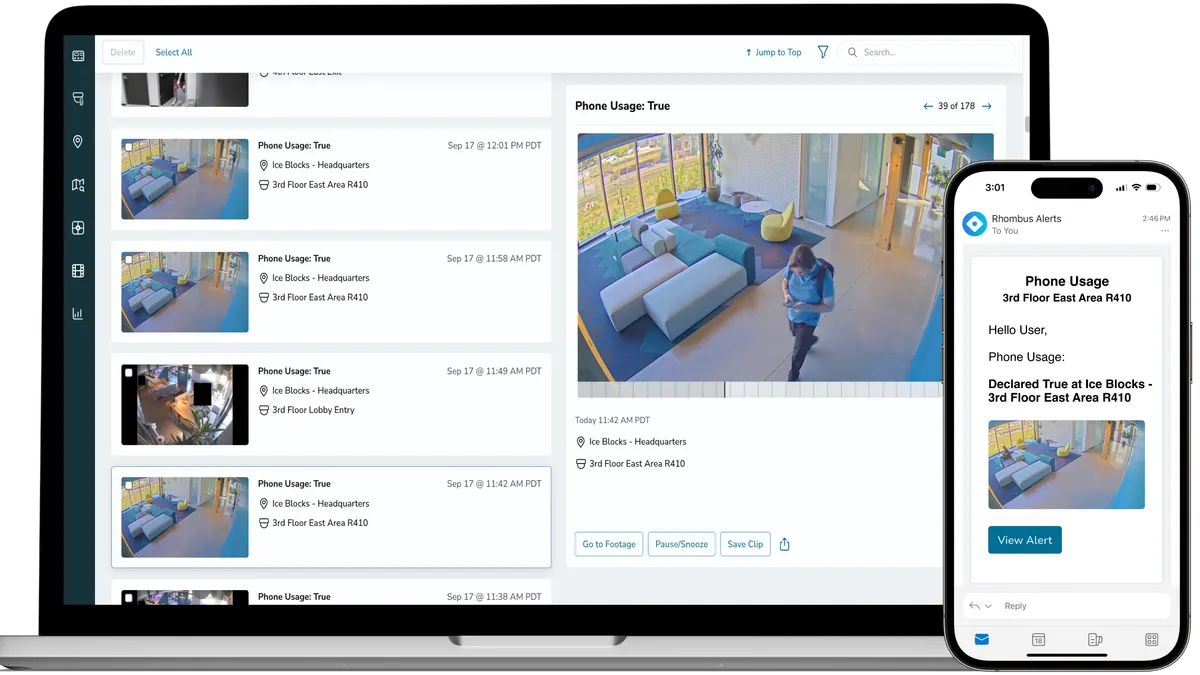
- Honeywell is expanding its security and access controls portfolio with AI-powered video through a collaboration with security specialist Rhombus, the company announced Thursday.
- Honeywell will offer Rhombus products through its channel partners and system integrator networks and will bring Rhombus’ AI analytics directly into Honeywell’s access control platforms, according to the release.
- "This strategic alliance combines the strength of Honeywell's access solutions portfolio, domain expertise and global reach with modern cloud video capabilities and AI enhancements," Billal Hammoud, president and CEO of Honeywell Building Automation, said in a statement.
Dive Insight:
Security and safety are top-of-mind AI use cases for a majority of building operators, according to a Wakefield Research survey, which polled 250 building managers and decision makers on behalf of Honeywell earlier this year. The most popular use cases cited by respondents were monitoring for unusual behavior (63%), location tracking systems for occupant safety (52%) and biometrics-based access control systems (45%).
The survey found that 85% of building managers plan to increase their use of AI in the coming year, “primarily to improve threat detection and make operations more efficient,” Ewa Pigna, vice president and chief technology officer of access solutions at Honeywell Building Automation, told Facilities Dive earlier this year.
Pigna said at the time that Honeywell was expecting facilities managers to add AI into their security systems as enhancements rather than rip and replace everything. “It's about building upon what works,” she said, by “adding cloud connectivity to traditional setups so that information from access controls, video cameras and alarm sensors can flow in real time.”
Honeywell’s partnership with Rhombus would fit into this iterative approach by providing customers access to AI-enabled cloud-based systems for video and access control that they can add their existing systems, according to Rhombus CEO Garrett Larsson.
The company provides a number of security cameras, all of which have enterprise-grade encryption and come with regular audits, automatic updates and a power-over-ethernet technology, the company says.
The security features, when looked at broadly, can help facilities throughout their operations, according to the company’s website. The technology can provide insights like, “Is there a lifeguard present?” or “Is a pipe leaking?” The platform’s AI analytics learn from business-as-usual situations to make the alerts better over time — for example, if an unmatched license plate is observed in a parking lot.
Pigna said the goal of integrating cloud-based AI-enhanced video with existing systems is to give the facilities team a picture of what's happening in a building at any moment. “At the heart of these changes is AI-powered detection, which will take center stage in providing real-time situational awareness,” she said. “Imagine cameras and sensors throughout a building that do not just record — they actively analyze.”
By using AI, these devices can learn what "normal" looks like in a specific space and then send an alert when the picture isn’t normal. “When something deviates — such as an unauthorized person lingering in a restricted area or someone trying to enter by closely following an authorized employee (a tactic known as tailgating) — the system flags it immediately and alerts the right people,” Pigna said. “This ‘always-on’ vigilance reduces response times dramatically, turning potential risks into managed situations before they worsen.”
The agreement to deliver integrated access control and video management in a single cloud solution adds to Honeywell’s effort to accelerate and modernize building security, which began in 2024 with its acquisition of LenelS2, the company said in its release. That addition was part of a $4.95 billion deal to acquire Carrier’s security business, Global Access Solutions, that added LenelS2 along with the Onity and Supra brands.
The agreement comes as Honeywell works to spin-off its aerospace business, filing its Form 10 on March 3, and reform its business model to focus more on recurring revenue through “stronger linkage” to its IoT platform Forge, CEO Vimal Kapur said on Honeywell's most recent earnings call. Recent launches for the company's remaining segments — building automation, process automation and industrial automation — have further signaled these intentions.