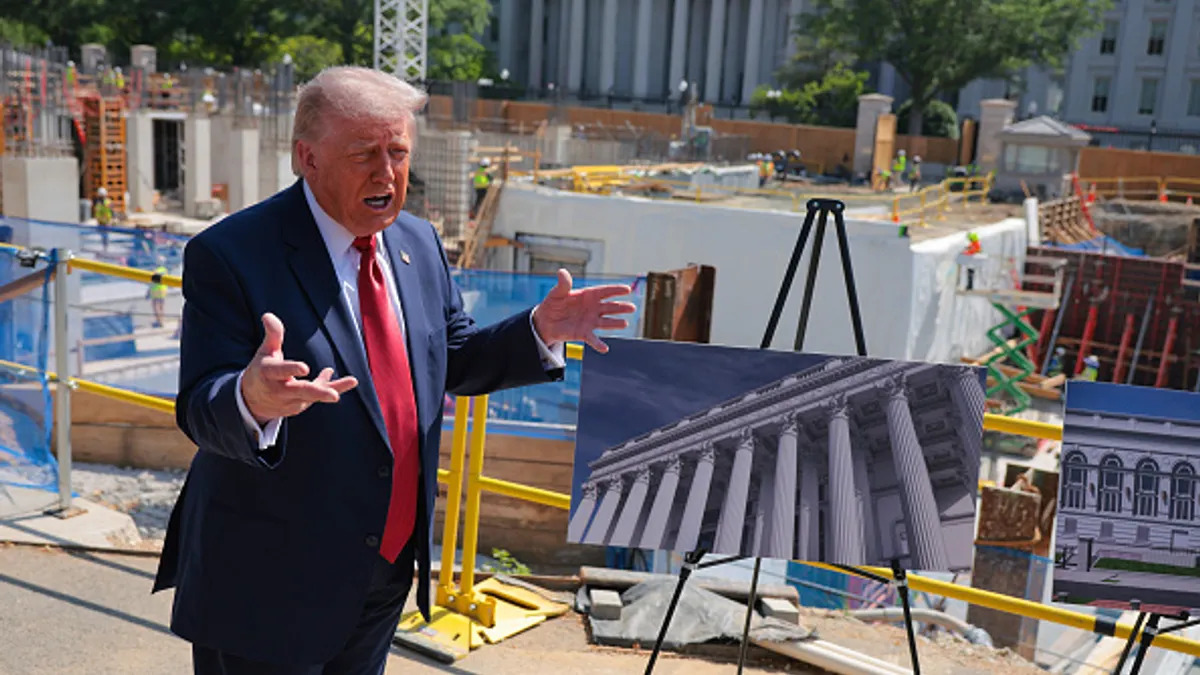
President Donald Trump has cited national security and inadequate event space as two of the reasons for his decision in October to tear down the East Wing of the White House and construct a ballroom. Behind the scenes, there’s a third: the World War II-era building was structurally unsound, moldy from roof and foundation leaks and had obsolete mechanical systems, according to a declaration by Joshua Fisher, the White House’s director of management and administration.
“Structural upgrades [were needed to] address the aging and structurally unstable East Wing colonnade roof along with insufficient foundation and underpinning support,” Fisher said in a declaration included in court material submitted to Judge Richard Leon of the U.S. District Court for the District of Columbia.
A ruling by Leon in March temporarily halted work on the project. An appeals court put the injunction on pause two weeks later, allowing work to continue while issues related to the size and scope of the ballroom and what input is needed from stakeholders are examined.
In his declaration, Fisher said that, as the White House’s point person on the project, he had consulted with the U.S. Secret Service, the National Park Service and other government agencies on the best way to upgrade the facilities, build the ballroom and add security measures.
“Each of the stakeholders identified various issues within the Executive Mansion and the East Wing that had been discovered over their many years of service to the White House,” he said.
The East Wing was built in 1902 as a formal entryway for visitors. An underground bunker, called the Presidential Emergency Operations Center, was built beneath it as part of an overhaul in 1942, according to a history of the East Wing on the White House website.
Fisher pointed to a report issued in 2000, when Bill Clinton was in office, that identified a need for an expanded event space on White House grounds. “Successive administrations have recognized this need as an ongoing priority,” he said. “The President directed me to initiate a project to implement those and many other longstanding goals important to him and various other entities within the United States Government.”
Fisher said the building had fallen into disrepair since its World War II-era renovation.
The colonnade roof had exceeded its service life and was leaking; the substructure was leaking, causing progressive deterioration and corrosion of structural components and mold and other toxic substances contamination; the electrical infrastructure was obsolete, undersized, at risk of operational failure, out of code compliance and a fire hazard. The steam and mechanical systems were old, inefficient and unreliable. The facility was in violation of the Americans with Disabilities Act and life-safety requirements and had asbestos and lead-paint hazards.
Given the scope of work that was needed, Fisher said, tearing the structure down and building new was the best course of action. “Based on a cost analysis, demolition of the existing East Wing structure and reconstruction of a new East Wing provided the lowest total cost of ownership and the most effective long-term risk reduction,” he said.
Trump said he expects the project to be completed in 2028.
“The funny thing is that from the standpoint of usage, other presidents will have it for 200 years,” Trump said in an interview May 30 with his daughter-in-law Lara Trump on Fox News. “I’ll have it for about six months.”