Dive Brief:
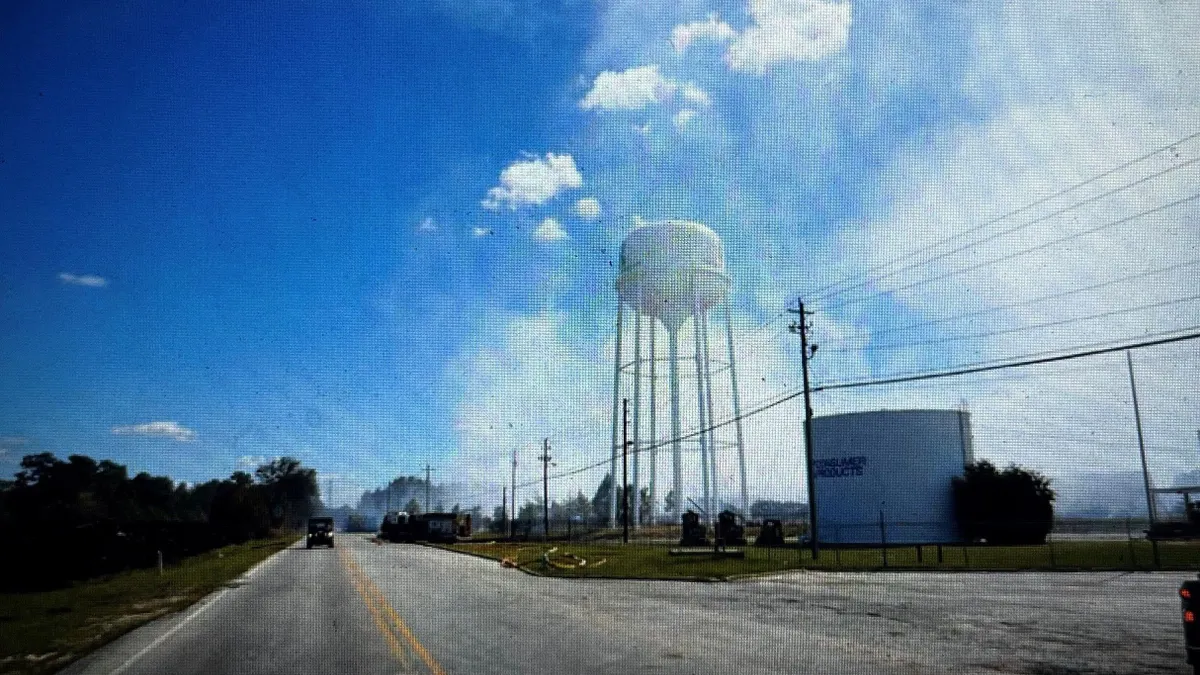
- A 2024 fire that destroyed a Conyers, Georgia, pool-chemical facility and released a toxic plume in the Atlanta area, requiring 90,000 people to stay in their homes, was caused by corroded sprinkler heads, according to a report released by the U.S. Chemical Safety and Hazard Investigation Board on July 21.
- “Components of the sprinkler system … had been experiencing significant corrosion and leaking,” CSB said in the report. “Nine months prior to the incident, over 1,100 sprinkler heads … were visually observed to be corroded.”
- Moisture from the corroded sprinkler heads mixed with millions of pounds of chlorine chemicals, causing the release of gases that ignited the fire and creating the toxic cloud and subsequent off-gassing that lingered over the area. “The multiple reactions … led to the decomposition of products and, subsequently, caused significant plumes of smoke, toxic vapors, and fires within the building,” the report said.
Dive Insight:
Corroded sprinkler heads had been a problem for years at the facility, owned by KIK Consumer Products affiliate BioLab, Inc., which stored chemicals for sanitizing pools, spas and industrial water applications, according to reports.
“I must have replaced at least 40 sprinkler heads,” Randy Garcia, a former engineer who left BioLab shortly before the accident, said in a Georgia Public Broadcasting report last year.
The corrosion stemmed in part from chlorine fumes combining with ambient moisture in the air to produce droplets of hydrochloric acid (HCI) condensing onto metal surfaces, including the sprinkler heads. “The production of HCI condensate damages building components such as the fire protection system … resulting in the premature corrosion of these systems even after short periods of chlorinated isocyanurates storage,” the report said.
Almost two dozen lawsuits have been filed since the accident, the latest last week for wrongful death by the wife of Kenny Johnson, a Rockdale County Soil and Water Conservation District employee who died in 2024.
“But for [BioLab’s] release of toxic gases, vapors, and smoke into Plaintiff’s community, Kenny would not have suffered respiratory distress and death,” the lawsuit states, Georgia Public Broadcasting reported.
One of the company’s insurers, Verlan Fire Insurance Company, sued the company last year to recoup $20 million it paid out after the accident, charging the company with "negligence, carelessness, and recklessness."
The facility was built in 2019 to store what BioLab said would be about 6 million pounds of chemicals. But it was holding more than 14 million pounds at the time of the accident, the CSB report said.
The chemicals included chlorinated isocyanurates, cyanuric acid, aluminum sulfate and sodium bromide. They were being stored in roughly 5,000 bags that CSB called “super sacks” — each one carrying more than a ton of chemicals.
“Some of them were stacked in such a way in the warehouse that responders were not able to keep the initial situation from developing into a catastrophic fire,” the report said.
The woven polypropylene sacks weren’t waterproof, so they didn’t prevent water leaking from the sprinkler heads from coming in contact with the chemicals.
Nor was the room sufficiently ventilated to prevent the resulting vapor from building up.
“These compounds … must be stored in a cool, dry, well-ventilated area,” the report said. “Exposure to heat or small amounts of water or moisture can cause [the] chlorinated isocyanurates to undergo a dangerous decomposition reaction.”
Neither the U.S. Occupational Safety and Health Administration nor the Environmental Protection Agency have rules covering the storage of reactive hazards like the ones in the BioLab facility, the report said.
“The CSB has been calling for greater regulatory coverage of reactive chemicals since 2002,” Sylvia Johnson, a CSB board member, said in a summary of the report,
In an email to Facilities Dive, a BioLab spokesperson said the company cooperated with CSB as it prepared the report.
“We will carefully consider its recommendations as part of our ongoing commitment to safety and continuous improvement,” the spokesperson said. “The health and safety of the communities where we operate is a top priority, and we worked collaboratively with first responders and relevant authorities to complete the emergency response in October 2024. We also completed the clean-up of the site affected by the fire and established resources dedicated to supporting area residents and business owners.”
The incident followed fires at the site in 2004, 2016 and 2020, according to an Atlanta Journal-Constitution report.