Will Gruver is chairman and founder of USP&E, an engineering and power project company that has delivered 150+ power projects in 45+ countries, with 25,000 MW contracted since 2002.
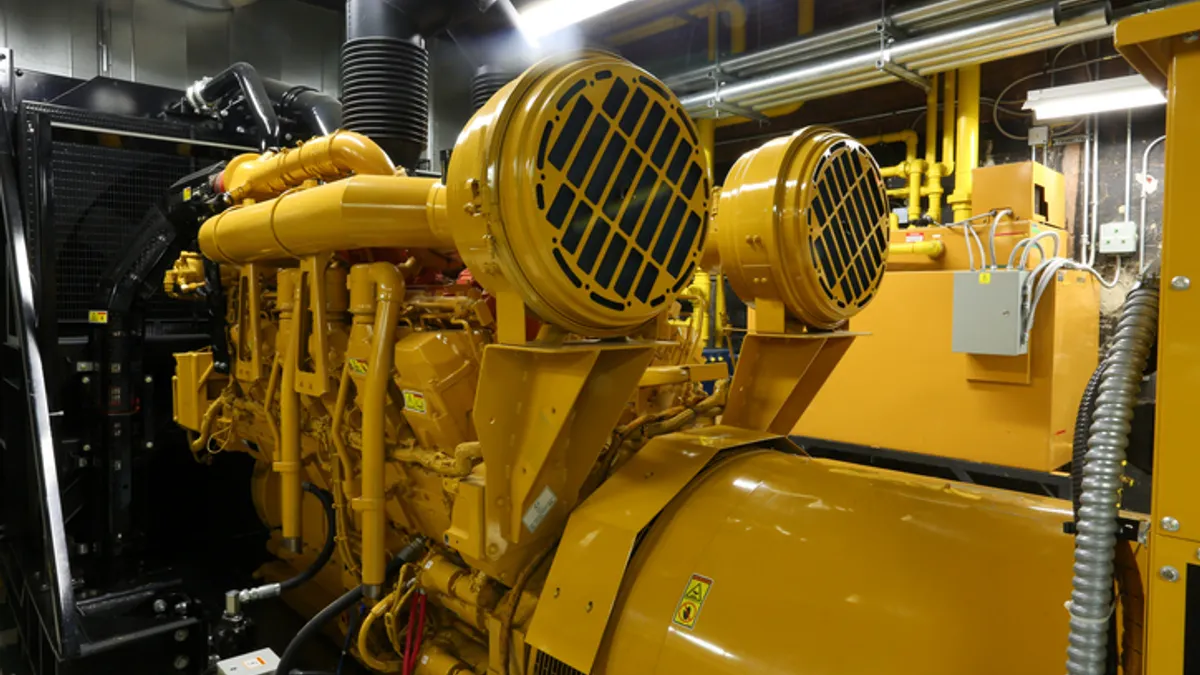
Walk into the generator room of almost any hospital, campus or data center and you will find a machine sized for a day that rarely comes. That is sensible. A standby plant has to carry the worst case. The trouble starts when the worst case is the only case anyone planned for, and the set spends its monthly tests and most real outages carrying a fraction of its rating.
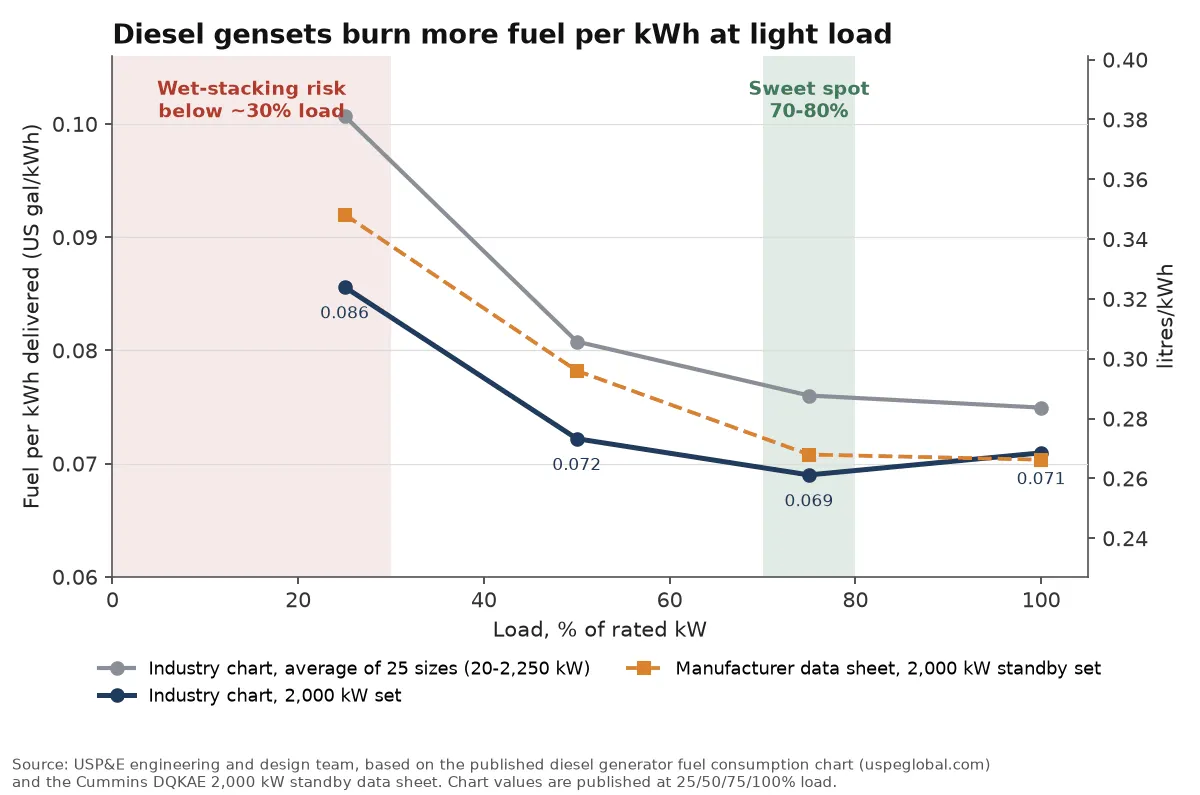
Diesel engines do not like that. Fuel burned per kilowatt-hour climbs as load falls, and below roughly 30% of rated load combustion is incomplete. Unburned fuel and carbon collect on injectors, in the turbocharger and down the exhaust. The industry calls it wet stacking. It is a fuel problem and a maintenance problem at the same time.
A worked example
Take an illustrative hospital, not a real one. It has a 2,000 kilowatt standby diesel set. When the transfer switch moves the life safety and critical branches onto it, during the monthly test or a real outage, the set picks up about 500 kW, or 25% of nameplate
The published industry fuel consumption chart puts a 2,000 kW set at about 42.8 gallons an hour at quarter load (162 liters). That is 0.086 gallons per kWh. At 75% load the same machine burns 103.5 gallons an hour for 1,500 kW, or 0.069 gallons per kWh. Delivered at that efficiency, our 500 kW would need about 34.5 gallons an hour. The lightly loaded set burns roughly 24% more fuel for every kWh it produces. One manufacturer's 2,000 kW data sheet shows a wider gap, about 30%. Across all 25 sizes in the chart, from 20 kW to 2,250 kW, quarter load averages 34% more fuel per kWh than full load. Smaller sets fare worse.
Now give our hospital a plausible year: twelve monthly tests of an hour each, plus 48 hours of utility outages. That is 60 running hours and 30,000 kWh. The set burns about 2,570 gallons where a well-loaded machine would burn about 2,070. The difference is roughly 500 gallons, or about $2,000 at an assumed $4 a gallon. In a single four-day storm outage the gap is about 800 gallons (3,000 liters), and that is tank autonomy you cannot buy back when the roads are closed.
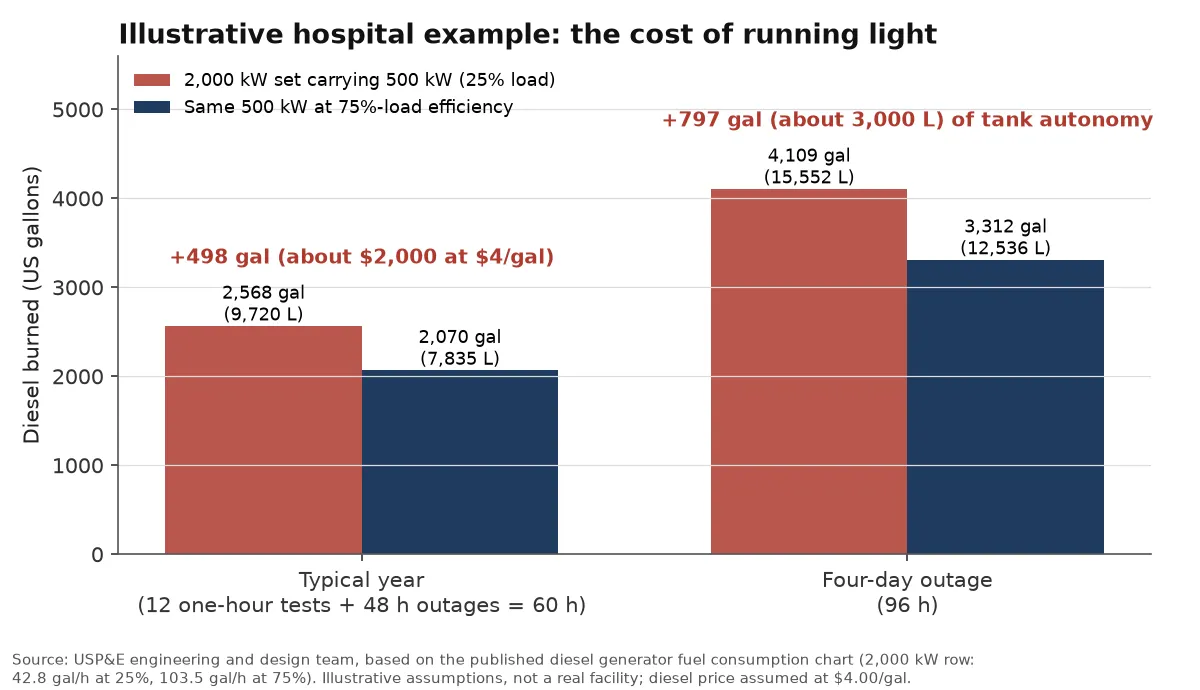
For one set, $2,000 a year will not alarm a CFO. Multiply it across a campus with six sets or a data center with twenty, and it becomes a line item. But fuel is the smaller cost. The bigger one is what those light-load hours do to the engine.
The code already sets the floor
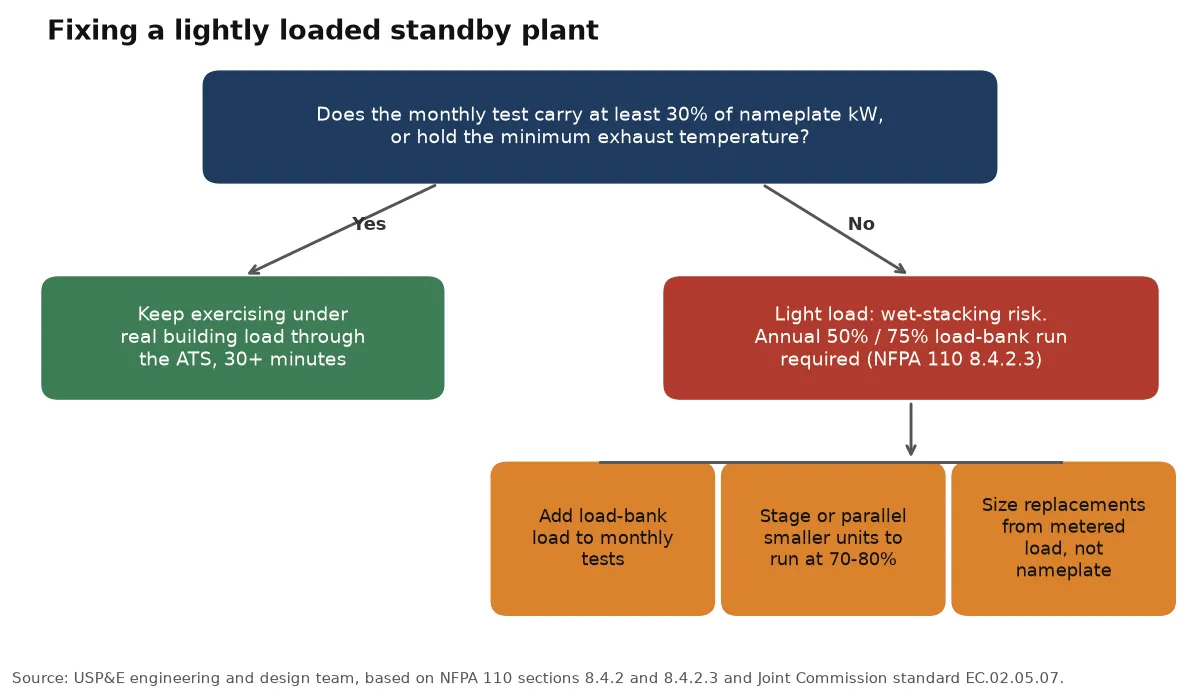
That 25% monthly test also misses the code. NFPA 110 requires diesel sets to be exercised at least monthly for 30 minutes, either at no less than 30% of nameplate kW or at a load that holds the manufacturer's minimum exhaust gas temperature. Sets that cannot meet that must run an annual supplemental load test: 50% of nameplate for 30 minutes, then 75% for an hour. For hospitals, the Joint Commission's standard EC.02.05.07 applies the same rules, with the monthly tests 20 to 40 days apart, and adds a four-hour run at 30% of nameplate at least every 36 months. A plant that meets the annual requirement on a load bank can still spend the other eleven months running wet.
What works
- Exercise under real building load. Transfer the actual load through the automatic transfer switch rather than running the set unloaded. A no-load run warms the coolant and proves very little.
- Stage the plant. Several smaller units in parallel, with load-dependent start and stop, keep the running units near 70% to 80% of rating, the flat part of the efficiency curve. Paralleling also adds redundancy.
- Use a load bank as routine, not as an annual event. If the building cannot load the set to 30%, add supplemental load during the monthly test and watch exhaust temperature, not the calendar.
- Size replacements from measured load. Meter actual demand, add a sensible margin for growth, and size from that rather than from a connected load schedule that will never all run at once.
The sweet spot for a diesel generator is 70% to 80% of rating. A standby plant will never live there, and it does not need to. But it should visit often enough to stay clean, pass its tests honestly and be ready for the day it was bought for.