Managed physical security is becoming a strategic asset for commercial real estate operators, according to Haniel Lynn, CEO of Kastle. His company provides access control, video surveillance, visitor management controls and other security services for more than 3,600 properties in the U.S and Australia.
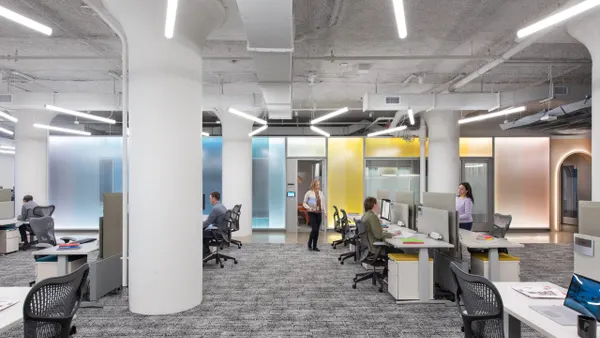
With office occupiers largely settled on hybrid work arrangements, Class A+ buildings are averaging 20% to 25% higher weekly occupancy than other classes, according to Kastle data.
“The idea of five days in the office is no longer proving to be the way that everybody does it,” Lynn told Facilities Dive. “There is a hybrid version of how people work in the office these days that has generally become accepted.”
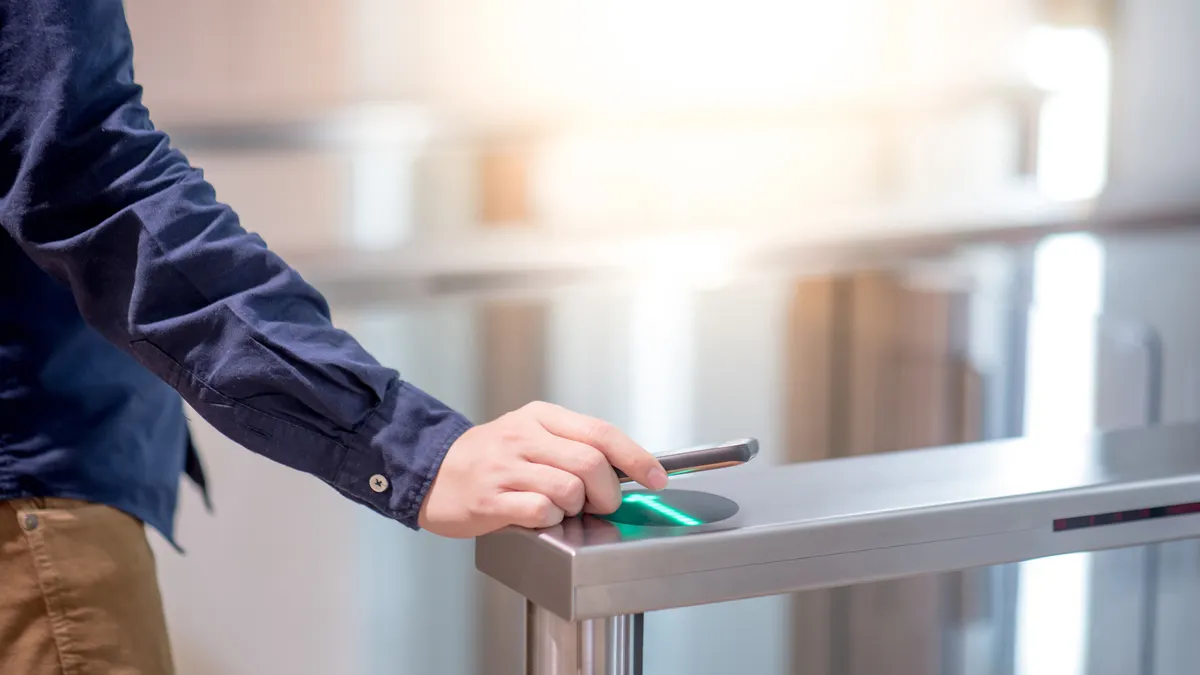
In this environment, security is no longer a back-office function, Lynn said. “The way that [security] manifests inside space shows up a lot in experience and what people feel,” Lynn told Facilities Dive. “These days, having your [access] badge on your phone and your mobile wallet, that’s a thing people who are in Class A office spaces have come to expect.”
Kastle has supported Aliro, an industry effort to standardize mobile access credentials developed by the Connectivity Standards Alliance. In March, Kastle announced it would become the first company to roll out Aliro 1.0 credentials across Apple, Google and Samsung mobile wallets and Aliro-enabled readers.
“Let’s say you’re a partner in a law firm, and you have to go from one building to another in a different city,” Lynn said. “There’s a good chance you were carrying four cards — one for your building, one for the suite, one for the other suite, one for the other building. That’s a very inconvenient, friction-filled experience. So [Aliro credentials are] the holy grail that everybody’s been trying to solve for a long time so that you can have one badge that works across all these various systems.”
The evolution of access control from a physical card or fob to an employee’s phone “would not have happened a couple of years ago without some of the tech advancements we have seen more recently,” Lynn said.
The more employees expect this ease of going in and out of a space with access control on their phones, the more Class A buildings will invest in such technologically-enabled experiences, he said.
The trend has led Kastle to take some big swings: The company has hired five senior executives as it works to become the category leader in integrated, intelligence-driven security platforms, the company said July 13 in a release.
New hires include Matt Burke, chief operating officer; Neil Thomas, chief revenue officer; Chad Pierce, chief information officer; Lindsay McLain, chief marketing officer; and Steven Weingarth, vice president of go-to-market. Thomas and Weingarth were previously with Motorola Solutions; Burke with Johnson Controls; and Pierce with WeWork.
“Five years ago, security was a back-office function,” Thomas said in a statement. “Today, it’s a business imperative and a competitive advantage.
“Customers … are trying to upgrade their tech stacks and to modernize their security platforms, [and] we saw all of that as opportunity … for us to grow and accelerate growth,” he said.
Kastle’s acquisition of a majority stake in i2G Systems also has provided it opportunity in data centers as well as high-security, complex and large-scale venues like sports venues, universities and hospital systems beyond its existing strengths in Class A offices and multifamily residential buildings, Lynn said.
“There are a number of different places that we are excited about growth prospects. The question for us is … less about where we could go, but where we want to make sure we are serving the existing market as well as we can,” Lynn said. “To support our existing customer base, to find the success that’s already there and to make sure that we’re capturing that opportunity.”