Dive Brief:
- JLL reported $7.3 billion in revenue during the third quarter — up 12% year over year — and, despite volatility in the macroeconomic environment, says it remains encouraged by demand across markets, per its earnings report.
- Real estate management services increased revenue 9% to $5.5 billion, with workplace management growing 10% and project management up 14%. Leasing advisory growth accelerated 27%, with broad-based performance across industrial, office and data centers, CFO Kelly Howe said on the company’s earnings call Wednesday.
- Although higher bond yields bear watching because of their potential impact on borrowing costs, CEO Christian Ulbrich said, “the underlying longer term fundamentals, such as economic growth and debt and equity capital flows, continue to support healthy activity levels. We remain encouraged by the underlying momentum in the business, the strength of our pipelines and platform efficiency gains as well as the global growth backdrop, particularly within the U.S.,” he said.
Dive Insight:
The deciding factor in commercial real estate markets is the income growth an investor can underwrite to offset the rising cost of capital, and that largely remains positive, Ulbrich said, “which is why U.S. multifamily has been most affected.” As clients look to JLL for intelligence and advice, the firm’s integrated and data-driven approach “ideally positions us to gain market share in complex environments such as this,” he said.
“We should not underestimate that even with that increase in pricing on the overall capital cost, the question is what people are expecting on the rental level side,” he said. “Whether they believe that they can increase rents going forward, which helps them to digest some of that increased cost of capital. In those areas where that is the least possible at the moment, you see then more impact. So multifamily in the U.S. is more affected by the increase in interest rates than others over the last couple of quarters, but we will still see healthy growth going forward.”
He noted that the strong majority of financings and transactions are still progressing and closing rather than collapsing from market uncertainties, but in some cases deal timelines are stretching out.
“We continue to monitor risk and opportunities in the market environment closely,” he said. “Against that backdrop, we remain optimistic for the fourth quarter.”
JLL’s real estate management services revenue growth was led by momentum in workplace management and project management, per the earnings release. “A largely balanced mix of mandate expansions and new client wins drove double-digit growth,” said Howe, noting the company’s “pipeline and contract renewal rates remain strong.”
Ulbrich said the company expects workplace management revenue to accelerate in the fourth quarter, thanks in part to its One JLL management approach, which will help it use proprietary data to identify where it can deliver more value to each client. Under One JLL, the company uses data and pulls resources from different business segments to address client needs as a one-stop shop.
The company’s relationship with companies that are operating at the top of their game in their respective industries is helping it boost its performance throughout its business units, Ulbrich said. “Within the different industries, you have companies who continue to win and take more market share and show very healthy growth,” he said. “We have a very strong foothold in the overall technology sector and many of our clients there are growing at very high percentage levels. That obviously has an impact on our business with them.”
Over the past three years, JLL has retained 99% of its top 100 clients, Ulbrich noted.
“Our first priority is to extend our client base within that Fortune 500 group for our work dynamics business, because that is where we can really create a strategic win for those clients with our global footprint,” he said. But the firm also has thousands of smaller clients, “and the general trend line is … the more complicated the world becomes [and] the more complex the situation for those companies, the better for JLL.”
The consolidation of product and service providers and suppliers is also a global trend that is helping JLL drive expansion of services with existing clients that are working to consolidate their vendors. “I spent a lot of time with different clients, and that was the common theme, that they were all working on reducing the number of suppliers they have, and that is something we will benefit from,” he said.
The firm saw double-digit growth in U.S. project management revenue, with particular strength in office and data centers, Howe said. “On a two-year stacked basis, project management revenue increased 38%, inclusive of 14% growth in the current quarter,” she said. “Client activity remains healthy, albeit with softness in certain areas.”
Leasing revenue grew 27%, driven by strength in the U.S., particularly within the industrial, office and data center asset classes, Howe said. “Our leasing performance has been pretty broad-based,” she said.
Gateway markets helped drive leasing volumes up 6% year over year in the U.S. West Coast markets, with demand up 30%, while secondary and tertiary markets were largely flat, according to JLL’s earnings presentation. At the same time, global vacancy rates declined marginally in the quarter to 16%, helping drive accelerated rent growth for top-tier assets, which exceeded 25% in rent growth year over year, JLL said.
“In the U.S., office has been quite strong, including clients in the technology space and AI space, but also professional services and a wide range of applications there,” Howe said. Ulbrich noted that despite recent news of voluntary buyout packages offered to employees at Microsoft, “the absolute employee number for most [tech] companies is still continuing to grow” and “as we are partners of those types of companies, we still benefit from the overall success of those companies because their real estate needs continue to grow.”
The firm’s 34% increase in global leasing advisory revenue over the past two years reflects strong and broadening demand, most notably in the U.S., which benefited from a “meaningful rise in average deal size as well as a few large data center transactions,” Howe said. These transactions helped drive a 39% increase in U.S. leasing advisory revenue, on a 24-month basis.
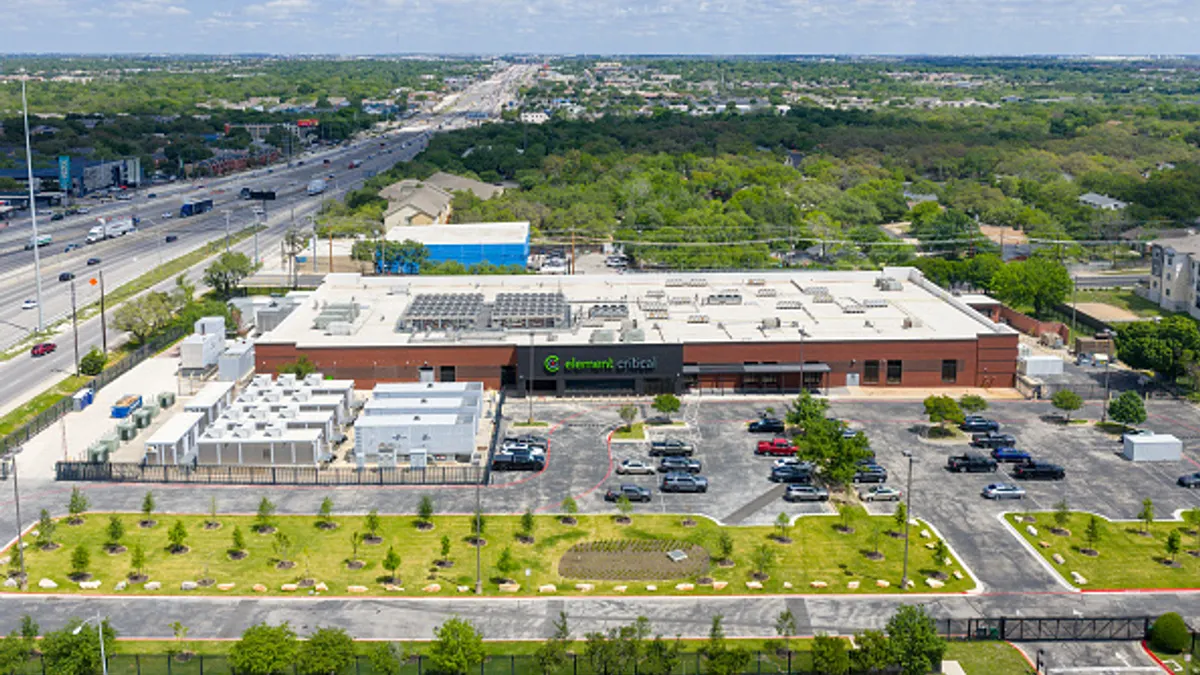
“Data centers are an important part of our leasing mix, but in the third quarter, they … contributed about 5%, mid-single-digits, to our total revenue,” said Howe, noting that the size of deals makes revenue from the segment susceptible to larger variations between one quarter and the next. “So again, important, but not the biggest part,” she said.
Although higher interest rates have impacted its capital markets business, its other business areas are more responsive to other economic signals, Howe said. “Other parts of [JLL’s] business [are] much more impacted by the general development of the economy, how GDP is developing and the confidence level which people have in the coming months,” she said.
With regards to 2027, “it is so difficult to make any kind of forecast,” Ulbrich said. “This is a very fluid environment.”