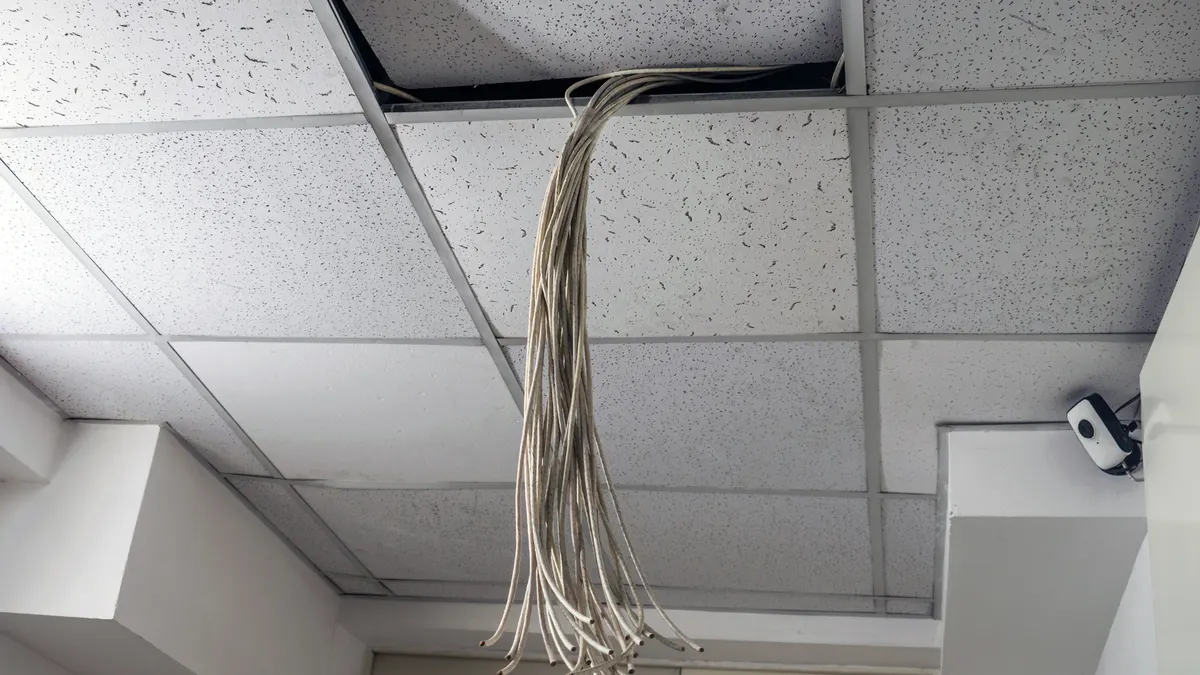
CHARLOTTE, N.C. – Counterfeit communications cables pose a serious liability issue for building operators, according to a presentation last week at NFMT East. Many cables sold online are not certified and raise serious smoke and fire concerns, especially when used for power, the Communications Cable & Connectivity Association said.
Conductors in communications cables, other than in coaxial cable, must be copper, according to the National Electrical Code. This includes communications plenum cable (CMP), communications riser cable (CMR) and communications general purpose cable (CM), David Kiddoo, executive director of the CCCA, said in a presentation.
Equipment, materials and services must be certified by UL or Intertek, two nationally recognized testing laboratories, according to the National Electrical Code. When bad cables are used, they present a serious fire hazard, with counterfeit cables contributing to flame spread and smoke, according to NFPA 262 testing conducted by the CCCA.
Counterfeit cabling contributed to $2.7 million in fire damage in Loudon County, Virginia, when a fire originated in an electrical power distribution panel within a structure, Kiddoo said.
“What we learned from these evaluations is that when you have a bad cable [with the] wrong materials … you can get really serious flame spread and smoke generation,” he said. “They’re just hideously generating smoke and flame spread in a very quick way.”
If a fire were to occur at a facility due to fraudulent cabling, there are significant legal ramifications for contractors and building owners, he said. “Without going into a lot of details, the breach of warranties and contracts and things like that, it becomes a very ugly situation between [the] contractor and building owner or facility managers.”
Facility managers can use the UL holographic label on packaging to verify that the cable has been certified, but because these labels can be simulated, it’s useful to look for other signals that cables might be counterfeit, Kiddoo said. The CCCA also has an application, CableCheck, that is available on mobile app stores and can be used as a field-screening tool and checklist, he noted.
Key indicators include either no UL or ETL marking on packaging or cables, a price well below market norms, poor design and quality control or claims that cables are “copper clad aluminum,” which might be advertised as a positive but is actually a tell: 100% copper is required.
“They’re telling you what’s wrong with it,” Kiddoo said. “Buyer beware, because shame on you. If you buy it, you’re buying something that is breaking the law.”
Especially when putting power over these cables, like Class 4 fault-managed power, or digital electricity, “some of these cables will fry even more and that causes serious, serious damage,” he said.
“If you were to Google or go onto Amazon and type in category six plenum cable, you’ll get roughly 30 to 35 hits. Every single one of them is not UL compliant,” Kiddoo said.
Price is the main tell, he said. “[If] you pay $130 bucks for 1,000 feet of category six plenum cable, what’s your first clue? They can’t even afford the materials at that price, [or] the certifications and everything else that goes with it,” Kiddoo said. “A standard box of cat-six plenum cable is roughly, ballpark, $450 bucks. So if you're buying it for $130 … you’ve got to know that ain’t right.”
When one of these cables is used, it can become a fuse in a fire hazard scenario, he said, “and certainly your data is going to disappear very quickly, because the heat that is generated from power and data on that same cable is going to disintegrate the cable materials.”
Another sign that cables are fraudulent is their appearance. “Look at the boxes,” he said. “Typically, any reputable manufacturer will have a box of cable that pulls out … nice and smooth. The ones that are counterfeited come out [kinked or tangled] and have all sorts of problems as well. If they’re going to cut costs on materials, they’re certainly going to cut costs on the conductor and copper.”