When Southern Home Services hired Matt Ellenberg to be its senior technical training manager in 2023, he had a mandate from the company: increase the number of training opportunities for employees. It was a challenging task for a company with 27 locations across 11 cities, from the East Coast to Austin, Texas.
“The day I got hired, it was very clear that there was a total lack of technical training,” Ellenberg, director of training at SHS, told Facilities Dive. “It just didn't exist at all.”
That first year he spent 240 nights in hotels, traveling the country to train the company’s employees on the latest advances in HVAC technology, plumbing and facilities management. To find a way to do it more efficiently, Ellenberg contacted a company called Interplay Learning that, in part, offers simulations using Meta Quest VR headsets.
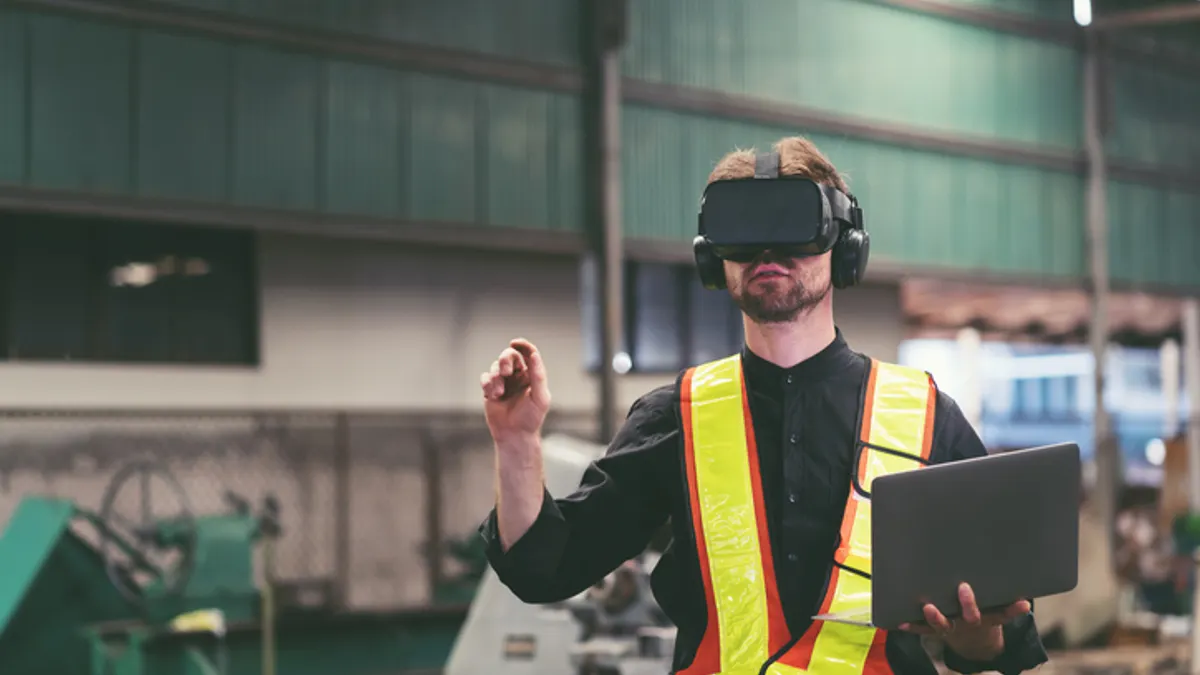
The software gives workers the impression they’re in the customer’s location. Looking down, employees see their hands wearing work gloves. They then do tasks like changing a filter or testing the equipment.
If a worker reaches for an electrified component before turning off the breaker, the joystick vibrates to simulate being shocked.
Virtual training remains a small part of how SHS uses Interplay Learning’s resources, Ellenberg said; his company mostly uses Interplay’s e-learning tools, like videos and quizzes.
The VR technology, while helpful, can’t solve all of SHS’s training needs, he said, so it acquired a facility in the Orlando area with HVAC and plumbing labs that enable employees to get more hands-on training in person.
“I think that using only Interplay without a hands-on component is a pipe dream as of now,” Ellenberg said. Right now it serves as an effective supplemental tool, he said.
VR limitations
The skilled trades are facing a worker shortage. The HVAC industry has 110,000 unfilled positions nationwide, according to the Sheet Metal and Air Conditioning Contractors’ National Association, or SMACNA. Bridging that gap will require a massive training effort, SMACNA says. But instructors say virtual reality has its limitations.
First, there’s a shortage of qualified instructors, Amanda Bergson-Shilcock, a senior fellow at the National Skills Coalition, says.
“You want instructors who have hands-on experience in the industry, but the reality is that the education field doesn't pay as well in many cases as the jobs themselves,” she said. Paying high school technical instructors to teach night classes for adults is a possible solution, she said, but it’s not clear having them teach using virtual reality is the way to go.
“I have not seen any rigorous data about the comparison of folks who've been through VR training versus folks who've been through traditional training in terms of their pass rates for exams or occupational licensure,” she said.
One employer in Louisiana who was training employees to dig trenches for fiber optic cables expressed concerns about how much more serious the consequences are in the real world, she said. Hitting a live electrical wire has the potential to injure or even kill a worker. Is a vibrating joystick enough to convey the seriousness of making a mistake?
Santa Rosa District Schools in Florida has been using virtual reality simulations in workforce education since the 2024-2025 school year. It introduces students to the technology as early as fifth grade. Jennifer Hines, the school district’s workforce education director, said approximately 10,000 students are enrolled in career and technical education. The program is mainly to introduce students to work they might like. It doesn’t go into detail on how the work is done.
One school has 20 VR headsets. Hines says the technology helps students complete a welding project, climb a tower or work in an emergency room.
“Just as much as they realize that something is interesting to them, they realize that they may not like blood, or they may not like height,” she said.
Hines said it brings learning to another level compared to watching a video or researching a career online. However, when it comes to training students, real-world experience remains the go-to teaching path.
“As much as we get advanced, there's nothing that can replace the true hands-on, in-the-field learning,” she said.