Dive Brief:
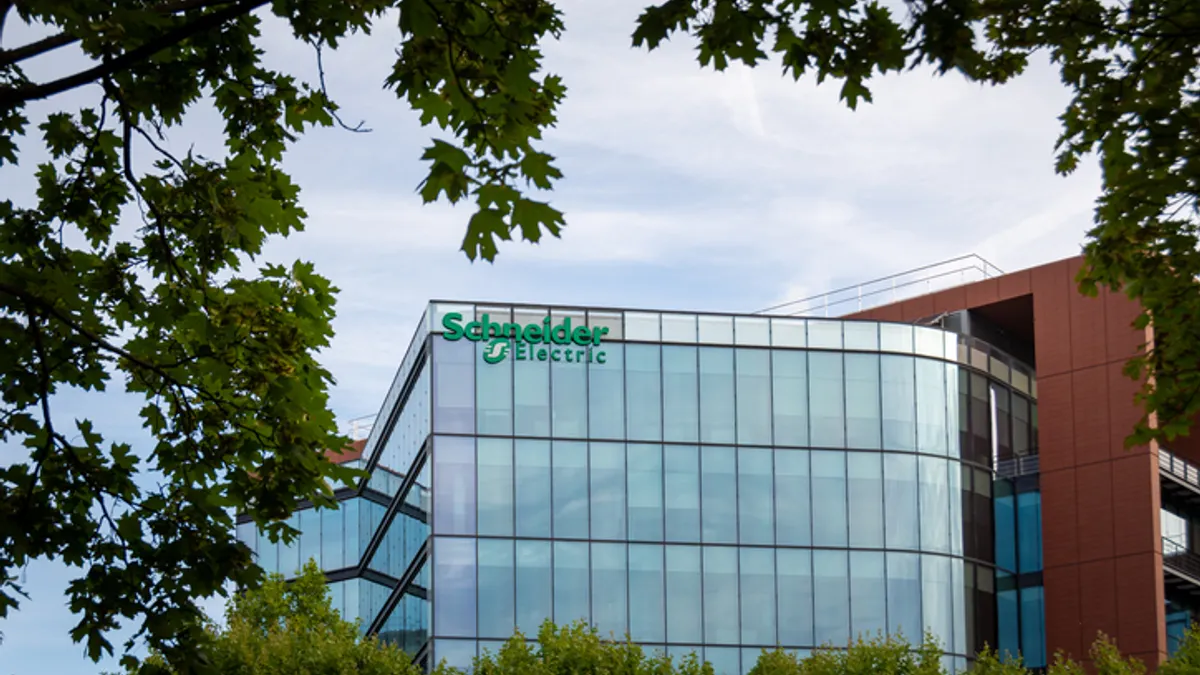
- Schneider Electric reported record quarterly revenue thanks to robust demand from data centers in North America and other regions, the company said on an April 30 call on its first-quarter 2026 earnings.
- Revenue in its energy management segment, which provides equipment and services to data centers and other energy-intensive facilities, increased nearly 13% year over year in the first quarter of 2026 “despite a high base of comparison” from Q1 2025, the company said.
- In a statement, CEO Olivier Blum said the AI boom and rising geopolitical tensions were “accelerating the existing structural growth drivers of electrification” and could further boost demand for Schneider’s electrical equipment and building systems.
Dive Insight:
“The energy transition is now increasingly central to energy security and sovereignty … alongside the rapid adoption of digital and AI-enabled technologies,” Blum said.
Schneider said demand from data centers, a subset of energy management, was up “double digits” as customers scale up cutting-edge “AI-ready” computing architectures and traditional architectures.
North America drove the majority of the end-market’s growth, but demand was also robust in other regions, Schneider said. The company pointed to customer demand for liquid cooling, a necessity for the high-density server racks running newer generations of AI chips, as a tailwind for the data center market and its energy management business generally.
Schneider also saw strong demand in its buildings end-market, particularly in “technical building categories” like government facilities and healthcare.
“Investments in modernization, building management systems and power management solutions” — all consistent themes of what Schneider has said is a multi-year growth cycle — drove demand, the company said.
Speaking to investors and stock analysts Thursday, Blum touted the broader “energy intelligence” strategy behind Schneider’s building automation and energy management solutions.
Blum said Schneider is helping customers transition siloed systems that require manual, time-consuming decision-making processes into more “preemptive,” unified frameworks capable of monitoring and acting of their own accord. That transition could unlock lower energy costs, less equipment downtime, faster incident response and extended asset lifespans, according to a presentation shared with the audience.
For data centers in particular, Schneider’s presentation touted full-lifecycle solutions that begin with a “digital twinning” partnership with NVIDIA and ETAP; continue through liquid and air cooling solutions from its recently acquired Motivair subsidiary and other product lines; unified operational support from its AVEVA software line; and building management via its EcoStruxure platform, among other offerings.
Though Schneider reaffirmed its financial targets for 2026, it sounded notes of caution around geopolitical and macroeconomic uncertainty.
Revenues in the Middle East and Africa were down, bucking the broader trend, due to “geopolitical and macroeconomic tensions,” Schneider said. That part of the world could hit the company’s overall growth, it said.