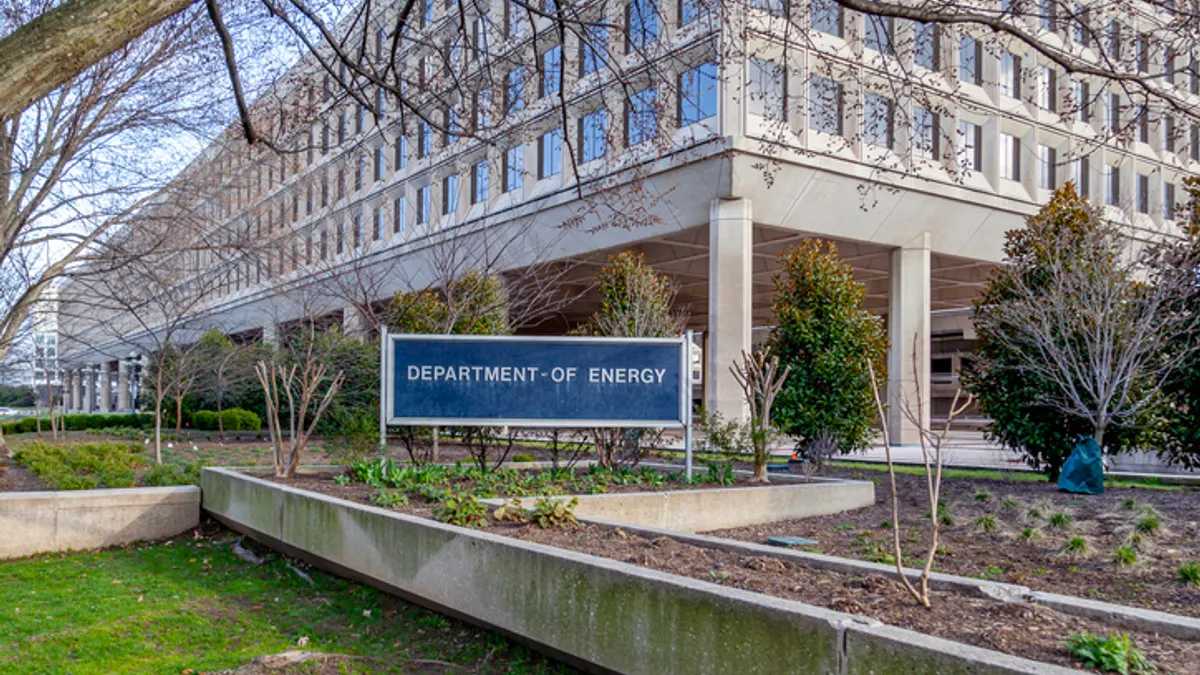
The Trump administration kicked off the fiscal year 2027 budget process with a request to fund the U.S. Department of Energy’s Office of Energy Efficiency and Renewable Energy at $1.1 billion, almost two-thirds less than the office’s current $3.1 billion budget.
DOE’s Building Technologies Office, which is funded as part of that $3.1 billion, would get $20 million, a 93% cut from its current funding level. The office oversees DOE’s Better Buildings Initiative, which is the agency’s mechanism for partnering with other organizations to advance ways for buildings to cut energy use.
In its budget justification, the administration says its priority is to unleash the country’s energy dominance in part by seeking an increase of more than $4 billion to DOE’s budget, to almost $54 billion, to spend on nuclear power and other ways to grow the country’s baseload power.
“The Department continues to be focused on turning our Nation's abundance of resources into affordable, reliable, and secure energy for all Americans,” the administration says in the document.
In a recent administrative change, the administration has organized the Office of Building Efficiency and Renewable Energy under the agency’s Office of Critical Minerals and Energy Innovation, which was created in 2025 to focus on mining and other types of resource extraction to further the country’s energy dominance. The agency’s Commercial Buildings Integration program, which has been part of the Office of Building Efficiency and Energy Resilience and focused on commercial building efficiency innovations, isn’t listed in the budget request.
Also not included is anything about Energy Star, which DOE is scheduled to take over from the Environmental Protection Agency this summer.
Congress earlier this year funded the program at more than $33 million after the administration in 2025 tried to eliminate EPA’s Office of Atmospheric Protection, which at the time operated Energy Star. The administration is once again trying to eliminate the Office of Atmospheric Protection, but with Energy Star operating out of a different EPA office and scheduled to move to DOE, the program should be safe. The absence of any mention of Energy Star in DOE’s budget request has some organizations concerned, however.
“The president’s budget request provides no new insight into how the program will be funded or staffed at DOE,” Sabine Rogers, federal policy manager at the U.S. Green Building Council, says in a budget analysis. “For FY2027, appropriators will have to decide whether to stipulate funding for the program at EPA or DOE.”
In its fiscal 2027 budget request, EPA says it will dedicate one staff person to Energy Star to support the program as it moves to DOE. “One [full-time equivalent] is allocated in this program project to support that work,” the EPA document says.
Organizations whose work touches different aspects of the built environment, from appliance manufacturers to electrical contractors, call Energy Star a model public-private partnership whose efficiency standards have saved consumers and organization billions of dollars in energy costs since the standards were created in the 1990s. State and local governments and building operators say they’ve come to rely on the program's platform, called Energy Star Portfolio Manager, to track building energy use.
The budget request starts the funding process by letting Congress know what the administration’s priorities are. Before any funding can be approved, lawmakers must pass a budget resolution setting spending parameters. Then, congressional appropriators must report out bills for House and Senate votes that fill in the amounts for each agency within the budget resolution limits. The current fiscal year ends Sept. 30.