Dennis Schuetzle is chief technology officer of Infinium. Views are the author’s own.
As rack densities rise, facilities teams are under pressure to manage heat while maintaining uptime and keeping operating costs down. Traditional air cooling is reaching practical limits in high-density environments, and immersion cooling is one approach to address these challenges. As these systems move into production environments, operators are learning that fluid selection plays a large role in long-term performance.
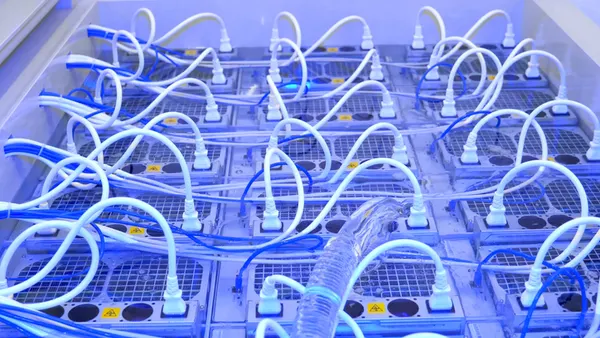
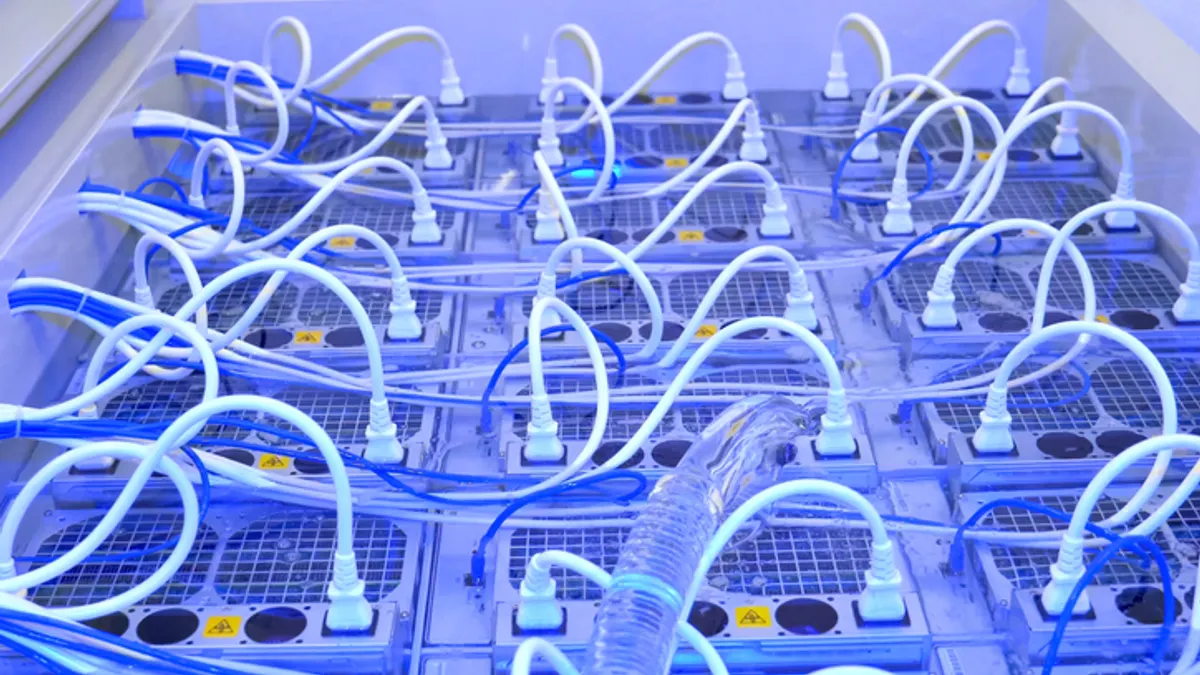
Immersion cooling is a liquid-based thermal management approach in which IT hardware is submerged in a dielectric fluid to enable high-efficiency heat removal, higher rack densities and reduced energy consumption compared to traditional air-cooled systems and direct-to-chip cooling. While immersion cooling has been deployed in Bitcoin operations and applications such as cryptocurrency mining, its adoption in AI and high-performance computing introduces operational complexity.
In these environments, IT hardware represents a significant capital investment, and systems are expected to operate reliably over long lifecycles. As a result, operators must understand how immersion fluids behave over time and how differences between fluid types can affect system performance, maintenance requirements and long-term costs. Once deployed, immersion cooling systems place IT equipment in continuous contact with dielectric fluid, making the fluid part of the operating environment that must be managed.
Fluid chemistry as operational consideration
Immersion cooling is often described as a heat-transfer solution. In practice, the fluid serves as the environment in which critical components operate. CPUs, GPUs, connectors, seals and printed circuit boards are exposed to the fluid for extended periods, and if that environment changes over time, it can affect both thermal performance and hardware reliability.
Those environmental changes are driven by chemistry. How immersion fluids are produced, including the choice of starting materials and refining processes, influences fluid quality, molecular consistency and long-term stability. These starting materials are directly tied to how the fluid behaves under sustained thermal and electrical pump stress in a live operating environment.
Fluid chemistry affects heat extraction capabilities, reliability, maintenance requirements, oxidation resistance, electrical behavior and overall system predictability. As hyperscale and edge data centers move toward multi-kilowatt processors, fluid selection is increasingly becoming an engineering and operational decision with long-term consequences. Thinking of fluid selection as a simple cost comparison won’t work.
Fluid chemistry importance
Immersion fluids fall into several primary categories: Fischer-Tropsch synthetic hydrocarbons, mineral oils, polyalphaolefins, esters, silicones and fluorocarbons. Each reflects an underlying chemistry that influences how the fluid behaves over time.
Properties such as volatility, oxidation stability, viscosity, thermal conductivity, dielectric behavior and environmental profiles are leading indicators of how much monitoring, maintenance and operational intervention a facility will require over time. Each carries direct operational consequences across reliability, maintenance planning and lifecycle cost. For an immersion system to function as intended over many years, the fluid must perform across a wide range of physical, chemical, electrical and environmental requirements.
Characteristics
- Viscosity and thermal behavior. Viscosity determines how easily a coolant fluid circulates within the immersion tank and through the thermal boundary layers surrounding heatsinks and across components. Lower-viscosity fluids can reduce pump strain, improve flow consistency and enhance heat transfer, contributing to reduced mechanical wear and more predictable system performance.
- Thermal conductivity. Thermal conductivity determines how efficiently a fluid absorbs and transports heat at the molecular level. In high-density racks, even small improvements can reduce component temperatures and improve thermal uniformity across systems.
- Dielectric stability. The dielectric constant describes how a fluid behaves in an electric field and can influence signal integrity and link margins. Maintaining stable dielectric properties over time helps reduce the risk of performance degradation or unexpected system behavior.
- Oxidation stability and aging. Oxidation is a primary mechanism that causes immersion fluids to change fluid properties over time. Fluids with lower oxidation stability may thicken, darken, or form deposits on server components, affecting cooling efficiency and mechanical reliability. For facilities teams, this can mean more frequent filtration, conditioning, or fluid replacement, increasing maintenance requirements and potential downtime risk. Fluids that age gradually and predictably are generally easier to monitor and manage than those that change more abruptly later in their lifecycle.
- Environmental and regulatory considerations. Some fluid classes may face scrutiny related to emissions, disposal or lifecycle impact. Facilities teams might need to consider compliance requirements, end-of-life handling and sustainability reporting when selecting and managing fluids.
Comparing fluid categories
The immersion market includes several fluid categories, each reflecting the strengths and limits of its molecular architecture. Each immersion fluid category offer distinct performance characteristics and tradeoffs. Some fluids may provide strong thermal performance but require tighter environmental controls, while others might prioritize long-term stability and extended service intervals. Understanding these tradeoffs is important when aligning fluid selection with facility design, workload requirements and maintenance capabilities.
Fluid Selection as risk management
As immersion cooling moves toward larger-scale implementations, facilities teams are starting to evaluate fluids using the same rigor applied to other critical infrastructure components. Key considerations include long-term stability, ease of monitoring, maintenance requirements, compatibility with materials and environmental impact, all of which influence both system performance and the level of operational effort required to maintain consistent conditions over time.
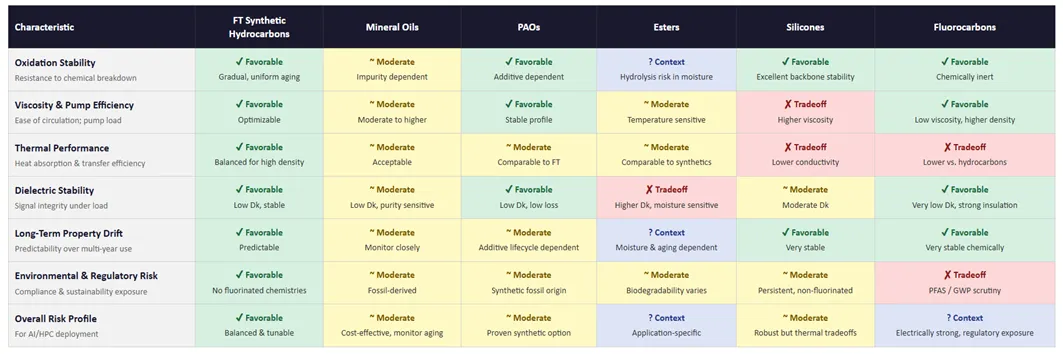
Different fluid classes offer varying levels of performance across these criteria, and no single solution meets every requirement equally. Some synthetic fluids, for example, are engineered through controlled processes that allow for greater consistency in composition, which might support more predictable performance in certain environments. Fischer-Tropsch synthetic hydrocarbons are one approach increasingly considered for high-density cooling environments.
As data center operators plan for higher densities and longer equipment lifecycles, fluid selection will play an increasingly vital role in determining system reliability, maintenance needs, and operational predictability. In this context, immersion fluid is not simply a consumable, but a long-term operational variable that must be evaluated and managed with the same level of attention as other core infrastructure systems.