Stadium operators are finding that faster sales at no-checkout concessions can double as a crowd-management tool by freeing up space on concourse floors during events, a review of case studies shows.
The Chicago Cubs’ hospitality and retail team saw game-time concourse crowding at Wrigley Field as a potential source of fan friction, so it sped up concession sales by installing a no-checkout system that uses cameras to read and subtract payments as products are carried through turnstiles without customers having to do anything.
“We’re seeing faster throughput, less time waiting in line,” Cubs Senior Director for Hospitality and Retail Brad Johnson said in a video produced by the technology company the Cubs partnered with on the project, Just Walk Out, an Amazon affiliate.
“Ultimately, [it’s] giving some of that space back to the concourse and less time in line,” Johnson said.
Concourse crowding has been an issue at BMO Stadium in Los Angeles during Major League Soccer games because the games only have a single 15-minute halftime break, giving attendees little time to buy refreshments.
“Venues like BMO Stadium [find it difficult] to serve nearly all of their fans at once” because of the limited window, no-checkout company Mashgin says in a case study.
BMO Stadium is the home field of the Los Angeles Football Club and seats 23,000 people. After a stadium experiment with four kiosks showed sales moving faster than traditional self-checkout — a median 12.5 seconds, roughly four times faster than industry averages, according to Mashgin — the stadium installed another four kiosks. Then, in a third phase, it converted part of a concourse with no concessions into a dedicated no-checkout concessions space.
“Not only did this initiate a whole new stream of revenue for the stadium, but it also allowed them to do so without reducing sales at other stands,” Mashgin says.
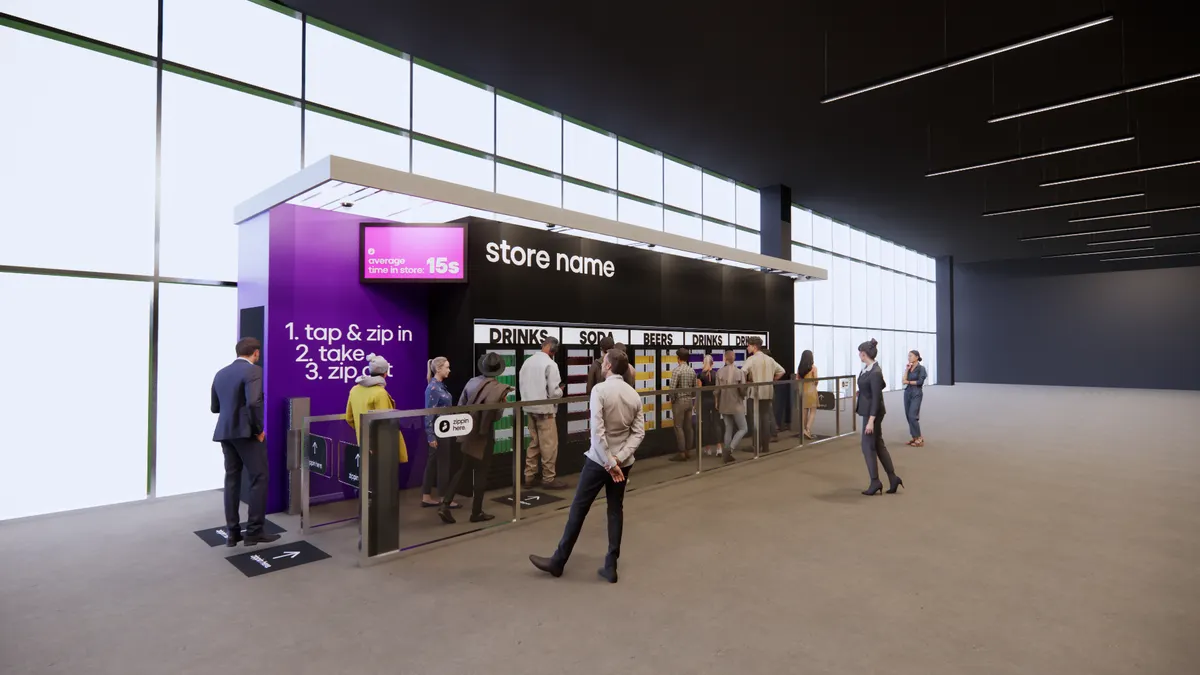
One concourse in NRG Stadium, the home field of the National Football League’s Houston Texans, was consistently congested during games because it had a smaller footprint than other concourses, so Aramark, the company managing concessions, replaced eight traditional walk-up concessions with no-checkout walk-ups from a company called Zippin.
The transition took little time, Zippin says, because installers could use the infrastructure that was already there. “The existing kitchen and counterspace could remain in place,” the company says in a project case study.
During an event after the kiosks were installed, the reduction in congestion led to an increase in sales of a hamburger that the stadium was promoting, according to Zippin. “Fans were able to move through the stand so quickly that Trill Burgers were sold out within minutes,” the company says.
Quicker concession sales aren’t part of the typical job list of stadium facility managers, but concourse congestion is. The case studies suggest that faster sales can give managers a crowd management tool they might not have been expecting.