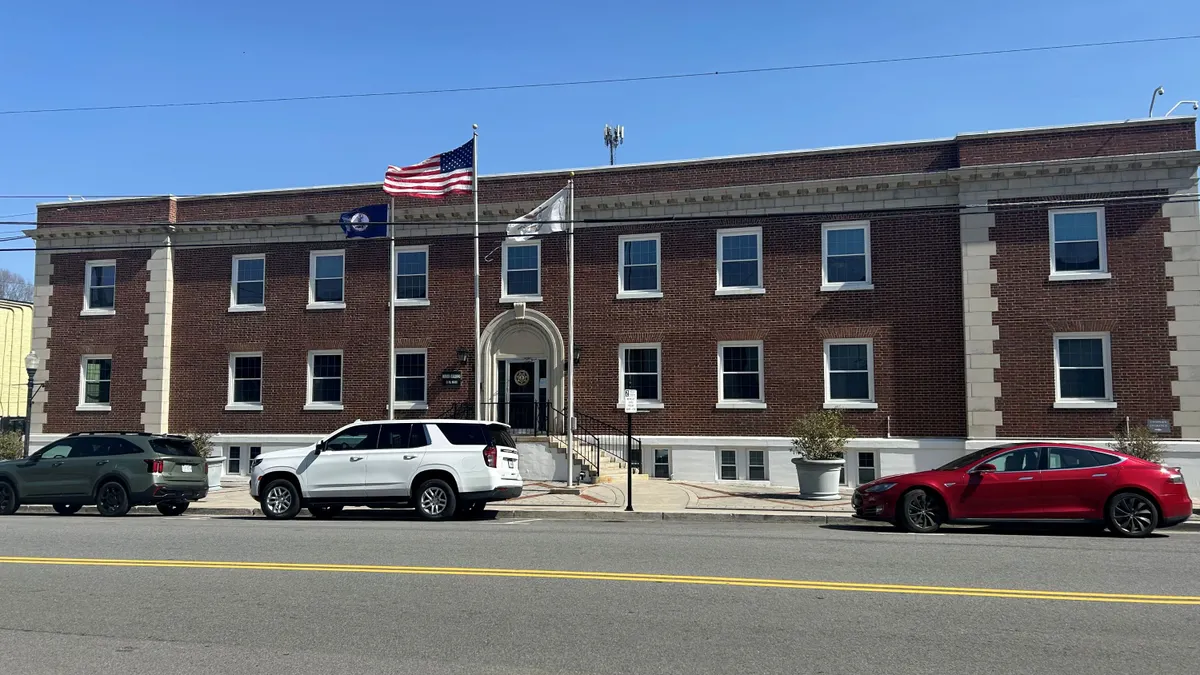

Pittsylvania County, Virginia, wanted to make its 1930s Moses Building, which houses the county sheriff’s offices, more energy-efficient and comfortable for workers. “The building was cooled with over 50 window AC units and steam boiler heat. Most of the time, the offices were too hot or too cold and the old windows were allowing moisture intrusion, which was causing peeling paint and failing plaster,” Pittsylvania County Public Works Director Chris Adcock told Smart Cities Dive.
With several other major projects on the horizon, the county didn’t have the funds to construct a new building, he said. Instead, it signed an energy savings performance contract with Ameresco, an energy service company. The contract helps the county make cash flow-neutral energy upgrades to its aging buildings while still adhering to historic standards and regulations.
Amaresco recommended that Pittsylvania County install new double-pane windows and a variable refrigerant flow HVAC system, “which worked really well for this project,” Adcock said. “It allowed us to create individually controlled zones without needing extensive ductwork, which was important because the 1930s-era building didn’t have much available space for chases or mechanical runs.”
ESPCs, which debuted nearly half a century ago, are becoming an increasingly popular way to retrofit aging city buildings, said Peter Christakis, chief operating officer for Ameresco.
“An ESPC is a wonderful vehicle for cities and towns that don’t have access to capital funds to really improve their facilities quickly,” he said.
According to the Environmental Protection Agency, energy service companies, or ESCOs, like Ameresco typically work on ESPC projects with 10- to 20-year contracts worth at least $1 million. These contracts usually stipulate that the city or county owns the equipment the ESCO installs, and the ESCO maintains the equipment over the life of the contract. The ESCO also guarantees a fixed amount of energy savings during the contract period.
Other companies that have implemented ESPCs on city and county facilities include the following:
- Enfra, which has worked with several colleges and universities.
- Honeywell, which worked with Bemidji, Minnesota, on a $2.45 million project completed in 2016.
- Johnson Controls, which worked with Cobb County, Georgia, and others to improve energy and water performance.
- Opterra Energy Services (formerly Engie Services US), whose citywide project with Oceanside, California, won an award this year from Smart Cities Connect.
- Schneider Electric, whose work with Madison County, Alabama, schools won a U.S. Education Department sustainability award.
- Siemens, which worked with Orem, Utah, starting in 2016 to replace streetlights and make facility upgrades estimated to save $11.5 million over 15 years.
Cities or counties usually generate the money for the ESPC upgrades through loans, tax-exempt municipal leases, bond issues, capital funds, rebates, grants or other vehicles, Christakis said.
“Our guarantee for the energy savings is ultimately used to repay whatever source of funding is used. So it’s a balance-sheet-neutral type of arrangement,” he said.
Pittsylvania County financed its $1.5 million Moses building upgrades as part of a loan from the Virginia Resources Authority, Adock said. While the ESPC contract with Ameresco guarantees energy savings, the project, which was completed in March, may still end up costing the county money.
“With the new, efficient system plus new windows, we hope to get some return on our investment. Perhaps not enough to pay the loan, but for a rural county with a limited budget, every savings is a help,” Adcock said.