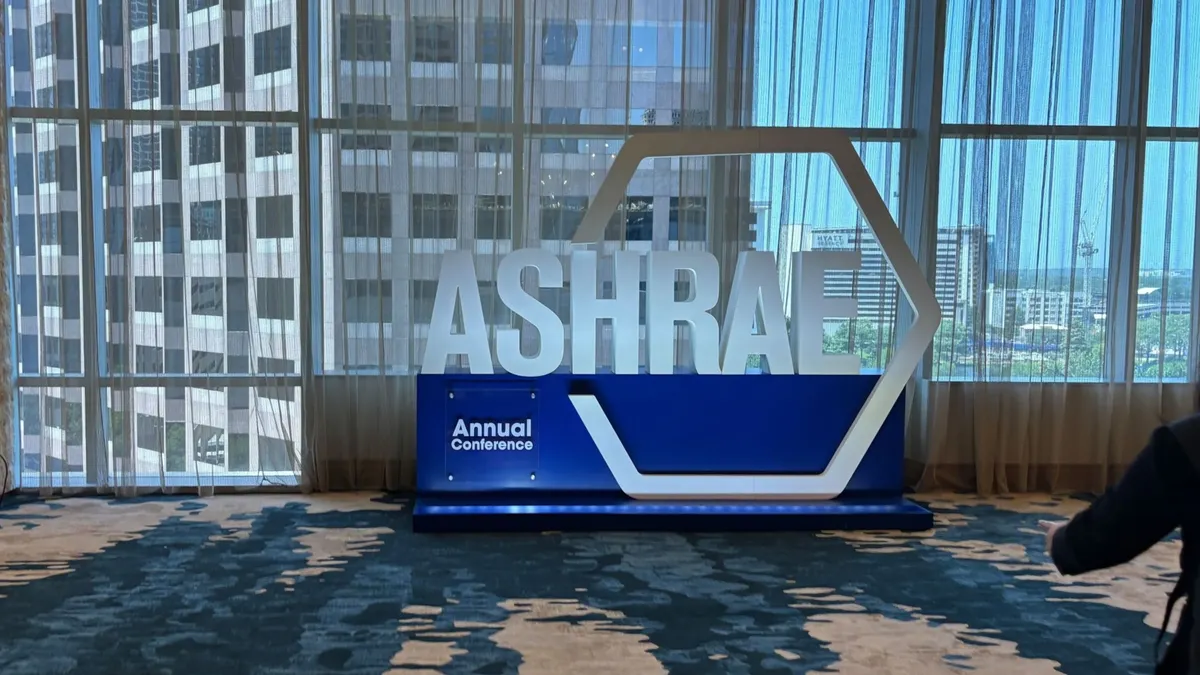
AUSTIN, Texas — Heating, ventilation, air-conditioning and refrigerant professionals celebrated successes and shared lessons learned while looking ahead to work to be done at the 2026 ASHRAE Annual Conference.
“ASHRAE has been providing leadership and guidance in energy efficiency, indoor air quality and carbon emissions reduction,” the organization’s new president, Sarah Maston, said in her inaugural address at the conference. “So, where do we go from here?”
Maston said her aim is to focus the organization on resilience — how the facilities profession can work together to develop game plans to improve the efficiency, performance and resilience of buildings in the face of climate and infrastructure challenges.
“Everyone needs to dig deep to meet the trials ahead,” said Maston, director of commissioning and energy services at Colliers Project Leaders. “Embrace the challenge and change the game…. We want everyone to get in the game.”
Lessons learned
At the conference, attendees shared best practices that they’ve learned over the past year, which focused on indoor environmental quality under 2025-26 President Bill McQuade.
Researchers at the Pacific Northwest National Laboratory, for example, held a workshop on how to achieve healthier buildings with lower cost and energy use. PNNL researchers Gabe Arnold, Meghan McNulty and Cary Faulkner shared data on the real-world costs of installing and using ventilation and air-cleaning strategies in classrooms to improve indoor air quality, and they provided guidance to help school districts choose building upgrades.
As part of a new course offering ASHRAE Learning Institute credits, David Schurk, a Distinguished Lecturer and Instructor for the ASHRAE Learning Institute, taught participants concepts for “demystifying dehumidification” and providing ways to design high-performance moisture control systems. The course discussed psychrometry, the field of science and engineering that studies the behavior of moist air, and reviewed findings from ASHRAE research on damp buildings and human health.
Schurk explained that, by using a psychometric chart, HVAC professionals can determine what actions to take to reach an optimal temperature and relative humidity level. As with a road map, “connecting dots tells me where I need to go, how I need to get there [and] how many gallons of gas I need to use to make the trip,” he said. “If I plot one point and then plot another and connect the dots, I can size the system. You get the dots in the right place to start with, then you make the calculations and then you apply the equipment that will meet the needs.”
In another session, experts from the University of Texas at Austin and Austin Energy discussed ways the City of Austin’s municipal utility and the university have embraced thermal energy storage, or TES, to reduce peak electric demand and meet air-conditioning needs for more than 55,000 students. By installing TES in its district cooling system and incentivizing customers to install storage in their facilities and adding price-driven chiller automated controls, operators were able to minimize demand charges and maximize the load shifted to low-cost periods.
The approach the university took provides a secure and reliable framework for optimizing thermal networks, said Whitney Moyer, industrial automation specialist at Austin Energy. “The program [used] 55% less energy within this non-charge window than the operator today,” Moyer said. He underscored that these interventions can not only reduce capital expenditures by eliminating the need for high-cost chiller compressor variable frequency drives, but also limit the need for operators to be directly involved in plant operations.
“This frees up their time,” Moyer said. “Being in a hybrid role is really the way going forward in our plans, because more and more of this is going to be automated away,” he said. “The more we do in-house, the cheaper it is.”
The conference wraps up July 1.