
Before the gates open
By the time the first fan walks through the turnstiles, a large venue has already been operating for hours.
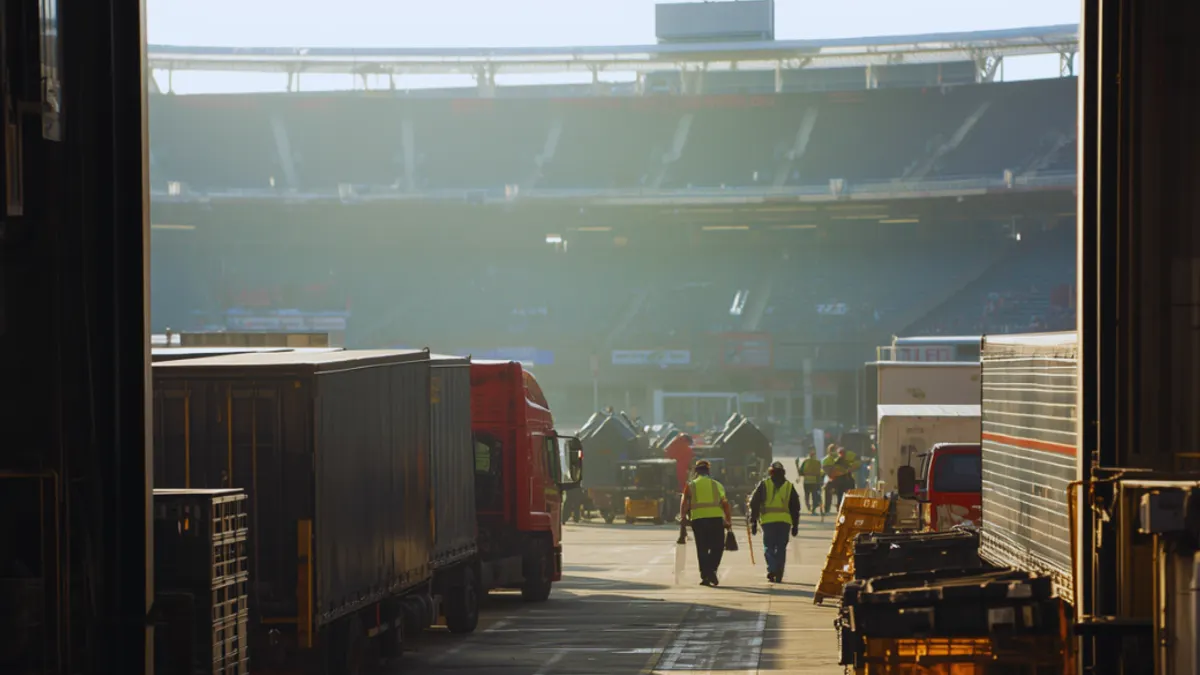
Production trucks have arrived with staging equipment. Food and beverage deliveries are moving through the dock. Contractors are checking in for last-minute work. Couriers are dropping parcels. Security teams are making access decisions at multiple entry points, while operations teams try to keep traffic, staffing and timing under control.
The event has not started. The back-of-house operation is already at full intensity.
Large venues are live logistics environments
Stadiums, arenas, convention centers, concert halls and mixed-use precincts are no longer just spaces where events happen. They are high-volume logistics environments where front-of-house and back-of-house workflows collide.
Every movement matters. A truck arriving at the wrong time can block a dock or take over parking space. A missing delivery can delay setup or create a dispute with a tenant, vendor, or event team. A contractor without the right credentials can slow down access or create compliance risk. A visitor, courier, or vehicle at the gate may be expected, or may need to be escalated.
For facilities, operations and security teams, the challenge is not just moving people and goods through the site. It is knowing what is coming, who approved it, where it should go and what record exists afterward.
When every team has a system, but no one has the full picture
Most large venues already have tools in place. Dock scheduling may sit in one system. Visitor management may sit in another. Contractor credentials may be tracked separately. Parcels may be logged through spreadsheets, photos, emails, or handwritten records. Vehicle access may rely on guards, cameras, radios, or license plate recognition.
Each tool may solve one problem. But when those workflows are disconnected, no team has the full picture.
The dock team may know which deliveries are booked. Security may know who checked in. Operations may know which contractors are expected. But if those records do not connect, the venue is still relying on people to reconcile the day manually, often while volume is highest and timelines are tightest.
That is where operational blind spots appear. Teams cannot plan staffing around actual demand. Proof of delivery becomes harder to defend. Contractor visibility depends on who has the latest list. Access decisions happen without full context. When something goes missing, arrives late, or causes a delay, the answer is scattered across systems, messages and people.
Access control needs operational context
Vehicle access control is one example. License plate recognition can confirm that a vehicle has arrived, but detection alone does not tell the team whether that vehicle was scheduled, which booking it relates to, which vendor or tenant it serves, which bay it should use, whether the gate should open, or what record should be kept.
For large venues, access is not just a yes-or-no decision. It is part of a broader operating workflow.
The case for one operational record
The practical answer is not more disconnected systems. It is one operational record for everything moving through the site.
A modern venue team should be able to answer simple questions quickly: What is arriving? Was it scheduled? Who approved it? Where should it go? Who signed for it? Which contractor, vendor, tenant, or event team is it tied to? Can the team prove what happened if there is a dispute, incident, inspection, or compliance request?
When those answers live in one place, the operating model changes. Teams can plan around what is actually scheduled, make faster decisions at access points, reduce manual coordination and keep a defensible record of what moved through the venue.
Connecting the workflows
Veyor brings dock management, parcel management, visitor management, contractor management and vehicle access workflows into one platform, helping facilities, security, operations and event teams work from the same record.
Large venues already run on a schedule — deliveries, load-ins, contractors and vehicle access are all planned. The problem is that the plan lives in spreadsheets, radios and separate systems, so no one has a live, shared view of who's arriving, who they're delivering to, or how long they're on site. At a comparable large-scale venue, putting that schedule into one live system took booking compliance to 85-90%, even with over 100 vehicles moving through a single shared dock each day.
For stadiums, arenas, convention centers and mixed-use precincts, the goal is not to add another tool to the stack. It is to connect the plan that already exists into one live record everyone can see.
Learn how Veyor gives large venues one operational record for everything moving through the site.