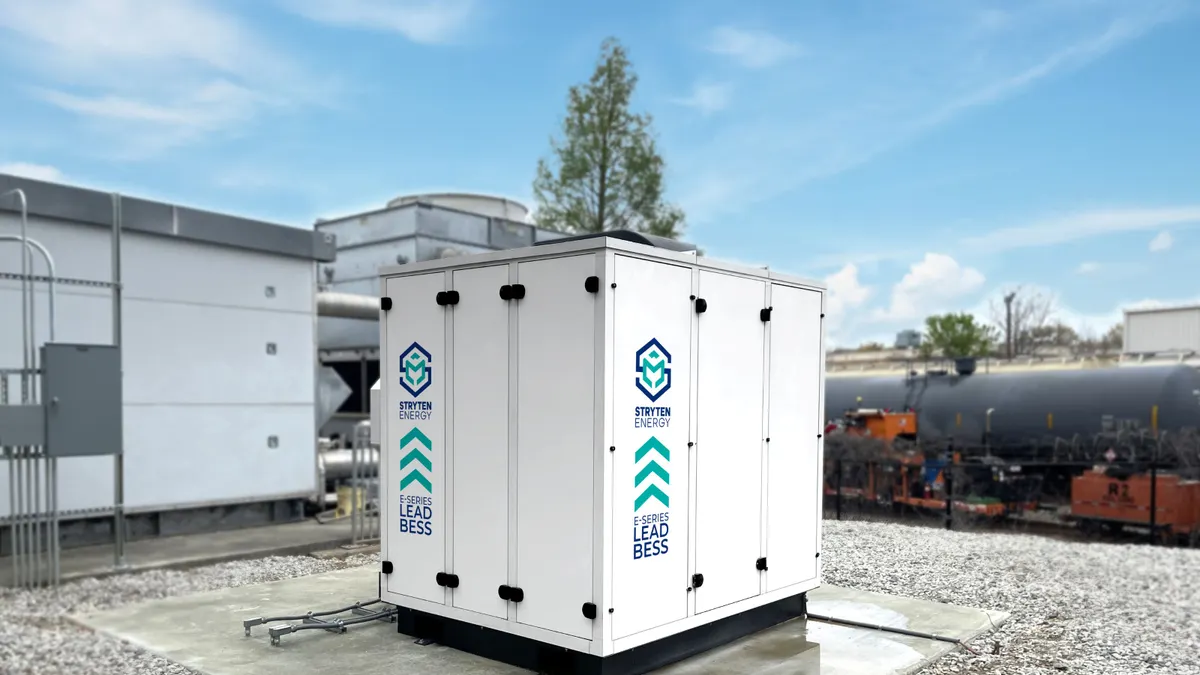
Much of the upfront cost of installing a battery energy storage system is the same whether you put in a four-hour battery or an eight-hour battery. So if you envision using a BESS system for time-of-use energy arbitrage as well as for backup power, it might make sense to go with a bigger battery, a battery executive says.
“If you install a 100 kilowatt-Hour battery … you still have all the [installation costs]” of a larger battery, Scott Childers, vice president of essential power at Stryten Energy, said in an interview. “If you install a 1 megawatt-Hour battery, you’ve spread those costs across a lot more hours, so in terms of the battery itself, it’s almost linear [whether] it’s a $100 battery [or] a $200 battery. There are definitely economies of scale.”
Manufacturing facilities have used battery energy storage systems for years to ensure they have power to maintain operations during blackouts and to cut utility pricing premiums during peak load periods, but today more facilities are looking at the systems as energy volatility increases and the costs of battery power drop.
“Interest in battery energy storage systems (BESS) has accelerated,” says Matthew Keever, director of onsite solar for North America at World Kinect.
U.S. battery demand for stationary storage systems jumped by 29% in 2025, according to data from the Solar Energy Industries Association, or SEIA. This year, U.S. BESS deployments are set to increase to 70 GWh/35GW, from 57GWh/28 GW in 2025, according to an SEIA report prepared by Benchmark Minerals.
Facilities can typically manage against blackout risk if they can draw on four hours of backup power when needed, but that doesn’t mean they have to ensure four hours of charge at all times, said Childers. “Most power outages are less than four hours,” he said. “So you’re going to cover 90%-plus of your risk scenarios by having a battery that’s four hours or greater in that location. But if you want a combination of both backup power and energy arbitrage, you’ve only got to save some of the charge for backup.”
For many facilities, a four-hour battery is probably sufficient, he said. In most scenarios, the facility can get away with discharging half of the battery storage for energy arbitrage during the day, when utility rates are highest, and then charge the battery back up to four hours at night, when rates tend to be lowest.
“It’s a little bit of a numbers game in terms of when an energy event will happen and when you’ll be using that discharge,” he said. “You can definitely play in that gray zone…. The worst-case scenario is, if you’re half discharged and you end up with an emergency event, you only have two hours of use of that battery instead of four.”
But even in that case, the likelihood is high that two hours of charge will be enough, he said. “Per the math, you have a really high probability you’re going to ride out that blackout,” he said.
Even so, it can make sense to install more capacity, whether it’s a five-hour or an eight-hour battery, because of the fixed upfront costs regardless of the battery size, he said.
“A lot of the costs that you experience when installing a battery are actually not the battery,” he said. “It’s all the installation. It’s a capital project. ... There’s concrete involved. There’s permitting and inspectors that have to take their time to issue [permits].”
Different batteries, different benefits
Traditional lead batteries are ideal for covering blackouts because they don’t require any digital support, he said. They can be stored inside the facility, and they kick in instantly when the grid goes down. “You won’t even know that the grid dropped because the battery will pick it up that fast,” Childers said.
They’re limited in their duration, though. Depending on the size of the battery, it won’t go beyond a few hours. For longer blackouts, facilities can better manage risk with a vanadium redox flow battery, or VRFB. “It’s excellent at long duration,” he said. “It can go days and beyond what a lead battery can survive.”
But they have their own limitations. VRFBs generate power by pumping an electrolyte solution, so they require their own separate power source to pump the liquid as needed.
“If you don’t need the vanadium flow battery, you would turn those pumps off, because they become a parasitic load,” he said. [But] if you turn it off completely, it takes a few minutes for those pumps to turn on and get the circulation of the electrolytes up and moving. It probably takes as much as 10 seconds to 30 seconds.”
In an electrical environment, even a delay as short as 10 seconds can be devastating, he said, because it can harm the variable frequency drives, or VFDs, and other components that are critical to equipment. “Those devices can be really sensitive,” he said. “You might blow four or five of your VFDs in one plant in one blackout event just from that surge.”
A good combination is a vanadium flow battery with a lead battery as support, he said.
“A perfect idea for hybridization is to take a passive lead device and put it in front of a vanadium flow battery,” he said. “You get the best of all worlds. You get a jump start from blackout conditions. You get parasitic load elimination from the vanadium flow battery, and you get the long duration.”
Lithium batteries are a third option, although those can come with safety issues that affect how they’re managed and stored.
“Each one has a specific application use that’s unique to it,” he said. “You can’t solve all of the energy scenarios with one chemistry.”
These three, by themselves or in some combination, would probably cover 90% of the scenarios for a typical facility, Childers said.
“These are the most technology-ready, cost-effective and fitting most of the applications,” he said.