Dive Brief:
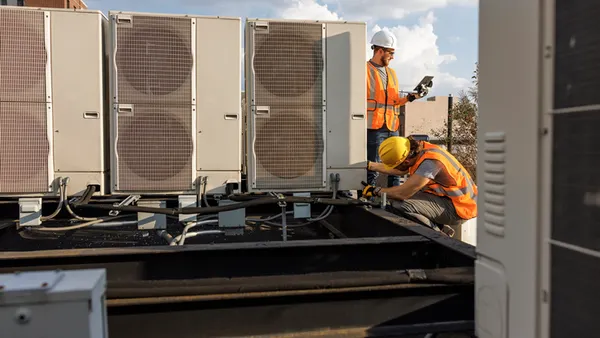
- Ninety percent of facilities managers believe in preventive maintenance but only 26% are practicing it, a survey by computerized maintenance management system software company UpKeep finds.
- Insufficient staffing and scheduling conflicts are the biggest barriers to having an operation that’s led by preventive maintenance, or PM, according to the company, which surveyed 214 maintenance and reliability professionals across industries.
- “These barriers are structural,” UpKeep says. “Telling maintenance teams to ‘do more PM’ doesn’t address staffing constraints. Encouraging technicians to ‘prioritize prevention’ doesn’t create protected maintenance windows. The barriers require organizational solutions, not individual behavior change.”
Dive Insight:
Lowering the barriers to a prevention-first operation requires the use of a workflow that quantifies the value of maintenance so facilities managers can make a business case for what they need, UpKeep says. “Maintenance operates without the measurement foundation that would enable it to demonstrate value and make data driven decisions,” it says.
Just under a quarter of survey respondents say they can measure the ROI of their maintenance operations effectively, according to the State of Maintenance 2026 report, released last month.
About a quarter of the respondents oversee maintenance for a facilities management or property management services company. Another 24% work in a manufacturing and plant operations setting, and the rest work across a wide range of sectors and roles.
Without having data to support what they’re doing, facilities managers face what the company calls an accountability vacuum. “Every claim of improvement is anecdotal,” it says. “This creates structural vulnerability; when leadership needs to cut costs, unmeasured functions are easier to cut.”
If their operations are improving, managers face a paradox if they can’t quantify why, the company says. “They can’t identify which interventions caused the improvement,” it says. “They can’t prove causation. They can’t replicate success systematically.”
Just over half of the managers surveyed, or 54%, say they’re seeing improvements in their maintenance operations but 62% say they can’t show that with data. “The majority of organizations that are improving don’t actually know why,” the company says.
Quantifying performance creates data that facilities managers can take into budget meetings, the company says. “Instead of speaking only in maintenance terms [managers can say the] ‘PM program contributed to 2.3% uptime improvement worth $1.4M,’” the company said. “Maintenance becomes a measured business function with defensible ROI rather than a cost center with anecdotal value claims.”
Other survey findings:
- 28% of respondents don’t know their annual maintenance budget.
- 19% have difficulty tracking preventive maintenance tools.
- 30.9% have maintenance programs that are mostly reactive; 7.3% are fully proactive.
- 38.2% are good or excellent at measuring maintenance performance; 61.9% are fair, poor or very poor at it.
- 9.1% have increased their use of maintenance contractors; 16.4% have decreased it. Most used contractors to access specialized skills.
- 72.7% haven’t used AI or only experimented with it; 61.9% are excited about the technology or view it as a useful tool.