Dive Brief:
- Boston-based sustainable indoor air quality startup Metalmark Innovations received support from JLL Foundation, the company announced Tuesday. The partnership is expected to accelerate deployment of Metalmark’s Tatama air cleaning system and Everglades smoke protection filters.
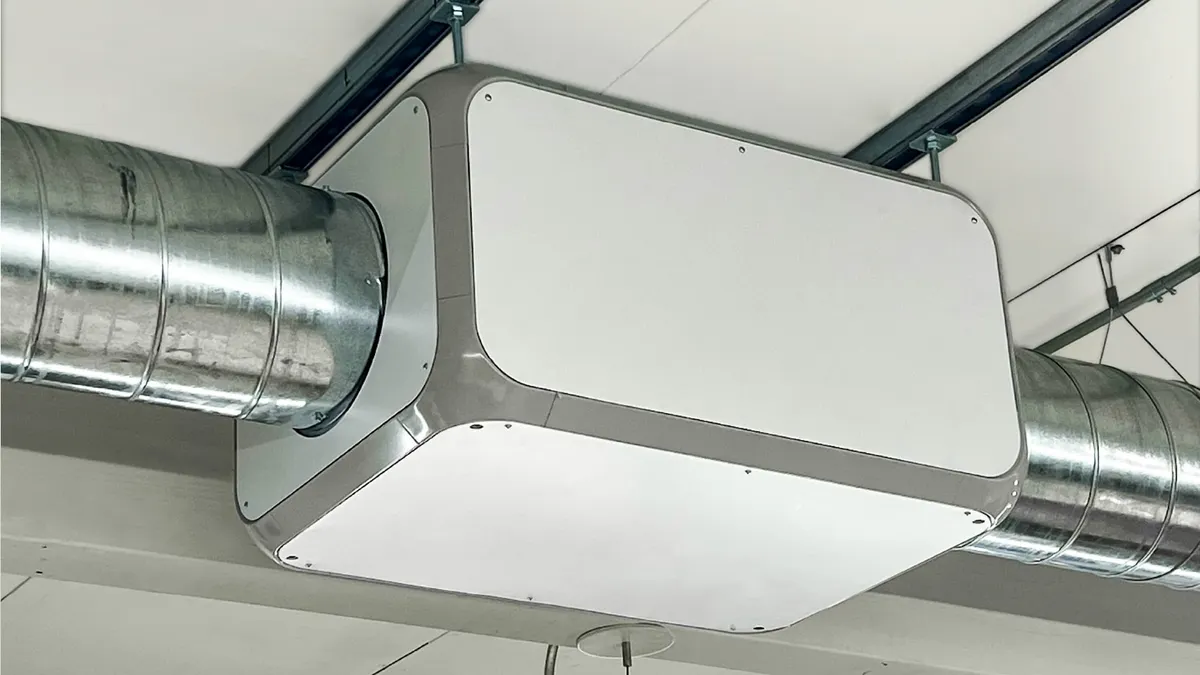
- Tatama is an air- mounted, self-renewing system that removes and destroys smoke particulates, pathogens and volatile organic compounds, Metalmark says.
- "JLL Foundation's support underscores the urgency and impact of our mission to make clean indoor air both sustainable and scalable," Sissi Liu, CEO and co-founder of Metalmark, said in a statement.
Dive Insight:
The investment comes as building owners and facility managers prioritize indoor air quality alongside energy efficiency and sustainability. Balancing IAQ and energy efficiency is top of mind for many in the industry as public perception of air quality rises, and the American Society of Heating, Refrigerating and Air-Conditioning Engineers earlier this year made air quality a central focus of its agenda.
“Maximizing the things you can do to create clean and healthy indoor spaces will in turn also maximize your efficiency,” Tony Abate, vice president and chief technology officer at AtmosAir Solutions, told Facilities Dive. The value of indoor air quality improvements can also help to offset upgrade costs and keep buildings efficient, with IAQ monitoring also helping to ensure HVAC systems are operating properly, others say.
"[Metalmark’s] technology advances decarbonization goals in the built environment while protecting human health and well-being,” Erin Meezan, executive director of JLL Foundation and chief sustainability officer at JLL, said in a statement.
Metalmark’s Tatama air cleaning system and Everglades Smoke Protect+ Filters use 3D nano-architectured materials that the company says were inspired by microstructures found on the metalmark butterfly’s wings. These microstructures enable HEPA-grade air filters that last up to 10 times as long as conventional filters, reducing maintenance costs, energy consumption and landfill waste, Metalmark said. The nanostructured materials also enable the Everglades filters to enhance wildfire smoke particle filtration by up to five times compared to conventional filters with the same MERV rating, without increasing energy demand, Metalmark said.
The Tatama technology was named a winner of the U.S. Environmental Protection Agency’s Cleaner Indoor Air During Wildfires Challenge, and has been tested to remove airborne pathogens, including viruses, bacteria, mold, wildfire smoke and more, while extending filter life to as long as five years. This addresses one of the key maintenance and cost challenges in building operations, Metalmark said.
In November, the Mayo Clinic tapped Metalmark to serve as a partner in a project awarded by the federal government’s Advanced Research Projects Agency for Health’s BREATHE program. The $40 million project brings together Mayo, Metalmark, Siemens and academic collaborators in a five-year effort to enhance indoor air quality monitoring capabilities and develop systems that can forecast and mitigate airborne pathogen threats.