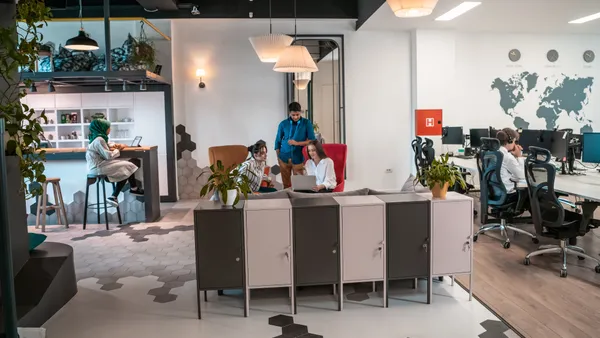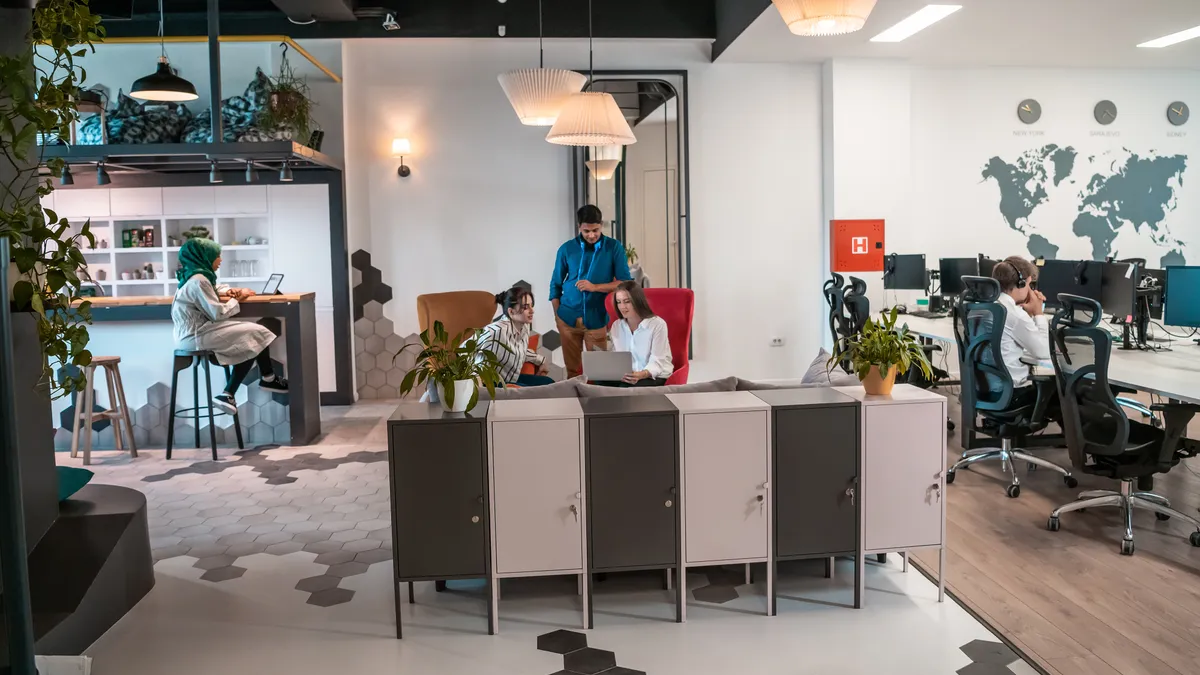
Coworking workplaces expanded 15% year over year in the fourth quarter of 2025 as businesses bring the office to their employees, according to a report by Coworking Cafe.
Employees in 97% of Fortune 100 employees are subject to hybrid or full-time in-office requirements, typically in four-days-a-week arrangements, according to JLL’s Q4 office report. This normalization of attendance policies, in conjunction with aggressive post-pandemic rightsizing, has meant many major companies need expansion space, the firm says.
As part of their search, organizations are turning to flex space and other innovative workplace strategies that vary from traditional leases, according to CBRE’s 2025 Americas Office Occupier Sentiment Survey.
Many of the world’s largest companies, including those mandating full-time in-office requirements, are using coworking space, according to a Wall Street Journal report, which named Pfizer, Amazon, JPMorgan Chase and Lyft among those using shared conference rooms and cubicles through coworking arrangements.
Of the 50 locations added last year by flex-space company Industrious, most growth came from larger companies using flex space for satellite offices, often with fewer than 100 employees, that offer amenities comparable to those at corporate headquarters, WSJ reported.
The increasing use of coworking space in large markets helped drive a 17% year over year increase in the sector, to 159 million square feet at the end of the year, according to Coworking Cafe. The national inventory of coworking spaces grew 5% quarter over quarter to 8,854, the company says.
Despite the growth, coworking as a share of space remains in the low single digits — just over 2.2% of total U.S. office inventory, “showcasing just how much runway remains,” Coworking Cafe said in its report. “That said, operators appear increasingly willing to wait for the right building, the right submarket and the right tenant mix before committing their capital.”
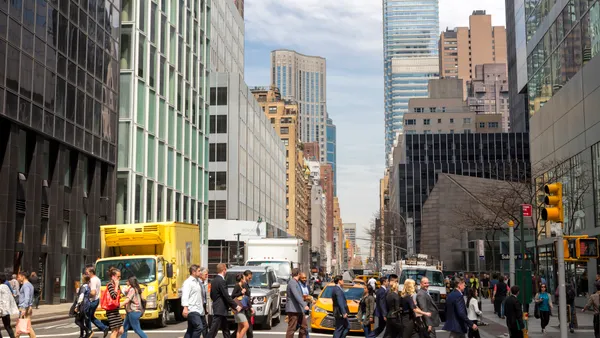
While coworking expansion is continuing, it’s increasingly concentrated in large, established markets like Los Angeles, Chicago, Dallas-Forth Worth, Washington, D.C. and Manhattan.
Los Angeles, at 338 spaces, is the largest coworking market, with incremental growth reflecting a resilient coworking ecosystem where operators are layering new sites into established submarkets rather than opening new territories, Coworking Cafe said. Washington, D.C. and Manhattan are posting modest quarter-over-quarter increases as organizations seek agility and hybrid work solutions, the report says.
In contrast, several mid-sized markets — including Raleigh-Durham, N.C., Nashville, Tenn., and Columbus, Ohio, recorded flat or near-flat location counts in Q4. “This pause suggests that operators appear to be focusing on maximizing performance at existing sites before committing to further expansion,” the Coworking Cafe report said.
Meanwhile, the average coworking site size and median price remain steady, at roughly 18,000 square feet and at about $220 per month, down slightly from $225, the report says. Day passes are sitting at $30. Meeting rooms cost about $45 per hour and virtual offices are about $159 per month, similar to the month prior, “marking a clear transition from adjustment to balance,” Coworking Cafe said