James Hamilton is global engineering manager at Hughes Safety Showers. Views are the author’s own.
An increasing number of data center operators are aiming for minimally staffed “lights-out” environments, but data centers still require technicians, engineers and contractors to inspect, fix and keep everything running.
In these high-density, high-energy environments, the focus is naturally on uptime, cooling performance and power resilience. But as systems scale, so do the chemical and mechanical hazards faced by onsite personnel. When someone is exposed to hazardous substance, every second matters. The faster a hazardous substance is washed from the skin, the more effectively the severity of a chemical burn can be reduced. That’s why the right emergency safety showers are essential.
Risks inside data centers
In data centers, thousands of servers run continuously, supported by cooling infrastructure and backup power systems. Across the United States, investment in new capacity is growing rapidly to meet demand for digital services, AI workloads and cloud expansion.
Although automation helps, it doesn’t erase risk. Battery rooms, cooling equipment, water treatment systems and cleaning processes are all places where workers can come into contact with hazardous substances that can harm skin or eyes on contact.

Building operators might assume smaller splash risks can simply be walked off or dealt with at a regular sink, but neither of these adequately respond to chemical exposure. For isolated hazard points, such as battery racks or water treatment dosing areas, portable emergency eyewashes provide fast, ANSI/OSHA-compliant decontamination without the need for a plumbed-in system. They’re often the quickest, most practical option in small, high-risk pockets of the facility.
Here are some hazards that building operators should give serious thought to how to address.
Chemical hazards
- Lead-acid and lithium batteries in backup power systems. These units contain electrolyte liquid that can cause immediate irritation or burns if it leaks and contacts the skin. Maintenance activities, such as cell replacement or rack inspections, create exposure risks. Lithium-based systems are increasingly common due to their performance advantages, but they present risks, including the potential for overheating. In both cases, technicians working in these spaces need immediate access to emergency safety showers following exposure to a splash or spill.
- Hazardous refrigerants in cooling systems. Servers generate substantial heat, making cooling systems essential. While some refrigerants are harmless on contact, others, especially ammonia, pose risks. Ammonia exposure requires flushing with water held within a specific temperature range. Where these systems are present, emergency safety showers must be located close by so workers can reach them quickly.
- Cleaning and water treatment. Data centers use chemicals in cleaning processes and in water treatment systems for cooling towers and humidification. And it doesn’t take a big spill to cause a problem. A splash is enough to cause significant injury if not washed off immediately. These risks are often overlooked during the design or retrofitting of facilities.
Emergency preparedness
Data centers prioritize floor space for critical infrastructure, leaving limited room for emergency systems. In multi-story or retrofitted facilities, a worker’s distance from a hazard point to the nearest safety shower may exceed best-practice limits. During an emergency, this short delay can allow a substance to remain on the skin longer that it should, making an injury more serious.
Some areas can’t be served by plumbed-in systems. For these locations, mobile emergency shower stations provide a practical solution. With a tank supplying continuous flushing and a durable, easy-to-move frame they ensure workers still have access to emergency decontamination when no fixed water supply exists.
Another common issue is assuming that hygiene showers can serve the same purpose as emergency safety showers. They cannot. Hygiene showers are intended for routine cleaning of non-hazardous debris, not for flushing hazardous chemicals during an emergency. Mixing them up can delay effective decontamination when time is critical.
Emergency responses
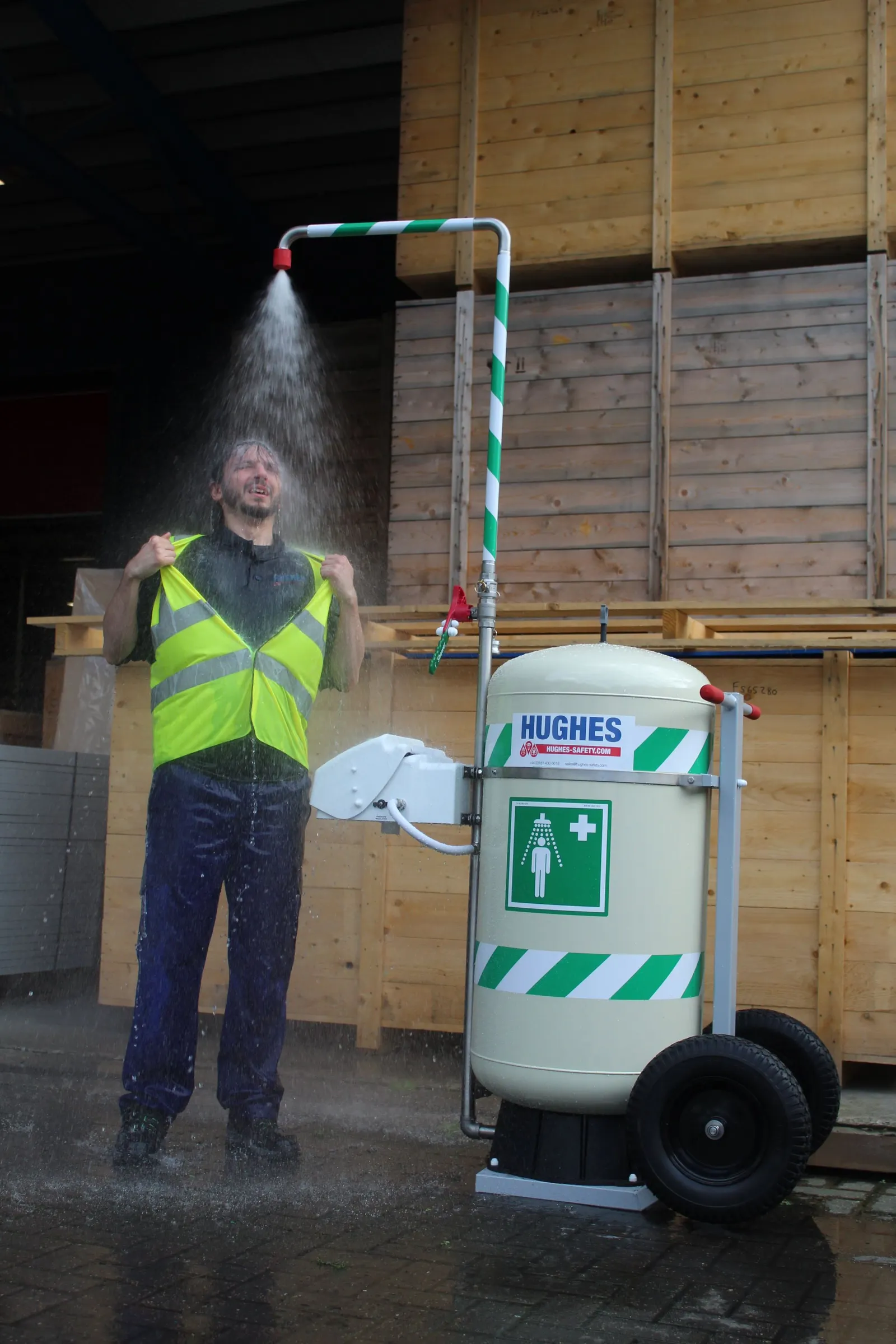
- The 10-second rule. Emergency safety showers and eye/face wash units must be positioned within 10 seconds of any chemical hazard, according to ANSI/ISEA Z358.1 standards. If a dangerous substance is present, showers should be located immediately adjacent to the hazard. These facilities must be easy to see, unobstructed and well-lit to ensure they can be accessed quickly in an emergency.
- Cubicle safety showers. In space-restricted environments, cubicle safety showers with built-in sumps offer a controlled, contained decontamination area. The sump prevents spray and contaminated water from reaching sensitive electrical equipment. These units offer a dedicated emergency space that fits within tight spaces.
- Chemical compatibility. To ensure thorough flushing, users must remain under the shower for 15 minutes without discomfort or shock. Safety showers must supply tepid water, typically between 60-100°F, Tepid water encourages the worker to remain under the shower for the full recommended duration. For plant rooms with refrigerants or chemicals requiring precise water temperature, temperature-controlled safety showers fitted with a heated tank and thermostatically controlled mixing valve supply ANSI-compliant tepid water for the full 15-minute duration, even in unheated areas or during supply fluctuations.
- Hard-to-reach areas. Facilities may have areas with inadequate water pressure or limited plumbing access. Emergency tank showers and mobile shower stations solve this by providing a self-contained supply of water, independent of the building’s infrastructure.
Testing and training
Emergency safety equipment must be tested regularly to ensure it works correctly during an emergency. Safety showers need to be activated weekly to check water flow and flush out stagnant water. A full inspection must be carried out annually to make sure everything still meets ANSI performance standards and remains easy to access.
Workers also need training on where safety showers are located, how to use them and why acting fast is key to reducing the severity of an injury. And they should be clear that hygiene showers or standard wash stations won’t help them in an emergency.
Data centers are engineered for resilience and 24/7 operation, and emergency preparedness must be given the same priority. As facilities continue to expand in scale and complexity, operators must ensure that emergency safety practices grow with them.
By identifying hazard points, choosing the right emergency safety showers, placing them properly, and keeping them in good working order through routine testing, data center operators can reduce the severity of injuries when something goes wrong.