Improving building envelopes to reduce heat loss and energy use could get easier as researchers say they’re finding advanced ways to use infrared thermal imaging to visualize temperature anomalies and energy loss without disrupting building operations.
Raytron has unveiled an infrared thermal imaging solution that it says will help energy auditors identify building heat loss, which could lead to more informed energy management and carbon-reduction efforts.
"Our goal is to make energy loss visible," Charlie Li, senior executive at Raytron, said in a statement. Our “full-stack thermal imaging solutions … help clients turn buildings into sustainable assets.”
Unlike traditional inspection methods, which requires experienced technicians to undertake invasive spot checks, infrared imaging offers a practical, non-destructive way to inspect building envelopes, pipelines and electrical systems, the company says.
Thermal bridges, insulation defects and building envelope air leakage can form hidden energy gaps, or inefficiencies that force HVAC systems to operate under sustained high loads that drive up energy bills, according to Raytron, a manufacturer of application-specific integrated circuits and chip manufacturer.
The building envelope, including the walls, windows, roof and foundation, forms the primary barrier between interior and exterior environments and accounts for approximately 30% of the energy consumed in commercial buildings, according to the U.S. Department of Energy Better Buildings program. The amount of energy used by building HVAC and lighting systems is significant, and inefficiencies are compounded in commercial buildings that have inadequate insulation, outdated HVAC technologies or suboptimal control solutions, according to a research paper published last year in Energy Nexus.
For HVAC inspections, Raytron’s thermal imaging technology can reveal heat loss or uneven temperature from damaged duct insulation, as well as blockages and hidden moisture from condensation, the company said. These insights can help enable targeted repairs and avoid costly equipment overhauls, making “infrared a faster, more comprehensive diagnostic tool that bridges the gaps left by conventional approaches,” it said.
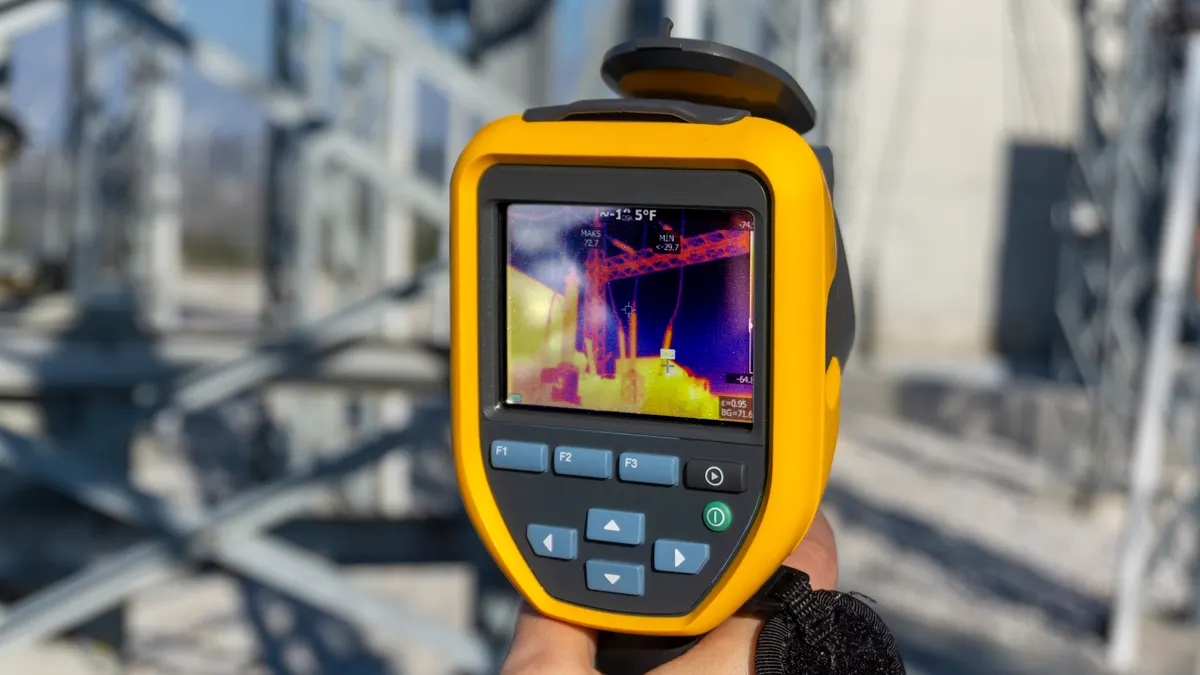
To support reliable diagnostics, the company said, it touted its handheld thermal camera, the CX200 Pro, which it says delivers the high sensitivity needed for on-site inspections. It can detect issues at a sensitivity rate as low as 40 millikelvin, ensuring subtle temperature differences are reliably revealed, it said.
The tool can also improve diagnostics in complex field environments through a digital zoom that allows engineers to scrutinize distant or small targets without compromising image clarity, Raytron said.
Further improvements ahead
Other advanced thermal imaging technology could be in the works, according to a study released in August in the journal Light: Science & Applications.
Scientists at the Beijing Institute of Technology say they’re working to improve operators’ ability to “see” heat by developing a sensor capable of capturing ultra-high-resolution images in 4K resolution,
The researchers say the first-of-its-kind artificial imaging system, inspired by specialized heat-sensing organs that pit vipers have developed to spot prey, passes radiation through different materials until it manifests on an 8-inch disc as an image visible to the human eye.
Visualizing infrared radiation effectively extends the range of wavelengths visible to humans by more than 14 times, with the camera fitted to the sensor technology able to detect warm objects in low light conditions, like fog, through smoke or at night, researchers said.
"The extended artificial vision into infrared range could operate in all weather, whether day or night, regardless of extreme weather, and be of use in new fields such as industry inspection, food safety, gas sensing, agricultural science, and autonomous driving.” The technology could also be feasible for consumer cameras and smartphones in the future, according to the study.