Dive Brief:
- The White House appears to be moving forward with the demolition of four historically significant federal buildings outside of statutory processes, a former General Services Administration official says in a declaration submitted to a federal judge at a hearing this week.
- Attorneys representing the federal government said the declaration is based on hearsay and that there’s no reason to assume the White House is acting outside of official channels. “It is wrong,” Principal Deputy Assistant Attorney General Adam Gustafson and Deputy Chief Marissa Piropato said in their response to the declaration, CNN reported. GSA, they said, is “evaluating those assets not for demolition but for disposal — meaning conveyance out of federal ownership,” and that GSA is following the prescribed process.
- The back-and-forth comes as historic preservationists try to stop the Trump administration from painting the historically significant Eisenhower Executive Office Building, located next to the White House. In a lawsuit, preservationists say the renovation work risks permanently damaging the building’s granite facade and isn’t following statutory processes.
Dive Insight:
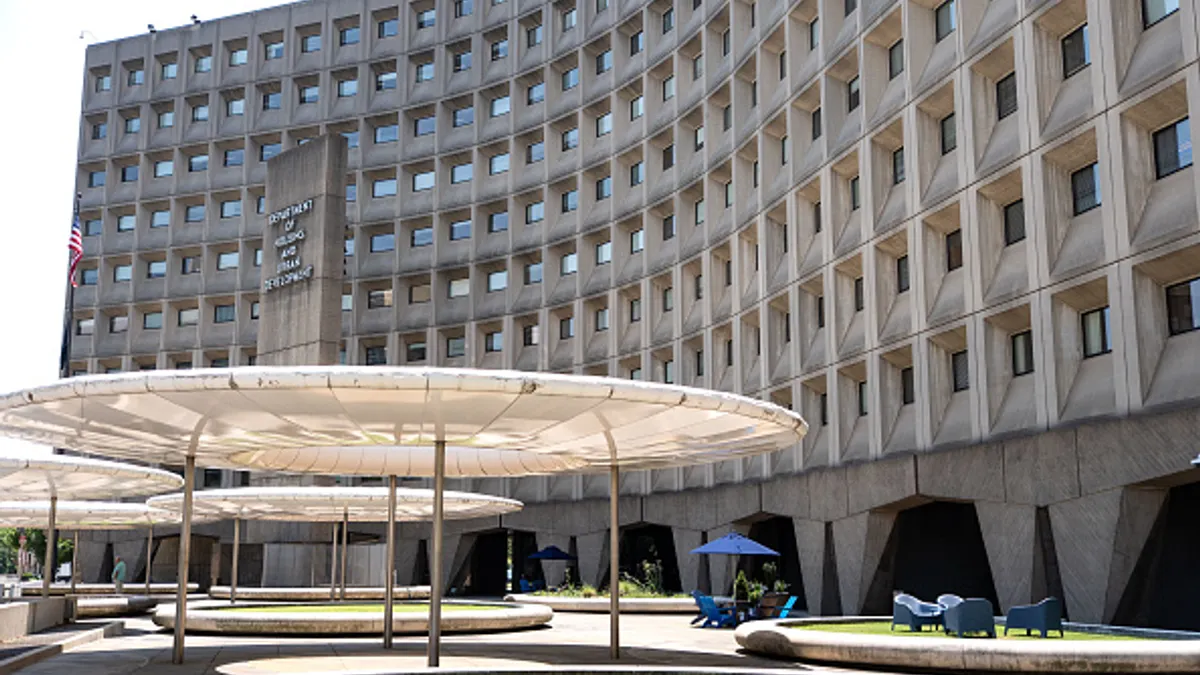
The declaration, filed by former GSA official Mydelle Wright, asserts the White House is deep into the process of selecting contractors to demolish four architecturally significant buildings: the Robert C. Weaver Federal Building, the Wilbur J. Cohen Federal Building, the GSA Regional Office Building and the Liberty Loan Building.
Critics say the buildings are examples of New Deal era architecture, which includes the heavy, raw-concrete “brutalist” style popular in the post-World War II era. These are “gems of America’s architectural history and its collective heritage,” Judith Levine, a civil liberties advocate and author, says in The Guardian. “They are not Trump’s to dispose of, like battered file cabinets or obsolete computers.”
Earlier this year, President Trump in an executive order said he wanted federal buildings to have a classical style and he called out brutalist architecture as something that needs to go. “The Federal Government largely replaced traditional designs for new construction with modernist and brutalist ones,” the executive order said. “The Federal architecture that ensued … was often unpopular with Americans.”
In her declaration, Wright said the White House is not acting through GSA as required under the National Historic Preservation Act and the National Environmental Policy Act. “As far as I am aware, GSA has not conducted processes to comply with NHPA Section 106 or 110(f) or with NEPA for this undertaking for any of the four buildings,” she said.
Instead, she said, the White House, on its own, has either solicited bids or is finalizing a bid package to “analyze and recommend for demolition” the four buildings.
“For the first time of which I am aware,” Wright said, “a President is personally involved in facilitating end-runs around the agency’s obligations to the buildings that are our national heritage, and who in the agency is going to tell him ‘No?’”
Gregory Werkheiser, one of the law partners at Cultural Heritage Partners that filed the lawsuit to block the painting of the Eisenhower Building, said he has no confidence GSA has control over the remodeling and other work Trump is having done on high-profile buildings in Washington, D.C. This work includes demolition of the East Wing of the White House to replace it with a ballroom that critics say will dwarf the White House itself.
GSA “doesn’t have the president’s actions under control,” Werkheiser said at the hearing, Bloomberg Law reported.
The four buildings are on GSA’s list of federal buildings that the agency wants to dispose of because they’re obsolete or underused. The list sparked an outcry when it was released earlier this year because of the impact the buildings could have on real estate markets and because of the historically significant buildings that are included in it.
Judge Dabney Friedrich of the U.S. District Court for the District of Columbia, who presided over this week’s hearing, asked attorneys on both sides to be prepared to meet again shortly. Should she issue a ruling, it will be over whether to stop the White House from moving forward with the Eisenhower Building painting until the plan has been through the statutorily prescribed process that requires reviews and public hearings to get expert and public input before the work is done.