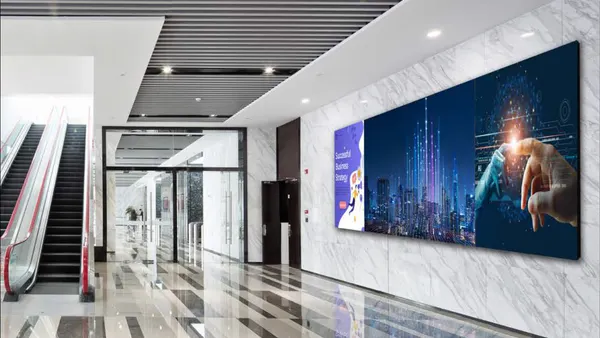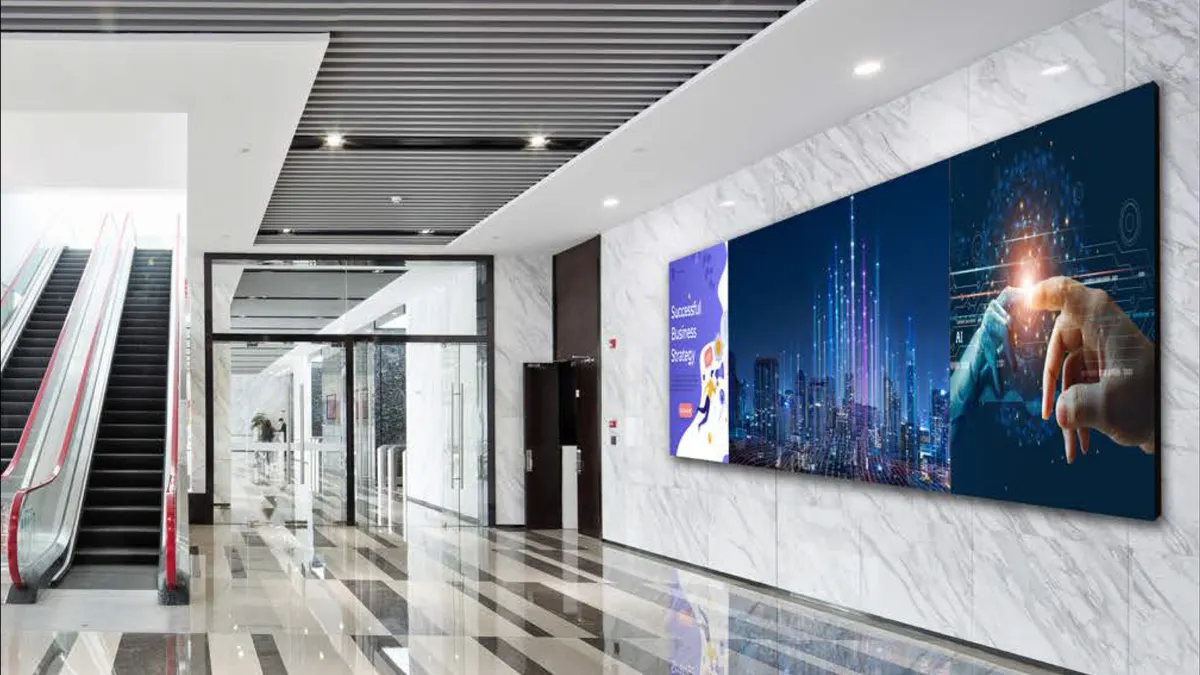
For facilities managers implementing digital signage upgrades, working with system providers can help ensure their organization gets maximum value for their purchase, according to Tom Bingham, director of vertical market sales at LG Electronics USA.
Rising demand for connected digital experiences — in stadiums, airports, retail stores and other settings — is consistent throughout the market, Bingham said in an interview. Building operators are trying to pull digital technology together “so that there’s a more meaningful interaction between the guest or the customer,” he said. “So now all those technologies [must] work together to create a cohesive experience that’s actually memorable for the customer and effective at driving sales and guest satisfaction,” he said.
Although every vertical and customer is different, there are three primary objectives that are common across them, according to Bingham: cost, management and return on investment.
“There’s a team of people making sure that, first, cost is the best value for the money,” he said. “Am I making the right purchase decision and getting the best at the lowest cost? Second, there’s going to be a person responsible for managing that asset during the duty cycle, and [third], people are looking for better ROI.”
How long the asset is going to last and the cost of its maintenance and operations are among the factors building operators want to look at, Bingham said.
What the product is doing to impact the positive attributes of the business is another consideration, he said. “What’s the business doing for their customers? What are they doing for their employees? And how does this device actually enhance that strategy?” he said. “So, we look at new designs [and] new attributes around software and third-party integrations … that actually help achieve that objective.”
Since organizations are looking to purchase digital signage as a way to solve bigger problems, such as driving experience or sales, the technology itself shouldn’t become a focal point of conversation, he said; instead, it should be viewed as a tool for enabling another function. It should “deliver reliable solutions … without having to be a disruption,” Bingham said. It “now becomes an enabling tool.”
LG Electronics USA is looking at other software and cloud-based solutions on the market to aggregate and apply data at speed to make its signage viable tools, “as opposed to something that you’re sitting there going, ‘How come my conference room doesn’t sync up with my laptop?’” he said.
“Those days are behind us,” he said. “Now it’s an interactive collaboration board for environments that are in multiple cities simultaneously, and drives data out to an endpoint so they can make decisions off of what’s shared quickly and easily.”
For example, digital signage and connected capabilities are becoming increasingly important for sports arenas and venues that host events beyond their home team’s games, Bingham said. “There are so many things that make [a] building operate seamlessly to create an experience. It’s no longer just telling me where my seat is … how much my concessions cost. All that signage … is informative … but now it’s part of the show,” he said. Another example is in higher education, where the University of Tennessee at Knoxville partnered with the company to link LG smart washers and dryers with an application that students can use to check availability and time remaining on each cycle, Knox News reported.
While connecting these systems can often create a headache for facilities and IT teams, a provider like LG can be a facilitator that takes the voice of customers and works with third-party partners to deliver a solution that drives the value that the teams are looking to accomplish.
“Businesses are in business for some other purpose than buying signage. We’re just a tool,” Bingham explained. “And recognizing that, we want to make sure that it’s much more than just a device. It’s now part of an entire system.”