Dive Brief:
- North American higher education facility managers and planners are seeing classrooms and offices sitting empty almost a quarter of the time as space utilization drops across campuses, according to research by Occuspace looking at fall 2025 year-over-year data. Dining rooms and student centers are the exception.
- Average campus utilization was 45%, down eight percentage points from the previous year, according to the occupancy analytics company. Flexible-use spaces like dining areas, student centers, study spaces and circulation areas showed steady use, while more specialized spaces saw deep declines.
- The findings can help facility managers and planners decide whether to shed leases and avoid new construction, among other ways to reduce costs, the company’s CEO, Nic Halverson, said in an email. “Given the high cost of wasted space, today’s facility teams owe it to their institutions … to understand their space usage and maximize the value of every square foot,” he said.
Dive Insight:
Institutions are targeting between 70% and 85% average daily peak utilization, suggesting there’s ample room for them to optimize space, according to the report, released Wednesday. Utilization refers to occupancy relative to the space’s capacity. Average utilization refers to average occupancy relative to capacity during operating hours.
The latest utilization results are surprising, Halverson said. “It could be a combination of several factors — remote/hybrid learning, declining enrollment, space allocation inefficiency,” he said.
Dining areas saw a 9% year over year increase to 85%, passing general use and athletics and recreation areas to become the most used spaces on campus, according to the company’s Higher Ed Space Utilization Index, which aggregates data on more than 40 million square feet of space from more than 100 North American institutions.
Recreation space utilization dropped 17 percentage points from the year prior, but it remains one of the most used across campus. The average dwell time, or how long people stay in the space, remained flat.
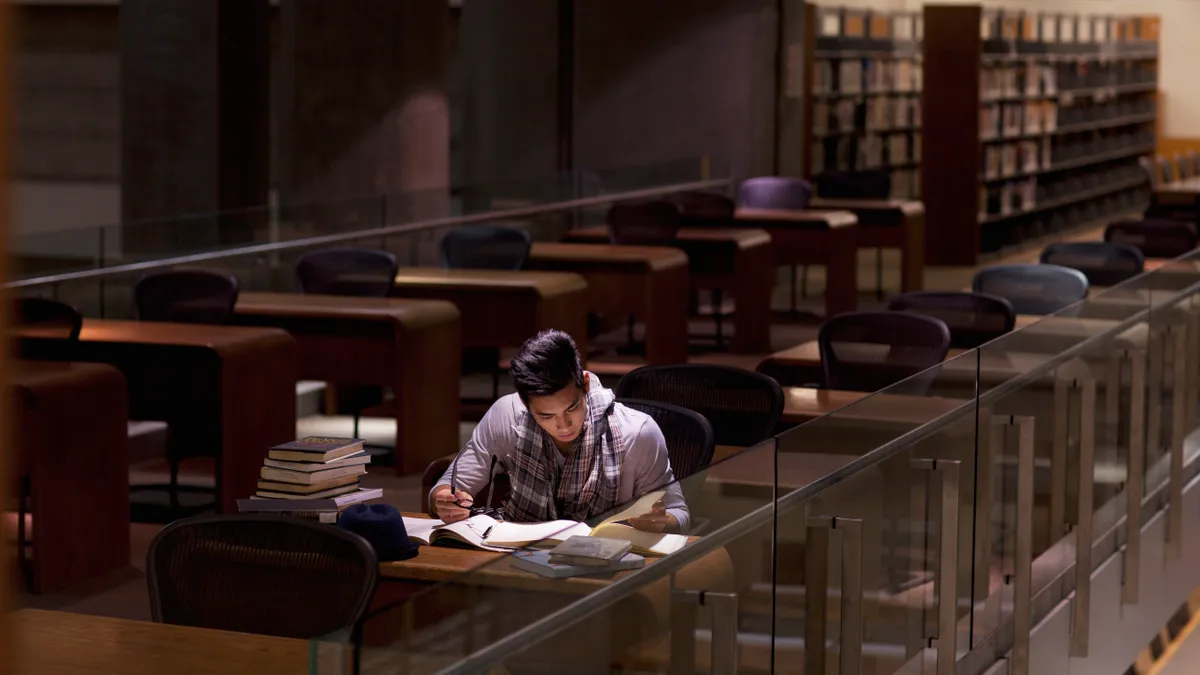
Use of study spaces tends to drop on the weekends. The latest data reflects that but also shows average dwell time increasing, “meaning fewer weekend visitors spend more time,” Occuspace said. Classrooms were used most on Wednesdays, reaching about 40% between the hours of 10 a.m. and 3 p.m.
Offices and meeting rooms are seeing some of the biggest drops. Office space utilization dropped 19 percentage points from 71% a year prior to a weekly peak utilization of 52%.
Faculty space was hit particularly hard, with humanities and social sciences departments and engineering and computer science departments seeing around 20% year over year decreases.
Small- and medium-sized conference rooms are often sitting empty — 64% of the time and, when in use, tend to only have a single person in them. Large conference rooms, with room for 12 or more people, are being used more, almost half the time, or 47%. They were also occupied by few people — one or two for 54% of the time.
Halverson expects large conference rooms and other spaces to offer an opportunity for operators looking to turn around use. For example, “spaces designed for how we worked and learned before COVID… e.g., conference rooms intended to hold 20 people [being] used as personal workspaces (phone booths),” he said.
Laboratory space peak utilization is also down, dropping 15 percentage points year over year to 41%.
To optimize their space and respond to these drops, facility teams must know how the different spaces are being used, Halverson said. “You can’t manage what you don’t measure, and facility teams should know that with today’s technology, you can get real-time occupancy data quickly, easily and affordably,” he said. “We believe that space utilization metrics will soon become a standard metric for managing modern building spaces.
Correction: We have updated this story to correct numbers that changed between a draft and final report from Occuspace. We also have clarified Halverson’s comment on the opportunity for better using large conference rooms.