As storms and seismic events intensify, facility managers should evaluate retaining walls and foundations, especially if they were built before today’s engineering standards took effect. Older structures are particularly vulnerable to failure in the face of weather events, says an engineer at a firm that provides inspection and repair services.
Water creates an outsized risk because its damage can go unseen until it’s too late, according to Joe Demers, a civil engineer at Alpha Structural.
“People don’t really see [the damage],” he said in an interview. “So when the heavy rains come, a lot of those problems are exposed.”
It’s not unusual for retaining walls to be overlooked in inspections when facilities are purchased, leading to blind spots that can later come back to bite, he said.
“People don’t think about how much stress [that] water puts on a wall,” he said. “If they don’t have proper drainage behind them [or aren’t] waterproofed sufficiently, the water can get into the wall and corrode the rebar.”
Even if water doesn’t get into the surface, he said, it adds pressure. “Just water building up behind a wall can double the amount of pressure that’s on it,” he said.
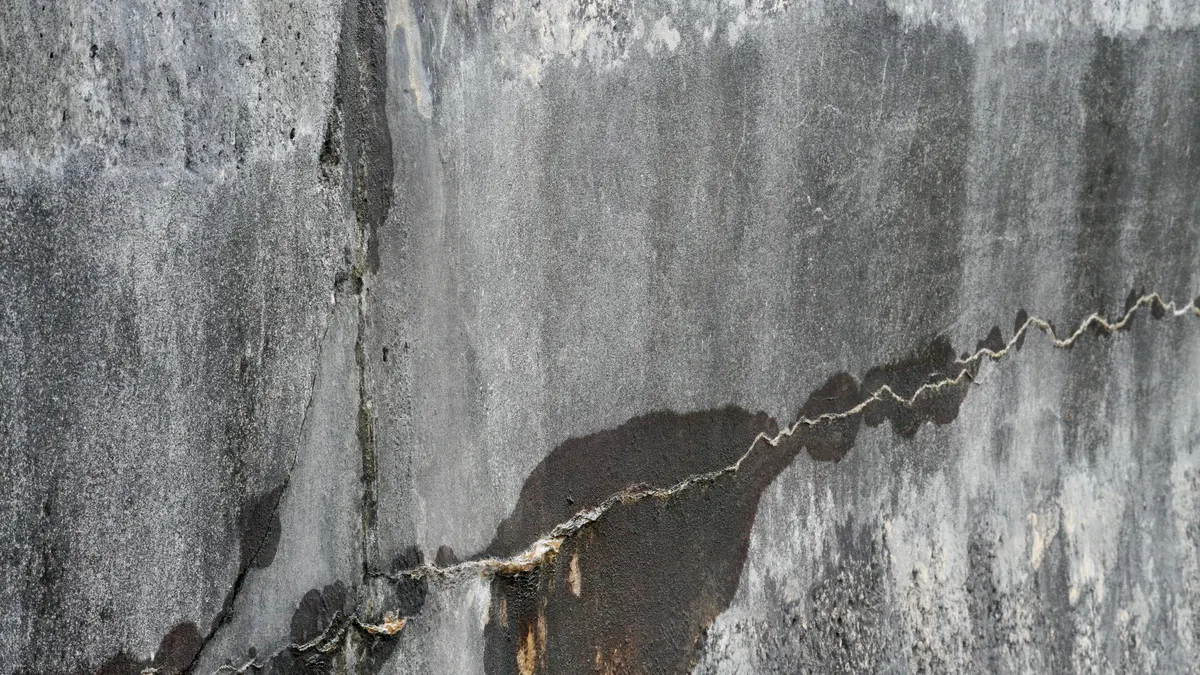
Leaning is the most critical sign facility managers should look for along with cracks, he said. “Small cracks in concrete are common and they’re not a problem,” he said. “It’s a little hard to tell when a small crack starts to become a big crack, but leaning walls is the main indicator that something needs to be replaced or repaired.”
To avoid problems, facility managers should try to keep water away from structures by putting in place proper drainage, because even small amounts of water over time can degrade foundations and retaining walls, he said.
“You need to have a drain behind the wall,” he said. “A lot of times on properties, drainage seems like an afterthought…. One of the first things to think about [is] getting surface water away from the structure and getting subsurface water that’s behind the wall away from the structure.”
If water becomes a problem, the retaining wall or part of the foundation may need to be replaced, or a new wall can be poured up against it, he said. “Even if it’s the basement wall of a structure, we can shore the whole structure up in the air, remove the wall and put a new one underneath, while the whole structure is being supported in the air,” he said.
On the plus side, foundations tend to fail slowly, leaving facilities teams with time to inspect them. “It’s not going to come out of nowhere,” he said. “If a wall is going to fail, you’re going to see it in the wall a long time in advance — slowly leaning, slowly failing.”
When Demers’ company comes to inspect a retaining wall or foundation, the first thing it does is check for sufficient drainage behind it, he said. “We can do some excavation to figure out how deep the footings are [or] can actually use radar,” he said. “We have equipment where we can actually see the amount of steel and the spacing of the steel inside. That’s a relatively new [way] to be able to measure steel … inside a wall.”
If a retrofit is required, a new type of rebar is available that’s not made of steel but fiberglass, which is resistant to corrosion. While not widely adopted, the material is something his company is starting to work with. “[It could] make walls last a lot longer,” he said.
If water is visibly rising, though, it might be too late, so facility managers should take time now to inspect their structures, Demers said.
“This is actually a good time of year to really start looking at it,” he said. “So if there is something, it can be fixed before it starts raining again.”