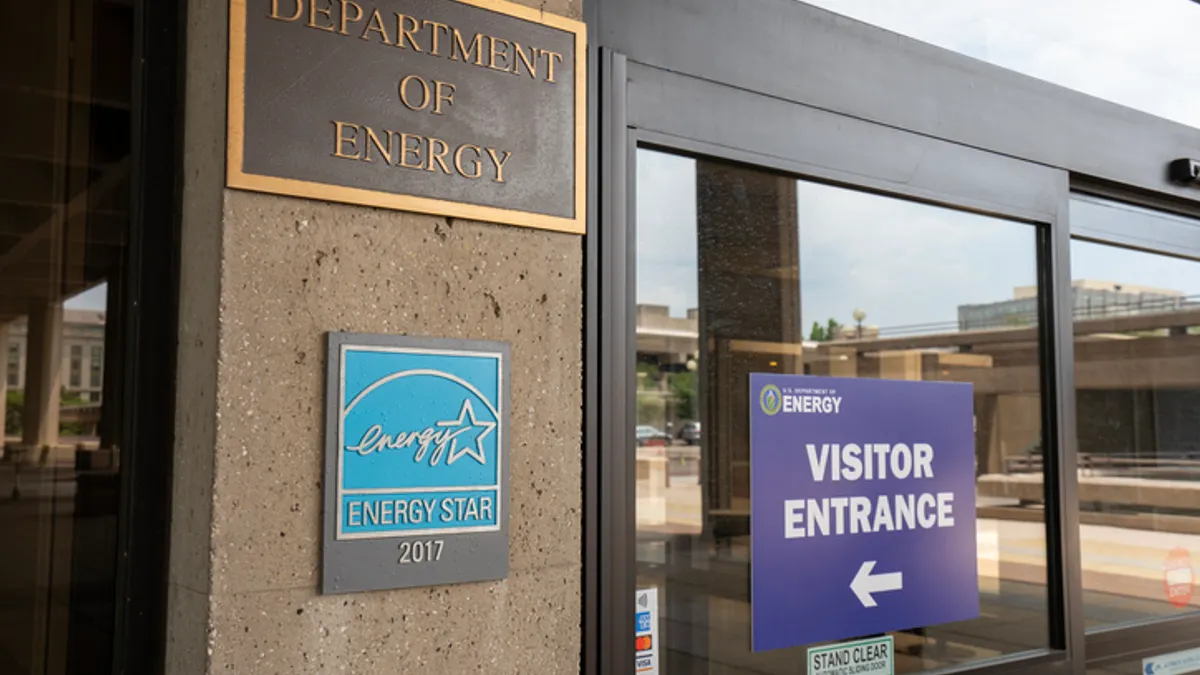
An agreement signed March 3 between the U.S. Department of Energy and the Environmental Protection Agency to move administration of the Energy Star program to DOE has industry groups hopeful the program will land on stable ground.
“This move appropriately aligns the program with the agency that possesses the deepest product expertise,” Kelly Mariotti, president & CEO of the Association of Home Appliance Manufacturers, said in a statement. “DOE administers the federal Appliance Standards Program, which establishes the baseline efficiency requirements that underpin ENERGY STAR specifications for appliances, making it a natural fit to manage the program for home appliances.”
“We have all the faith in the world DOE will continue running the program as EPA has done for 30 years,” Todd Sims, senior director of regulatory and industry affairs for the built environment at the National Electrical Manufacturers Association, told Facilities Dive.
For the transition to succeed, DOE should be transparent about how it plans to oversee the program, the U.S. Green Building Council says.
“Given EPA’s statutory responsibility and strong institutional knowledge in managing the program, a change of this magnitude calls for more transparency, oversight and public engagement,” Ben Evans, federal legislative director at the U.S. Green Building Council, said in a statement. “Partner organizations, the public and Congress need to know more about how DOE would operate and fund the program moving forward.”
The Trump administration last year raised concerns among industry groups about the future of the program when it proposed in its fiscal year 2026 budget request the elimination of funding for Atmospheric Protection, a division within EPA that administers the program. Congress responded by funding Energy Star at $33 million, an increase from fiscal 2024. In an unusual move, lawmakers added language directing the administration not to reduce the amount. That was the first time Congress had stipulated a mandatory annual spending level for the program, “placing a clear and binding legal requirement on the administration,” Sabine Rogers, federal policy manager at the USGBC, said in a blog post at the time.
Energy Star was created in 1992 to promote energy-efficient products and buildings and has become central to the way states and localities regulate building efficiency and emissions. A component of the program, called Energy Star Portfolio Manager, is one of the main ways facilities managers and local governments track how much energy and resources their buildings use.
Advocates call the program one of the most successful public-private partnerships the federal government has created. “EPA has been hugely successful in creating and managing ENERGY STAR for more than three decades, saving businesses and organizations more than $40 billion in energy costs annually,” Evans said.
The memorandum of agreement outlines a 90-day period in which the program’s “activities … partnership agreements, trademark(s), as well as IT systems and databases” will move from EPA to DOE. The agreement lasts 10 years, although either agency can walk away with a year’s notice. The agencies will use their administrative funds to cover transition costs.
Like other federal agencies, EPA saw staff reductions last year as part of the cuts recommended by the Department of Government Efficiency, or DOGE. The agency’s workforce dropped from 16,155 at the beginning of last year to 12,448 in July, the agency announced.
A portion of those cuts were from the Energy Star program. “The program has been operating with limited staff because of reorganization efforts within the EPA, as well as the loss of many longtime ENERGY STAR staff members in 2025 through federal buyouts, early retirements and layoffs,” Rogers said.
DOE also saw big cuts — about 11% of its workforce, or 1,800 out of roughly 16,000 employees.
EPA declined a request for comment. “Please reach out to DOE,” a spokesperson said in an email.
In its response to a request for comment, DOE confirmed the MOA was signed. “On March 3, 2026, EPA and DOE entered into a new joint Memorandum of Agreement establishing DOE as the lead federal agency,” the email statement said.