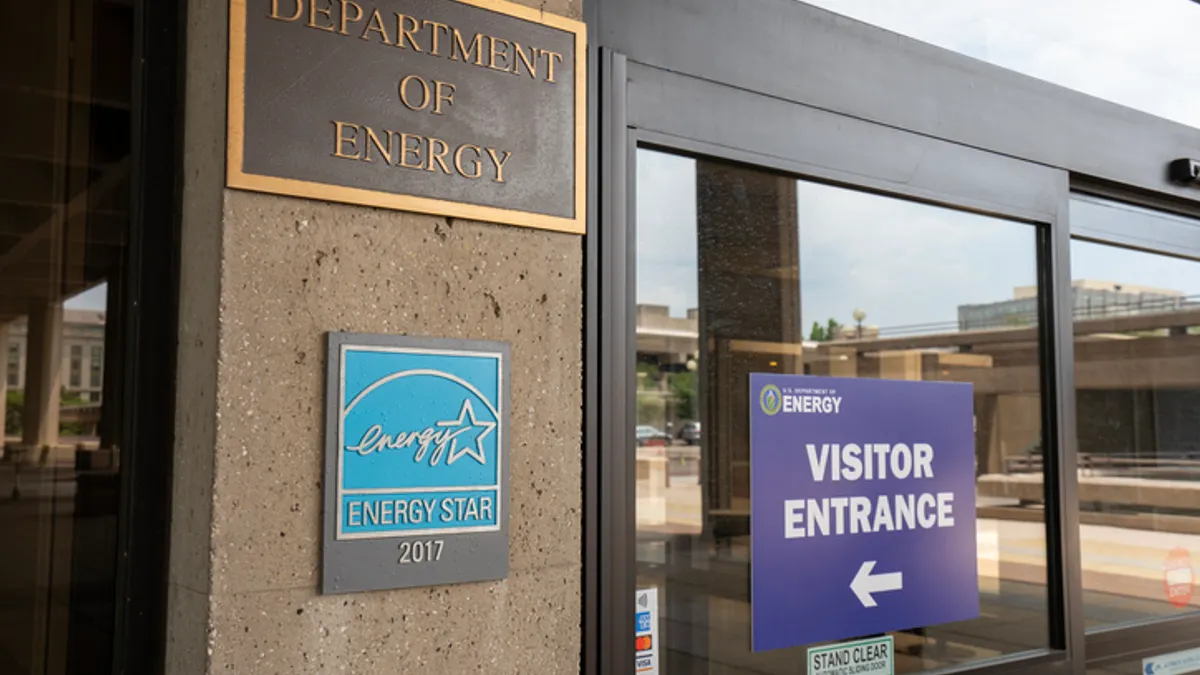
Congress has fully funded the Energy Star program through fiscal year 2026 as part of a funding bill that President Trump signed into law Jan. 23. The administration tried to zero-out the program in early 2025.
“The funding is a huge win,” Sabine Rogers, federal policy manager at the U.S. Green Building Council, says in a blog post.
A provision in the fiscal 2026 appropriations bill that funds the U.S. Environmental Protection Agency and several other federal agencies, H.R. 6938, mandates that the administration provide at least $33 million to carry out the program through the fiscal year ending Sept. 30, a modest increase over the $32 million provided in FY2024, the most recent year where program funding data is available. The provision includes a directive from Congress that the administration not take actions to reduce the amount.
“[This is] the very first time that Congress has stipulated a mandatory annual spending level for Energy Star,” Rogers says, “placing a clear and binding legal requirement on the administration.”
More than 1,200 organizations lobbied Congress last year to save Energy Star after the Trump administration in May proposed eliminating EPA’s Office of Atmospheric Protection, which oversees the program. In letters calling for the EPA to continue the program, organizations said its elimination would damage the real estate sector at a time when it is already facing significant uncertainty.
The Energy Star program has saved consumers and organizations some 5.2 trillion kilowatt-hours of energy and more than $500 billion in costs since it was created in 1992, according to the program website. “Energy Star has grown to become the international standard for energy efficiency and one of the most successful voluntary U.S. government programs in history,” the site says.
Energy Star Portfolio Manager, a free tool that allows commercial building operators and municipalities to track their energy and resource usage, is used in about 25% of all commercial building space in the U.S. and is the basis for building energy requirements in seven states, 48 local governments and two Canadian provinces, according to Energy Star. The tool contributes more than one-third of the Energy Star program’s savings, according to the Institute for Market Transformation.
”The ENERGY STAR Program provides critical infrastructure for organizations to benchmark their building performance, as well as comply with state and local laws that require building owners to disclose their energy and water consumption,” Craig Walter, principal energy advisor at Engie Impact, said in an email. “While use of the funding and next steps are to be determined, approval of the line item funding with bipartisan support is a celebrated win for corporate efficiency programs and the long-term outlook of the program.”
Energy Star funding levels have historically been left to the discretion of the administration, resulting in steady decreases over the past 10 years, so Congress’ mandate that no less than $33 million go to the program is a milestone, Rogers said. But the program still faces challenges, she said
“[It’s] currently operating with limited staff and function because of reorganization efforts within the EPA, as well as the loss of many longtime ENERGY STAR staff members in 2025 through federal buyouts, early retirements and layoffs,” she said.
Mike Zatz, a 19-year veteran of the Energy Star Portfolio Manager program, left last year to join Measurabl. There, he is working to expand the company’s proprietary building performance benchmarking platform, the Free Sustainability Software Solution.
In addition to feeling the loss of Energy Star staff, energy-efficiency supporters will have to deal with other federal-level challenges, Cliff Majersik, senior advisor at the Institute for Market Transformation, wrote in a LinkedIn post. “Sadly, there are spending cuts elsewhere in the package that will hurt energy and environmental programs,” he said.
Those include a cut of 10% to the Office of Energy Efficiency and Renewable Energy, a 13% cut to the Building Technologies Office and a more than 40% cut to the Federal Energy Management Program, according to USGBC.
“Unfortunately, a significant portion of the FY26 funding for EERE — $1.15 billion — is taken from remaining unspent dollars for programs created under the Bipartisan Infrastructure Law,” it said.
This likely means that the final rounds of funding for IIJA programs like Renew America’s Schools and the Resilient and Efficient Codes Implementation program are likely to be taken back, Rogers said.
“In the months to come, USGBC will be watching closely how the administration administers the ENERGY STAR program with this new funding,” Rogers said.