Dive Brief:
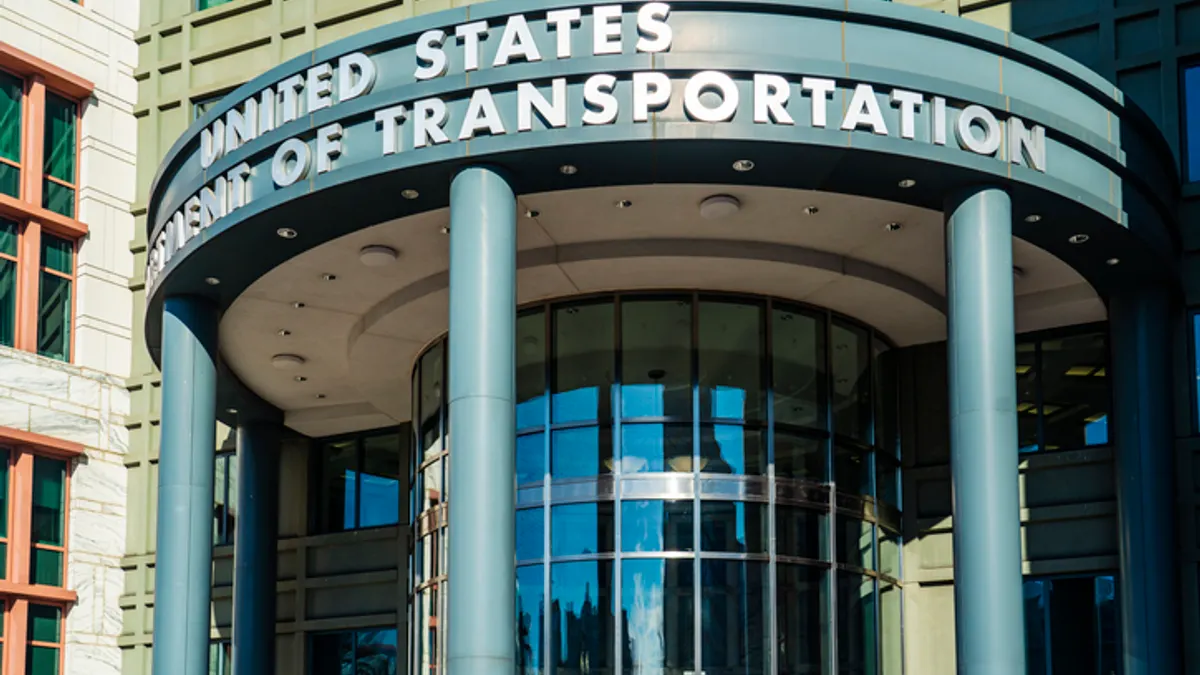
- The U.S. Department of Transportation doesn’t come close to meeting the 60% utilization that federal agencies are supposed to meet nor does it have a plan to reach that goal, the U.S. Government Accountability Office says.
- Across a portfolio of 189 buildings, DOT has an average utilization of between 37% and 41%, costing it $370 million a year in excess property costs, says GAO, the federal government’s watchdog.
- The one plan the agency has for consolidating space, by moving staff at the Federal Aviation Administration headquarters to the DOT headquarters, both in Washington, D.C., is stalled, in part because FAA has secure-room requirements that aren’t in place at the DOT headquarters.
Dive Insight:
The 2025 Utilizing Space Efficiently and Improving Technologies Act, or USE IT Act, requires federal agencies to reach 60% utilization in each of their buildings or take steps to consolidate space.
In its examination of how DOT is doing, GAO found the agency stymied in meeting its goal by incomplete planning and funding constraints. “As of March 2026, DOT did not have plans to consolidate … DOT offices beyond FAA headquarters despite … 89 percent of DOT office buildings [not meeting] the USE IT Act utilization threshold,” says the report, released to Congress on July 15.
Across its portfolio, DOT’s utilization rate is 37% for buildings the federal government owns and 41% for private-sector buildings that it’s leasing.
A 140,000-square foot building FAA is leasing in Springfield Gardens, New York, for example, has capacity for more than 900 people, assuming a federal benchmark of 150 usable square feet per person, but has a utilization of only 13%. The agency is spending more than $15 million a year leasing the space.
Only the agency’s smallest buildings, which have a roughly 50% utilization rate and house an average of 16 people, come close to meeting the 60% threshold, says GAO.
The agency's one consolidation effort involves moving 950 staff out of its FAA headquarters to DOT headquarters, which will bring utilization to almost 60% at the DOT building. “A combined average of 4,044 employees … would represent 59 percent utilization if they all worked in the DOT headquarters,” the report says.
If it adds staff from other satellite offices in the area, it can get utilization above 60%.
The agency says it’s working towards a mid-2027 goal of getting its FAA staff to the DOT headquarters. It has made 70% of one tower in the DOT building available for FAA staff, in part by slimming down workspaces from 8X10 feet to 6X8 feet, but it hasn’t started moving staff in yet. It has spent about $12 million of a $60 million authorization on the consolidation, which is expected to cost $91 million when done.
Once the move is final, the agency expects the FAA to save $56 million a year in lease payments it makes to the U.S. General Services Administration, the federal government’s real estate arm that owns the building. It would also save $131 million in deferred maintenance, assuming GSA sells the building.
In addition to DOT’s incomplete plans and funding, the consolidation is held back in part by the FAA’s specialized space requirements. It maintains classified secure space and an airspace monitoring control room that have yet to be recreated in the DOT building.
Outside of that consolidation, the agency has nothing in the pipeline, GAO says. “DOT has not developed a comprehensive plan aimed at maximizing space efficiency that covers all its office space departmentwide,” the report says.
GAO points to a common practice in the private sector, in which buildings maintain a system for employees to reserve a seat for when they come into the office, as a way to cut costs by avoiding a one-to-one ratio of desks to employees. “Officials from four architecture and engineering firms we interviewed told us that desk sharing is an important strategy for increasing space utilization,” GAO said.
DOT rejected that idea. It maintains a policy requiring employees who work in the office at least six days in a pay period to have their own desk.
Many of these employees spend half their time outside the office on field work, leaving these desks unoccupied much of the time, GAO said.
“Implementing a desk reservation system could help DOT use space more efficiently and increase utilization,” the report said.
In an email to Facilities Dive, a DOT spokesperson said the agency has been centralizing its operations and making them more efficient under its 1DOT initiative. “One of our FAA buildings has already been returned to GSA and over 800 FAA employees have already been relocated to DOT HQ,” the spokesperson said. “Between our consolidation efforts and cutting government waste, we have already saved taxpayers $14 billion since the start of the administration."