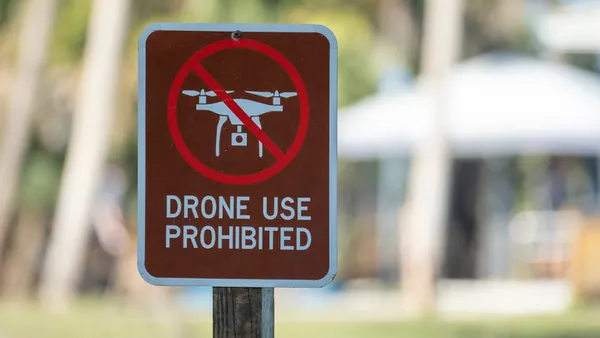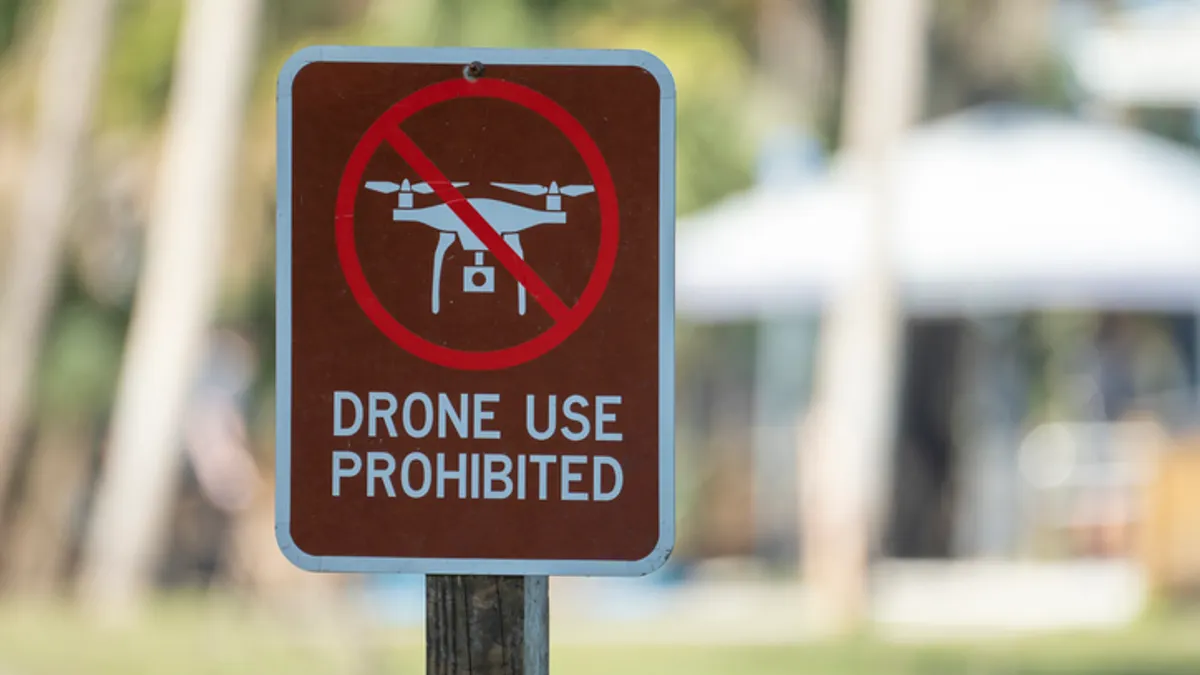
The Federal Aviation Administration has designated Disney World and other big amusement parks no-drone zones because of the high concentrations of people who visit the parks and the dangers unauthorized drones pose to them and to park attractions. With passage of the Safer Skies Act in November, parks have an additional tool to combat unauthorized drones.
The law creates a pathway for parks and other types of facilities to work with state and local law enforcement agencies to interdict drones if they enter into the facilities’ airspace. Prior to passage of the law, there was little facilities could do. The FAA treats drones as regulated aircraft, so taking them down is illegal. Only some federal law enforcement agencies could do that. Now, the law authorizes facilities to work with authorities in their area to seize or disable drones if it can be done safely.
As with other types of facilities, amusement parks have operational reasons to allow authorized drones over their airspace, typically to help with maintenance and repair. But parks also want to use them for light shows and other attractions.
To learn more about how amusement parks are balancing the two sides, Facilities Dive interviewed Keith Stephenson, director of public affairs for North America at the International Association of Amusement Parks and Attractions, over email.
The following Q&A has been edited for clarity and length.
FACILITIES DIVE: How do unauthorized drones pose safety and security risks at amusement parks?
KEITH STEPHENSON: Fixed-site amusement parks are dense, open-air environments where moving mechanical rides, pyrotechnics and aerial entertainment elements operate in close proximity to large crowds — approximately 880 million visitors annually nationwide. Unauthorized drones — also called unmanned aircraft systems, or UAS — introduced into that environment create avoidable safety and security risks. A drone collision or falling device over a high-density guest area [could result in] a foreseeable and avoidable risk of injury, operational disruption and liability exposure.
Why is there no clear authority for parks to respond when drones enter restricted areas?
The FAA retains exclusive authority to regulate aircraft operations. Parks cannot independently establish no-fly zones or lawfully disable or interfere with drones.
What recent action has the federal government taken that could give amusement parks more control over unauthorized drones?
Congress reaffirmed implementation of Section 2209 in the FAA Reauthorization Act of 2024, directing the FAA to establish a petition process for designated facilities — including amusement parks — to seek UAS flight restrictions. In parallel, recent counter-UAS legislation — specifically, the Safer Skies Act — strengthens detection and mitigation authorities and improves coordination with state and local law enforcement. Section 2209 defines where drones may be restricted; the Safer Skies Act and related counter-UAS statutes define who may act [when there are incursions into those areas].
How are amusement parks balancing innovation with public safety?
Parks support authorized, park-operated drone activity, including FAA-compliant drone shows, inspections and media operations conducted pursuant to federal approval. We have proposed that Section 2209 [preserve] authorized, park-operated unmanned aircraft operations within designated areas. The objective is not to ban drones outright, but to deter unauthorized incursions while maintaining compliant, safety-managed innovation overseen by the parks themselves.
Who leads this issue within an amusement park?
Drone-related risk is typically led by safety and security leadership due to its intersection with threat assessment and law enforcement coordination. However, it is a cross-functional enterprise risk issue involving facilities, operations, legal, and risk management functions.
What has IAAPA done to strengthen protections?
IAAPA and its members have engaged at both the legislative and regulatory levels. With Congress, we supported inclusion and reaffirmation of fixed-site amusement parks under Section 2209 and advocated for expanded counter-UAS clarity through the Safer Skies Act framework. With the FAA, we have provided recommendations on eligibility definitions, risk-based standards, geographic boundaries, buffer considerations, and preservation of authorized park-operated drone activity. The effort is centered on developing a framework that respects federal aviation authority while addressing the security realities parks face on the ground.