Dive Brief:
- A new approach to data center cooling is more efficient than traditional air-cooling solutions and could improve on newer direct-to-chip liquid cooling approaches, according to a study from the University of California-Los Angeles using a solution from liquid-cooling company Ferveret.
- The study of adaptive phase cooling shows a 15% improvement in computational efficiency, measured in teraflops per kilowatt, over direct-to-chip liquid cooling. Across an entire data center, the solution offers a power usage effectiveness ratio of 1.03, meaning about 97% of the facility’s power consumption goes toward computing.
- “It is critical that we improve the environmental footprint of data centers,” Reza Azizian, Ferveret’s CEO, said in a statement. “Our adaptive phase cooling solution eliminates the need for water while dramatically improving computational efficiency, allowing customers to extract more compute from the same power envelope.”
Dive Insight:
A UCLA scientist involved in the study said the results show that in addition to improving the energy efficiency of high-performance cooling systems, adaptive phase cooling may offer more direct benefits for AI training teams.
“Our recent study shows that Ferveret cooling reduces the time required to train machine learning algorithms by enabling hardware to operate at higher sustained clock speeds,” Omid Abari, an associate professor in UCLA’s computer science department, said in a statement. “In other words, Ferveret not only provides a more efficient thermal solution but also delivers better performance.”
The UCLA Intelligent Connectivity Laboratory conducted the study in partnership with Ferveret using NVIDIA H200 graphics processing units, Ferveret said Wednesday.
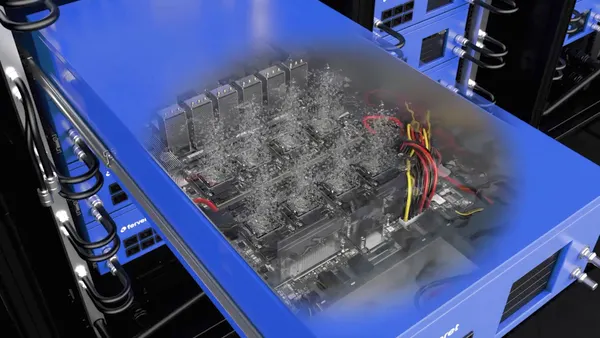
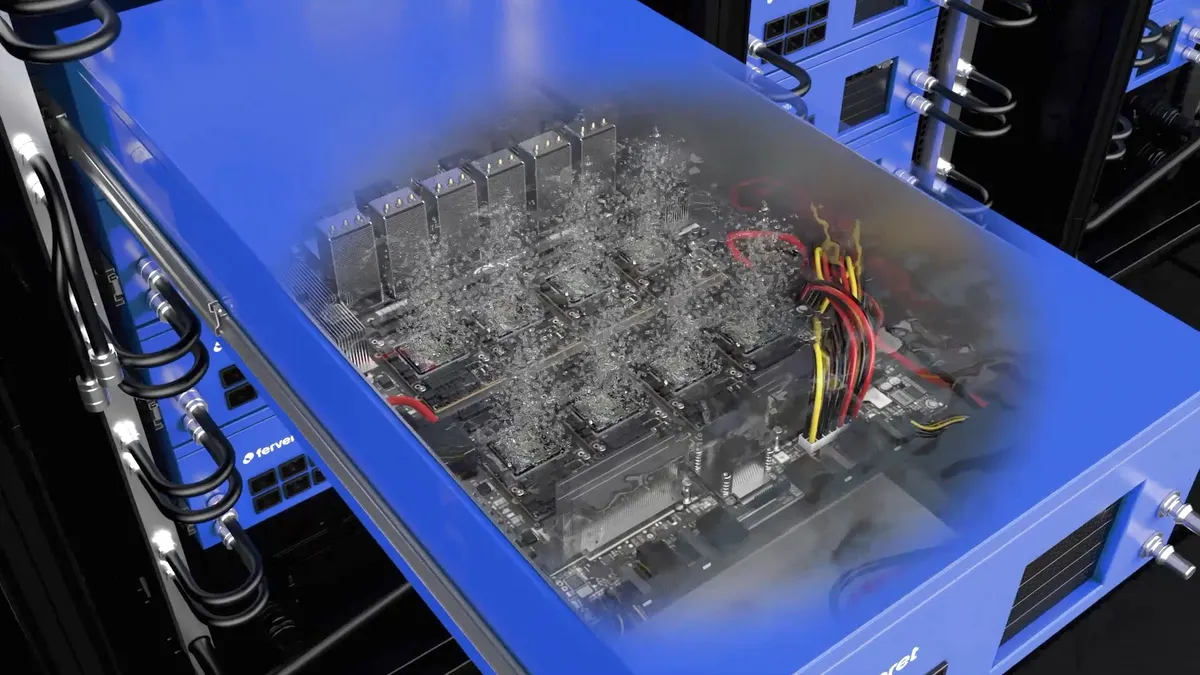
Typical two-phase cooling systems use a process called “saturated boiling” to evaporate liquid refrigerant as it collects heat from chips, Ferveret says. This produces relatively large bubbles that collect in a “plenum” before eventually recondensing into liquid for another pass through the system.
Ferveret’s technology instead relies on “subcooled boiling,” a process used in some nuclear reactors, to produce smaller bubbles that condense faster and thus reject heat more efficiently.
“The result is lower operating temperatures and the ability for chips to run reliably at higher power,” the company says.
Though electricity represents a relatively small share of large data centers’ combined capital and operating costs, power availability is among the top constraints on rapid deployment of computing capacity in top data center markets like Virginia and Pennsylvania. Facilities that can use power more efficiently or flexibly can reduce years-long wait times for permission to interconnect to the grid and avoid expensive investments in onsite power.
Feveret’s solution — and competing “waterless” options — has implications for another constraint on data center development. Like data centers running other single- and two-phase cooling systems that use non-water refrigerants, those using Ferveret’s solution have less impact on groundwater or municipal water resources in the communities where they operate.
Such data centers may still use closed-loop water piping and conventional chillers to reject heat collected by server cooling equipment, but those systems consume orders of magnitude less water than evaporative cooling systems.
The latest data center designs use more water-efficient equipment or shun evaporative cooling altogether amid growing pushback from environmental advocates and residents of host communities. Last year, Amazon said it would use recycled water at more than 120 of its data centers by 2030, its self-imposed deadline to become “water-positive.”