Researchers have long assumed ancient engineers used a slaked lime-and-ash solution to manufacture the concrete that continues to stand in Rome, some 2,000 years later. But findings from a newly discovered work area, preserved under layers of ash, appear to confirm a theory introduced three years ago by MIT researchers that the slaked-lime concrete was likely used for decorative elements and other purposes, while for load-bearing walls, the ancient engineers used a heated quicklime-and-ash solution. The quicklime solution left ungainly white blocks in the concrete that historians assumed were imperfections. But these blocks, called clasts, are deposits that stay active and, under certain conditions, release a paste that fills cracks before they threaten the integrity of the concrete.
“This calcium-rich solution reacts with [volcanic ash] to form … various polymorphs of calcium carbonate within cracks and pores during natural wetting and drying cycles, effectively functioning as a crack-filling mechanism,” Massachusetts Institute of Technology researchers said in a Nature Communications paper released this week.
The findings might provide a scientific basis for developing more durable concrete, researchers say. Today, the typical lifespan of concrete is less than 100 years.
Ancient ruins
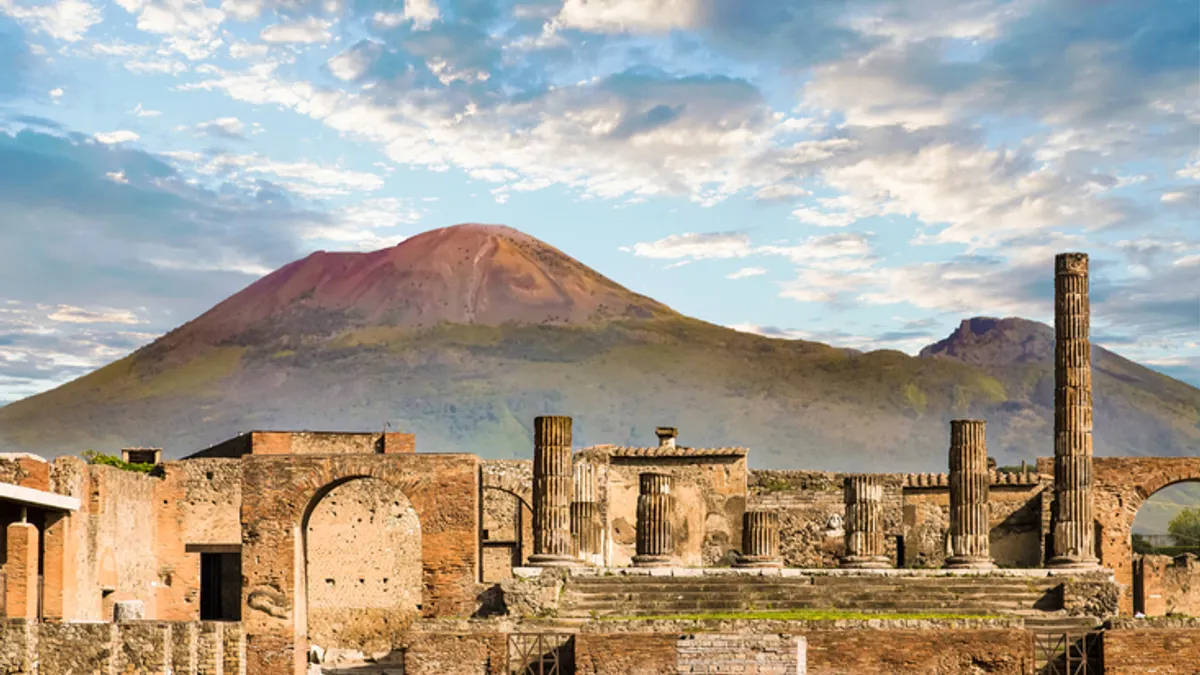
Rome is filled with structures dating back to the time of Pompeii, which was buried in A.D. 79 when Mount Vesuvius erupted in what historians generally consider the most famous volcanic eruption of all time. The favored view of researchers trying to piece together the concrete manufacturing technique of the ancient Roman engineers was that they mixed calcium hydroxide, known as slaked lime, with water at room temperature before adding it to volcanic ash and other aggregates.
The slaked lime thesis comes in part from researchers’ interpretation of a book called De Architectura, published around 25 B.C. by a historian known as Vitruvius, who described the production of slaked lime. But after combining findings from the recent excavation of the work site with other research, MIT researchers say they’re revising their understanding of what the engineers were doing.
“Alternative or complementary methods may have been in use in 79 CE, highlighting a knowledge gap in our understanding of Roman construction techniques,” the study stated.
Based in part on the Vitruvius text, researchers believed engineers created slaked lime by mixing burned lime – quicklime – with water to cool it to room temperature before mixing it with ash and other aggregate to create the concrete mixture. “This interpretation seemed sensible,” a summary of the study in Study Finds says. “Slaked lime is easier to work with and doesn’t generate the violent heat reaction that quicklime produces when it contacts water.”
Forgotten knowledge
After analyzing materials from the buried work area, researchers found what they believe are supplies of quicklime already mixed with aggregate waiting to be combined with water, which would produce what the researchers call a hot mixing process because of the intense heat the quicklime generates when it reacts to water.
This “exothermic reaction … significantly increased the temperature of the mortar mixture, sometimes exceeding 200 °C in localized ‘hot spots,’” the researchers said.
A byproduct of the hot mixing process is the large white deposits – the clasts – that historians generally dismissed as “signs of poor mixing or inferior materials,” according to the StudyFinds summary.
But the discoveries from the excavation site change this view.
“The preservation of [these] white lime inclusions … in the mortar matrix … have been linked to the durability and self-healing properties of Roman concrete,” the paper says. “These undissolved clasts retain a reactive calcium-rich core, that when exposed to water serve as a mobile calcium source that slowly dissolves into the crack and pore network within the matrix.”
The slaked lime-and-ash mixture, which was commonly used throughout the period, was probably used in structures that didn’t require long-term strength “such as in decorative work or flooring,” the paper says.
The research was led by MIT Associate Professor Admir Masic and included researchers from MIT and the University of Sannio and other institutions in Italy.