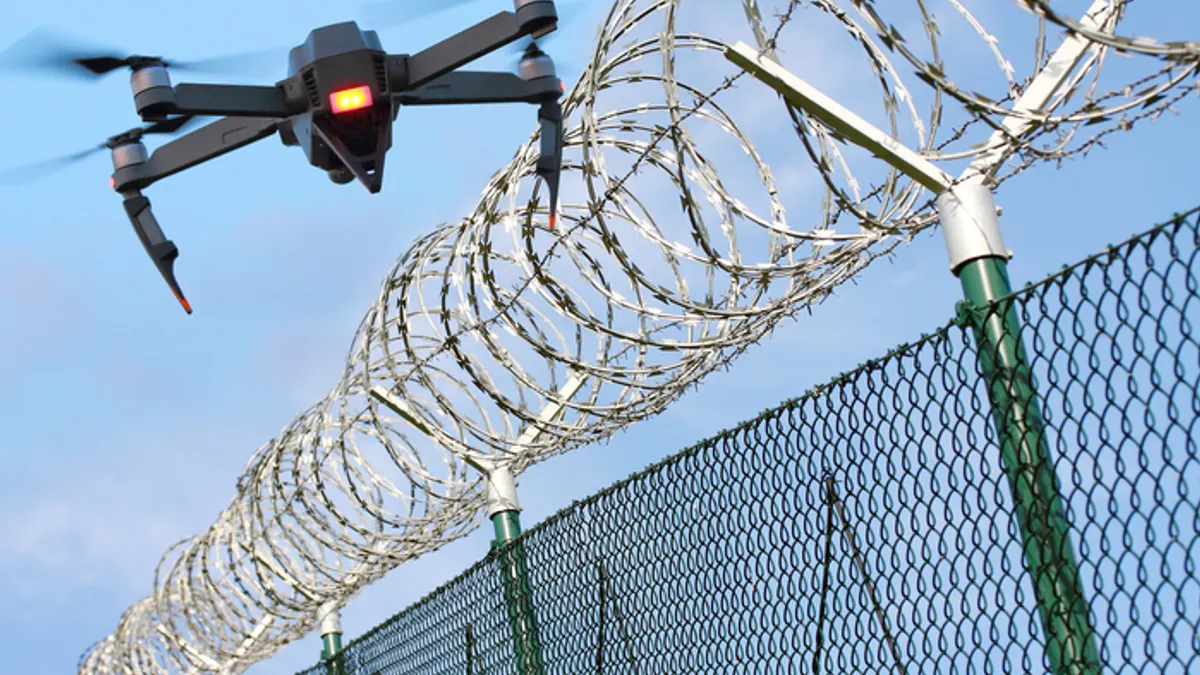
Prisons have fences around their perimeter to keep inmates from escaping but these structures have been unsuccessful at stopping outside collaborators from using drones to drop drugs, phones, tools and other contraband inside the fences for prisoners to use.
“We fight this battle every day,” Joel Anderson, director of the South Carolina Department of Corrections, told WIS News 10 in a Jan. 21 report.
Over the last decade, contraband drops have become a problem for facilities, in the United States as well as Canada, the U.K., and other countries, reports show.
A phone scam targeting healthcare workers in Iowa that netted $500,000 in illegal proceeds, for example, originated from a prison in Georgia by inmates who were running a call center using phones delivered to them through drone drops, ABC News reported.
“A person inside of the Calhoun State Prison in Georgia … was running the show," Joseph Vogel, an Iowa private detective who investigated the calls, said in the report.
Department of Justice and FBI officials in testimony last year said there were 479 drone incidents at federal prisons in 2024, up from 23 in 2018.
Consolidated data on state prison incursions isn’t available, but in South Carolina, there were 254 reported drone drops last year, say prison officials in the state. They think that number could be higher.
“It could be well over 300, 350,” Anderson said in a Corrections 1 report. “We don’t see [those flights] in the middle of the night that never make it in.”
In Georgia, officials reported more than 70 incidents in November, the highest one-month tally they’ve seen, the ABC News report said.
"We're under attack every single day when it comes to combating this issue," said Tyrone Oliver, commissioner for the Georgia Department of Corrections.
From a legal standpoint, prison facilities are limited in what they can do, in part because of Federal Aviation Administration rules prohibiting drones from being shot down because of their classification as registered aircraft.
Even if prisons could shoot them down, a Rand study says, officials would be inviting legal liability because of the danger a disabled drone would pose to surrounding areas. “Legal limitations notwithstanding, there are significant questions about the practicality, safety, and effectiveness of [shooting down drones],” it said.
The FAA cites safety issues as one of the reasons it hasn’t carved out a shoot-down exception for drones. “An unmanned aircraft hit by gunfire could crash, causing damage to persons or property on the ground, or it could collide with other objects in the air,” the agency says.
The drugs that these drones typically carry could also be a problem. Prison officials in South Carolina said they apprehended a drone that contained enough fentanyl to kill everyone in the prison. “Four hundred and sixty-four grams of fentanyl in one bag with one drone," Anderson told Fox News. "We would hate to disable a drone, and it flies off into a subdivision somewhere, and then we don't know where it is."
The FAA is aware of the risk of drones over prisons and released an update when the problem was emerging, about eight years ago, to restrict flights over some of the federal government’s prisons, but it has yet to add prisons as a class to its list of facilities over which it prohibits the flying of drones.
States are filling the regulatory breach within the authority they have, but because they must work within FAA restrictions, the laws tend to focus on stepped-up penalties, not on how drones can be apprehended. Maryland, for example, enacted a 2024 law imposing a $1,000 fine and a 3-year sentence on anyone caught flying a drone over a prison, while a 2019 Delaware law makes it a felony to fly a drone over a prison.
Tracking and apprehension
The best practice for prison facilities dealing with drones is to deploy technology to track them and when one lands within the premises, to apprehend it.
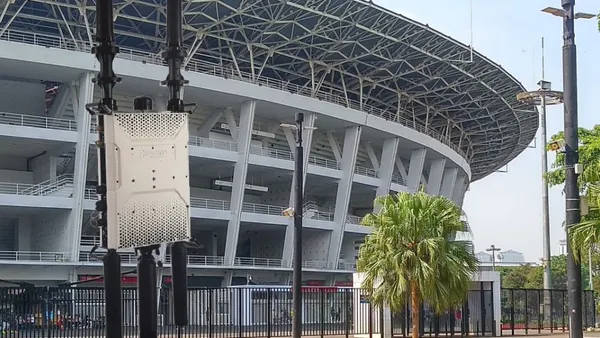
South Carolina officials are doing that using a detection system for its medium and maximum security prisons. The system sends an alert so the prison can activate a pre-selected team of facility staff to go to the area to recover the drop — and sometimes the drone.
"We've had drones caught in our nets,” Anderson said in the Fox News report. “We've had drones caught in our fences. We've had drones crash on the yard. We've had drones where the battery ran out."
The FAA permits drone tracking in part to regulate their use over restricted areas, like airports, but a 2020 advisory prepared by the FAA and other federal agencies says only federal authorities can jam or otherwise interfere with drone operations. That means prison officials are generally limited to dealing with the drop, not the drone itself, unless one crashes or is otherwise recoverable.
“Correctional institutions must assume a detect-and-respond posture,” the Rand report says.
It’s valuable for prison officials to track the drone even if they can’t apprehend it because they can obtain the identity of the owner, manufacturer, model and other data that can be useful for spotting patterns and handed over to law enforcement, says a white paper prepared by Dedrone, a security technology company.
“Security personnel can use flight data to determine if a single drone has visited the area multiple times or if there are multiple, individual intruders, and record if there are certain days or times where there are an increase in incidents,” the paper says. “This data is invaluable when looking to identify and prosecute pilots who violate laws.”
Tracking technology that homes in on the radio signals that all drones release is widely available and is indispensable for prison facilities trying to combat the problem, the Rand paper says.
“Most institutions rely on human observation for detection, but this is problematic,” the paper says. “Many agencies are experiencing significant staff shortages and perimeter patrols and tower posts might not operate at full capacity, particularly during overnight hours, when most drone activity is likely to occur Furthermore, at a distance, drones can be virtually invisible to the naked eye or mistaken for a bird or another object and the sound of a drone can be easily misinterpreted.”
“Recorded cases of drones being used for contraband have been exponentially increasing,” says a post by Airsight, a drone detection company. The company touted its technology as the kind of thing prison facilities can put in place to give themselves some defense against incursions even if they can’t stop the drops. “Early Detection … provides immediate alerts when unauthorized drones breach the perimeter, allowing prison staff to take swift action,” it says.
Given the safety issues of interfering with drones, the FAA is unlikely to allow facilities to take more action, so detection appears to be prisons’ go-to defense for now.