A carbon nanofilter designed to be slotted into a ventilation system like a HEPA filter can remove almost all of the carbon dioxide in a building, helping to reduce emissions and save building operators money by enabling HVAC systems to work more efficiently, a study published in Science Advances says.
“Every building already has ventilation systems that move large volumes of air,” said Ronghui Wu, an assistant professor at Nanyang Technological University in Singapore who led the research while at the University of Chicago from 2022 to earlier this year. “By integrating our carbon-capture filters into these systems, we can remove carbon directly from the air without building new plants or using extra land. It’s a practical and scalable way to make carbon capture part of everyday infrastructure.” Wu made her remarks in a University of Chicago summary of the research.
Thinking big picture, Wu said, if all buildings globally used filters like these, 596 megatonnes of emissions would be reduced each year, equivalent to taking 130 million cars off the roads.
“By taking advantage of billions of ventilation systems in the world, [the] technology can shift the paradigm and strengthen the present joint force to confront climate change,” Wu and the other researchers said in the paper.
The researchers made the distributed carbon nanofiber direct air capture filters out of a polyethylenimine material. In their experiment, they generated 92.1% efficiency in CO2 removal, enough to offset whatever CO2 would be created in the commercial manufacturing and distribution process.
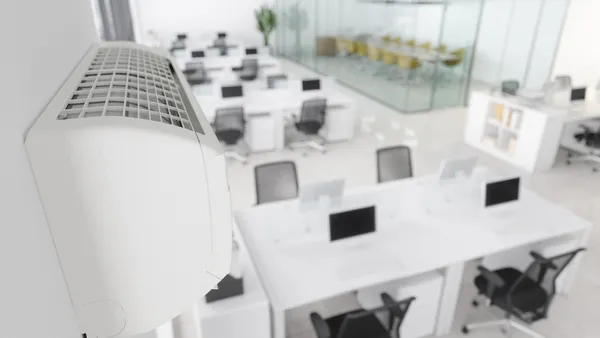
The filters would be used in the same way as high-efficiency particulate air, or HEPA, filters. Building operators would slot them into existing HVAC systems and replace them as they get saturated. The used filters can be cleaned and put back into service.
You can “ship the saturated one to a centralized facility to dissolve the CO2 or make it into highly concentrated CO2 to capture or, even better, convert to high-value chemicals or fuel,” Wu said.
The researchers said the polyethylenimine material has high solar absorptivity, which means filters can be cleaned by thermal solar methods – essentially leaving them out in the sun.
“Solar thermal regeneration holds great potential since it allows the direct conversion from solar radiation to the thermal energy of the adsorbents, without requirements for additional materials or energy resources,” the researchers said in the paper.
On the operations side, the filters would be expected to lower energy costs. As the CO2 levels go down, the amount of outside air the HVAC system would have to pull in goes down, reducing how much the system has to run.
“Less air needs to be heated or cooled, which reduces the energy consumption,” Wu said.
Ventilation specialists reacting to this article say it’s misleading to connect a reduction in indoor CO2 levels to a reduced need to run an HVAC system.
“Absorbing CO2 in any normal building does nothing to improve IAQ and cannot be used to lower ventilation rates, let alone save HVAC energy,” Max Sherman, chairman of the Environmental Health Committee of the American Society of Heating, Refrigerating, and Air-Conditioning Engineers, said in an email. “This technology would [not] be useful in lowering ventilation rates or improving Indoor Air Quality.”
“Removing CO2 from indoor air will not reduce the outdoor air supply rate required,” David Wyon, a consultant for the International Centre for Indoor Environment and Energy at the Technical University of Denmark, said in an email. “CO2 is an indicator of the presence of bioeffluents, not a pollutant that matters in itself at the concentrations that occur indoors. Current outdoor air supply rates are set to reduce the concentration of the thousands of other bioeffluents exhaled and emitted by occupants, and the concentration of emissions from building materials and furnishings, to levels that have no measurable negative effects on occupants.”
The paper doesn’t look at what it would take to commercialize the filters for widespread use.
Editor’s note: This piece has been updated to include comments from ventilation specialists.