Flush with billions of dollars in appropriations as part of the Trump administration’s goal of deporting up to 1 million people a year, Immigration and Customs Enforcement is planning to buy dozens of warehouses around the country and convert them into a network of facilities that will temporarily house detainees while they undergo processing for deportation.
“U.S. Immigration and Customs Enforcement aims to speed up deportations by establishing a deliberate feeder system,” the Washington Post reported at the end of last year.
By some accounts, the feeder system is expected to consist of more than a dozen facilities holding roughly 500 to 1,500 people each for short periods of time before detainees are moved to about half a dozen larger facilities, housing between 5,000 to 10,000 people each, according to the Washington Post story and other news outlets.
To date, ICE has closed on several warehouses, including a 518,000-square-foot warehouse in Berks County, Pennsylvania, for $87.4 million; a 400,000-square-foot facility in Surprise, Arizona, for $70 million; a 1.3-million-square-foot former Big Lots warehouse in Schuylkill County, Pennsylvania, for $119.5 million; and an 825,000-square-foot warehouse in Hagerstown, Maryland, for $102.4 million.
Facilities specialists who help ICE convert warehouses to detention centers or manage them afterward will likely face a rough road navigating zoning ordinances, renovating them to create detention facilities and keeping the facilities safe and orderly, reporting shows.
Warehouses are Plan B
Relying on warehouses was not the administration’s first choice but is a Plan B, according to a Bloomberg report.
Shortly after the Trump administration took office last year, it worked with private prison companies — including Geo Group and CoreCivic — to ramp up ICE’s ability to hold detainees.
At the time, GEO Group Executive Chairman George Zoley said his company expected “unprecedented future growth opportunities;” CoreCivic CEO Damon Hininger said he anticipated “a period of accelerated demand.”
These two companies, along with a third company that specializes in transporting detainees, shared in ICE contracts worth about $2 billion, according to The Wall Street Journal.
To house up to 100,000 people a year to meet its goal, the administration discovered it needed facilities beyond what existing providers could accommodate, Bloomberg reported. “They had to pivot and look for other ways to build more detention,” Bloomberg reporter Sophie Alexander said in a Jan. 20 podcast.
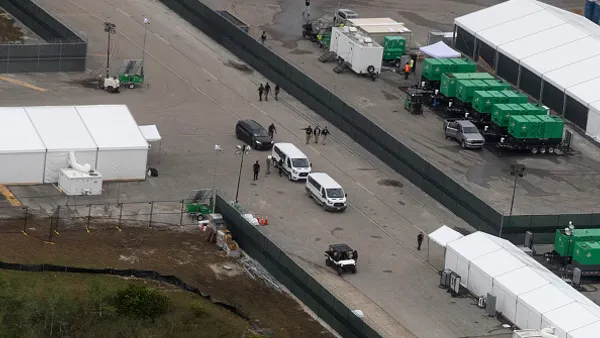
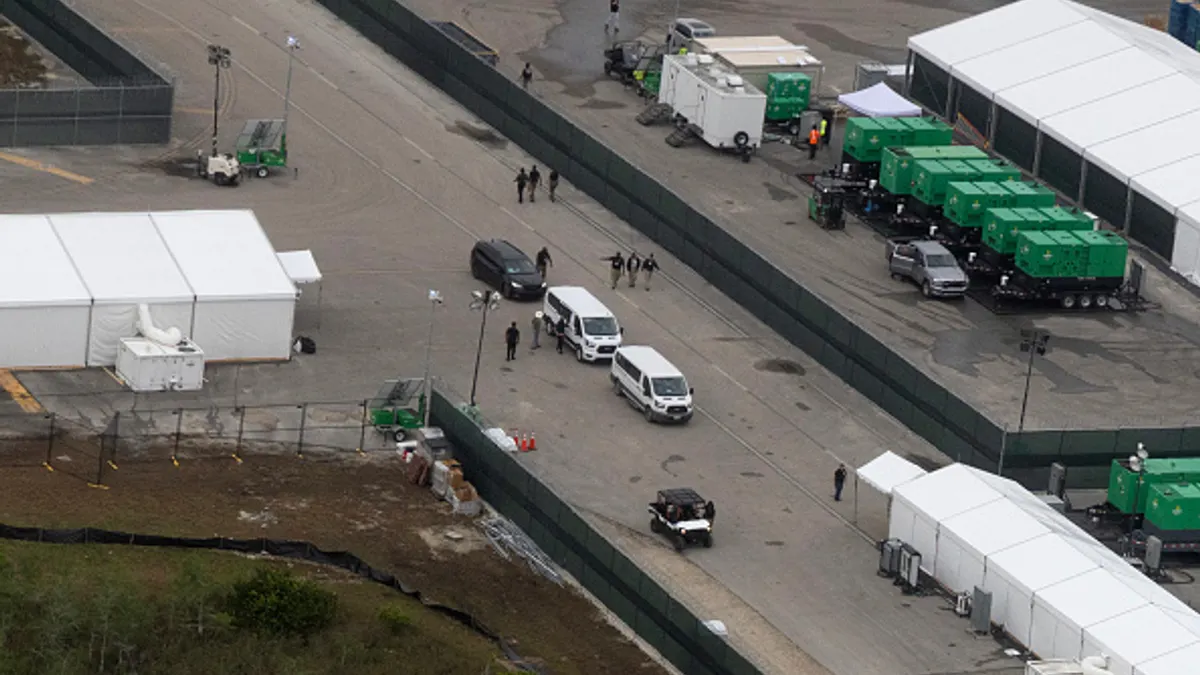
In its first pivot, ICE worked with companies to house detainees in tent cities, but it found these were harder and slower to put in service and manage than it expected, according to Alexander.
“They were tapping all these tent companies that usually build base camps for oil companies,” she said, “or they respond after natural disasters like hurricanes. [But] I think the administration is learning that this plan isn’t working out.”
Its most high-profile tent city — a facility in Florida called Alligator Alcatraz by the state’s attorney general, James Uthmeier — has been plagued by allegations of human rights violations.
“People held there say worms turn up in the food,” AP reported last July. “Toilets don’t flush, flooding floors with fecal waste, and mosquitoes and other insects are everywhere.”
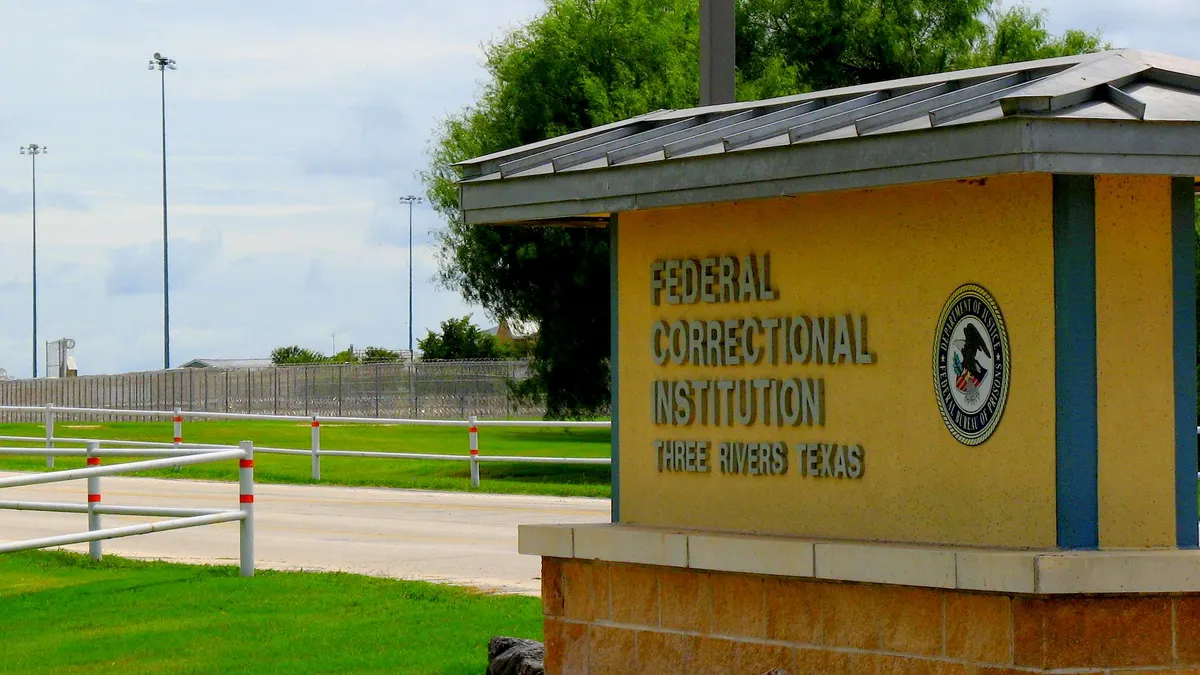
ICE’s other main tent facility, called East Montana, on the grounds of Fort Bliss in Texas, is the country’s largest detainment facility, with about 3,000 people on any given day. It’s been plagued with its own accusations of bad management, including conditions that have led to the deaths of three people, NBC News reported.
“There’s just so much urgency in this that there are questions around the safety and how much attention is being paid to things like the national immigration detention standards,” Alexander said.
ICE’s national immigration detention standards, created in 2000 and updated last year, require the agency to ensure its facilities have adequate water, ventilation, lighting and noise levels in accordance with state and local standards, among other things.
For its pivot to warehouses, ICE is using a contracting system, the Worldwide Expeditionary Multiple Award Contract, or WEXMAC, that the U.S. Navy uses for its deals, according to Bloomberg.
“Because it’s run through [the Department of Defense], there is more of a delay in what information is shared, so it’s harder to know what is happening [in] real time with the contracting process and who is winning what, when [and] who is going to be building out these facilities and where,” Alexander said.
“There’s been like a feeding frenzy — a level of excitement in these industries about the potential windfall,” Fola Akinnib of Bloomberg said on the podcast.
At least two acquisitions have fallen through, though, and more face pushback by anti-ICE activists, residents and municipal leaders.
Pushback threatens expansion plans
In Oklahoma City, the owners of a warehouse that had a sale to ICE pending pulled out after learning from the mayor the project was largely opposed by residents. “They are no longer engaged with the Department of Homeland Security about a potential acquisition or lease of this property,” Mayor David Holt posted on X Jan. 29.
At a forum the city hosted last month, residents came out strongly against it, NBC affiliate KFOR reported. “If the people hadn’t spoken out in unison, and so many emotional and eloquent voices hadn’t spoken up at the meeting … this [pullout] would not have happened,” Mark Faulk, an activist and candidate for the local county commission, told the station.
In Ashland, Virginia, a deal for a 550,000-square-foot warehouse opposed by residents fell through when the seller walked away, saying it had only recently learned the buyer was ICE. “We became aware of the ultimate owner and intended use of the building,” said Jim Pattison Developments, the Vancouver, Canada-based property owner.
The seller’s parent company, the Jim Pattison Group, owner of Save-On-Foods grocery stores and other businesses in the U.S. and Canada, had been facing the threat of boycotts in both countries because of the deal, a Connect Canada CRE report said.
In about 15 areas that ICE is looking to buy, including in the rural town of Social Circle, Georgia, residents and the municipal government are pushing back against the acquisitions, the Washington Post reports.
In Social Circle, the local government took issue with the potential impacts of the facility on infrastructure and public safety. “In addition to the lack of water and sewer capacity, there is not a site within the city that will provide a safe distance from homes, businesses and schools,” the city government said in a Facebook post.
U.S. Sen. Jon Ossoff, D-Ga., has gotten involved and is calling for ICE to end its bid. “[The plan] risks overwhelming the City's resources and more than tripling its population,” Ossoff said in a statement he released with Social Circle Mayor David Keener.
City leaders in Orlando, Florida, are fighting back as ICE tries to buy a warehouse 10 miles east of the Orlando International Airport.
County Commissioner Nicole Wilson said the site isn’t set up for waste collection; the new use of the facility would cause logistical issues and impact corporate property owners nearby; and it would complicate heavy equipment traffic in the area. “This wasn't built for human beings to be located in,” she said.
As a federal agency, ICE has authority under the supremacy clause of the U.S. Constitution to buy property, whether the state or local government wants it to or not, legal scholars say.
“When a federal official or institution is acting within the scope of their federal duties, the states just have to get out of the way,” Roderick Hills Jr., a law professor at New York University, said in a forum at Northwestern University last year. “It’s not a question of balancing the state interest against the federal interest; you’ve just got to move aside because federal law is supreme.”
Operational risk
Companies and the facilities professionals they employ can expect a rough road getting warehouses ready and then managing them, news reports suggest.
Transitioning a building built for storing and shipping material to hold people, particularly in areas with strained infrastructure, will be a challenge, Tania Wolf, an advocate with the National Immigration Project, said in the Washington Post story. The structures tend to be poorly ventilated, they lack precise temperature controls, and because they’re often located on the outskirts of town, they are unlikely to have access to the plumbing and sanitation systems needed to support thousands of people.
“It’s dehumanizing,” Wolf told the Post. “You’re treating people, for lack of a better term, like cattle.”
Staffing facilities that will be housing hundreds or thousands of people will be a particular challenge because of the standards they’re supposed to meet, Jason Houser, a former ICE chief of staff under President Joe Biden, told the Washington Post. Prospective workers will need medical or other specialized training and will have to pass federal security clearances. “We can always find more warehouses,” he said, but the ability to operate facilities like this safely is “always limited by staffing.”
Critics point to reports that ICE has not followed its own standards in the detention centers it’s already operating, including at its Fort Bliss facility in Texas, where inspectors last year found 60 violations. “Many of the deficiencies … stem from the hasty construction and early opening of the makeshift facility,” says a Washington Post story on the findings, which the paper says haven’t been made public.
“You can’t build things quickly and expect them to be good,” Imelda Maynard, legal director at nonprofit legal services provider Estrella del Paso, said in the article.
ICE looks like it wants to speed up rather than slow down as it tries to make progress on these facilities, based on what ICE’s acting director, Todd Lyons, said at a conference in Arizona last year. “We need to get better at treating this like a business,” he said, the Arizona Mirror reported. The deportation process should be “like (Amazon) Prime, but with human beings,” he said.
The potential upside to working on these projects is likely not enough to offset the downside, Mike Wessler, communications director of the Prison Policy Initiative, told Facilities Dive last year.
“If I were to give one piece of advice to a company looking to move into this space, it would be, don’t do it,” Wessler said. “Any company jumping into this space will … likely face public backlash that could affect other parts of their business,” he said.
The threat of a boycott of Pattison Co. businesses due to its now-scuttled plan to sell ICE its Ashford warehouse might serve as a cautionary tale. The deal created “a public-relations firestorm” for the company, Connect Canada CRE said in its coverage.
ICE didn’t immediately respond to a request for comment about its effort to meet health and safety standards at its facilities, but in a statement to the Washington Post, it said the “well-being of individuals in our custody is a top priority.”