Dive Brief:
- Two fast-growing infrastructure companies are teaming up to deploy a modular data center solution that could significantly reduce the time needed to scale up AI computing facilities.
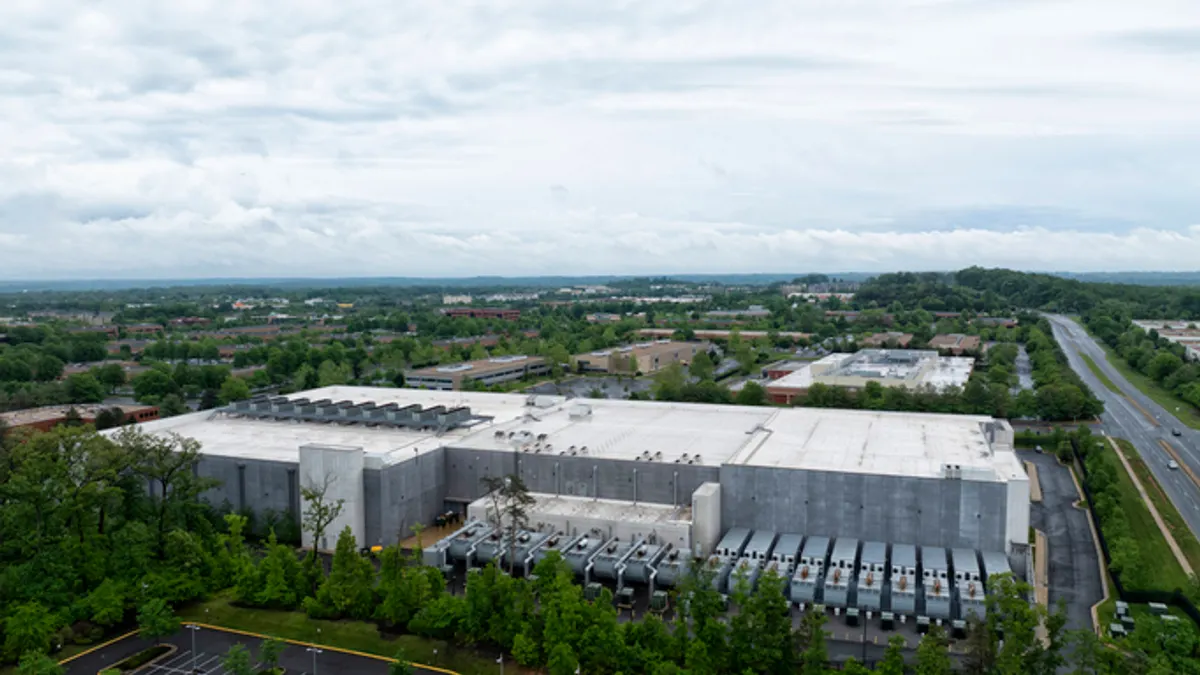
- Energy Vault, a provider of grid-scale energy storage systems, said on Feb. 11 that it had inked a strategy partnership with Crusoe, an AI infrastructure developer, to build what it hopes will be the first of many modular “powered shell” deployments at its technology center in west Texas.
- The powered shell is “designed to enable fast, repeatable deployment of the electrical and mechanical systems required for high-density compute,” and will support Crusoe’s own Spark-branded modular data center infrastructure. Each deployment can accommodate up to 25 megawatts of total electric load, Energy Vault said.
Dive Insight:
Energy Vault says its solution will help companies like Crusoe power up computing infrastructure more quickly, potentially giving them an edge in the race to commercialize AI tools.
“We are seeing that power infrastructure is increasingly the gating factor for bringing new AI capacity online,” Marco Terruzin, Energy Vault’s chief revenue officer, said in an email.
Cully Cavness, cofounder, president and chief strategy officer at Crusoe, said in a statement that his company’s partnership with Energy Vault would strengthen its position as a provider of cutting-edge solutions for both developers and end users of AI tools.
“This project demonstrates the potential for modular AI factories across applications such as distributed low-latency inference, on-premise deployments, grouped training clusters, data-sovereignty deployments and many more potential use cases,” Cavness said.
Crusoe began life as an IT infrastructure company that used “flare gas” — planet-warming methane produced as a byproduct of oil production that would otherwise be vented or burned off into the atmosphere — to power Bitcoin mines sited near the oilfields. It has since diversified to become a more generalized provider of modular, high-capacity computing facilities and associated infrastructure, including Oracle’s flagship Stargate campus near Energy Vault’s Texas technology center.
Energy Vault’s first energy storage product was a novel gravity-based storage system that cycled weights through a heavy-duty mechanical system that resembled a mid-rise building under construction. While it continues to work on that technology — pursuing the first grid-scale deployment at the same Texas facility that will host the modular data center demonstration — it has in recent years turned its focus to more conventional lithium-ion battery systems.
Energy Vault generally owns and operates its own energy assets through its Asset Vault platform, which it says will expand to accommodate the “powered shell” product. It expects its AI infrastructure deployments to be 10 to 20 times more profitable relative to traditional infrastructure products thanks to “contracted cash flows, standardized and repeatable modular design, and strong demand” for compute capacity that can be deployed rapidly.
“This agreement marks an important milestone for Energy Vault as we establish a commercial platform in AI infrastructure to complement our Asset Vault platform while expanding our build-own-operate strategy into a new, high-growth segment,” Energy Vault chairman and CEO Robert Piconi said in a statement.
For now, Terruzin said Energy Vault’s partnership with Crusoe is focused on his company’s Snyder technology center but that the company aims to “ramp deployments with additional sites and customers as we advance this technology offering.”
The first deployment will pair battery energy storage systems with onsite solar arrays to reduce carbon emissions and local pollution, Terruzin said. He previewed more to come.
“We look forward to sharing additional details as the partnership evolves over the coming months,” he said.