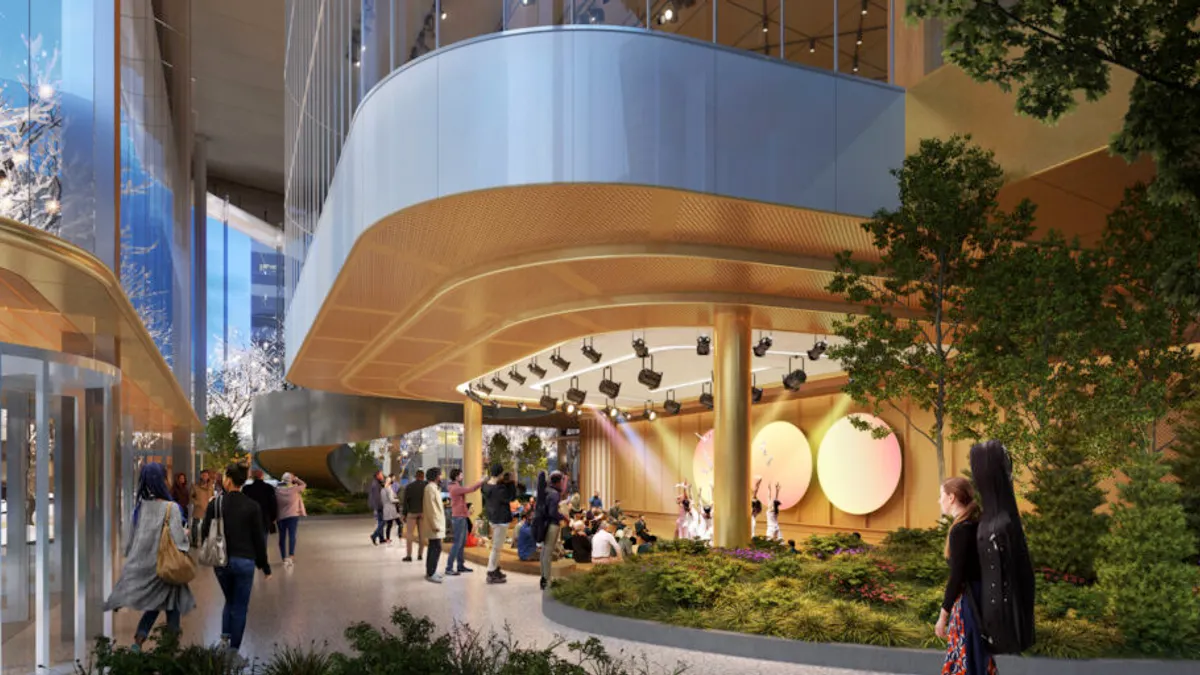
Property specialists are responding to the flight-to-quality trend in the life sciences sector by giving tenants options like those at 585 Kendall under construction in Cambridge, Massachusetts, according to Sal Zinno, senior vice president of development at BioMed Realty, which owns the property.
The 16-story, mixed-use lab and office building in the city’s Canal District also houses a performing arts center with a 400-seat theater and indoor garden that were developed with nonprofit Global Arts Live.
“A lot of our larger clients are taking [a] soft approach to getting people back in the office,” Zinno said in an interview. “What can we give them that they can’t get at home?”
Life sciences company Takeda has leased the property’s 600,000 square feet of lab and office space to create a purpose-built facility that will be home to its global research and development center. The building also has 10,000 square feet of flexible, all-season space on the ground floor, according to construction firm Suffolk, which worked on the project.
Zinno said Takeda enlarged the doors between indoor and outdoor spaces to have the two “blend and integrate more easily.”
Developments today must be designed with adaptability and resiliency at their core, according to BioMed Realty. Spaces must evolve with tenants, accommodate emerging technologies and support hybrid work, sustainability goals and rapid scaling, the firm said.
The performing arts center at 585 Kendall will complement Canal District activities including farmers’ markets, ice skating, lawn games like cornhole and a concert series, which BioMed Realty sponsors, Takeda said in a release.
“You can’t go to a 420-seat venue at home,” Zinno said. You can’t “listen to live music, go downstairs, have a drink, sit at the winter garden, watch a game or see a comedy show. That doesn’t exist at home.” The interior and exterior spaces within the 45,000-square-foot performing arts center, to be known as The Platform, have been designed with close attention to accessibility to ensure that local employees, artists and patrons feel welcome, BioMed Realty said in its announcement of the space.
After years of growth, the U.S. life sciences real estate sector has been experiencing a rough patch, with vacancy rates reaching a new high of nearly 24% in the second quarter of 2025, leading to a softening in asking rents and concessions, according to a report by Cushman & Wakefield.
Even with the softening, life sciences rents “still command a premium over office rents,” said C&W, because of the occupants’ specialized needs. It noted that life sciences rents were 31% higher than office rents in the 12 U.S. markets it tracks. The premium is even more pronounced in Boston (75% higher) and San Diego (70% higher).
With location increasingly impacting occupier real estate decisions, Zinno touts the location of 585 Kendall relative to transit. “We’re a stone’s throw away from the Red Line [subway station]. … People want to basically walk out of the front door and want to walk to the parking garage or walk to the [subway]. They don’t want to walk 10 minutes,” he said.
In addition to planning for occupant-focused amenities, BioMed Realty and Takeda are partnering to achieve key sustainability goals in the building’s development and operation, including LEED Gold certification or higher and healthy building certifications. To help meet those goals, the building will operate on 100% renewable electricity and offer enhanced ventilation strategies and biophilic design principles that will improve occupant wellbeing, comfort and productivity, Takeda said.