Dive Brief:
- Access control startup Alcatraz received $50 million in series B funding for its AI-powered physical access control system that uses facial authentication to control employee access without retaining personal biometric data, the company said in a release Wednesday.
- "Our technology is AI-powered and completely anonymized,” Alcatraz CEO Tina D'Agostin said in a statement. Instead of identifying a person based on stored photos and personal data, the system converts faces into mathematical representations that can be verified by the access control system, D’Agostin said.
- With the biometric system, employees can enter the workplace without having to swipe a badge or pin, which can be lost or stolen. “For the workplace of today, badges and passcodes inherently invite too much risk," the company says.
Dive Insight:
Most major biometric security systems are built on facial biometric technology that ties an employee’s personal identity to their face and stores that data, according to Alcatraz. That stored data is a high-value target that attracts breaches, the company says.
Alcatraz’s access control and identity authentication solution — The Rock — confirms people’s identities without storing photos or accessing non-facial personal data, the company said. Employees enroll voluntarily and can delete their data at any time, it said.
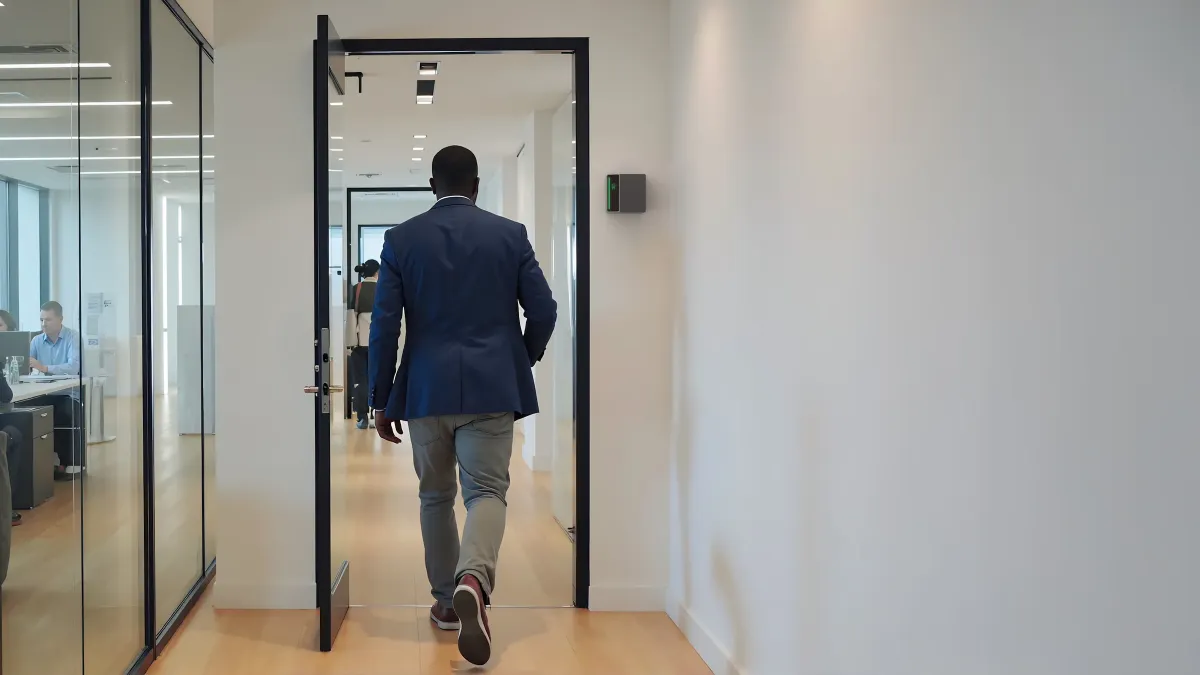
Tailgating — an unauthorized person entering a facility behind an authorized person — is a problem that the technology can help protect against, D’Agostin said.
“Tailgating … is the No. 1 cause of a security breach,” D'Agostin told Facilities Dive in an interview. “It’s never something really elaborate. It’s a courteous human being holding the door open for someone who is unauthorized that goes in to be a bad actor, and all the other technologies do not prevent that.”
Even if a facility has access-control technology, most of the time it’s useless if someone holds a door open for another person, she said. This system detects tailgating and provides a video stream — separate from the access control transaction — to identify that tailgater, she said. This keeps employees' identities protected while also reducing the need for multiple solutions from different vendors, she said.
Physical security professionals are looking more at AI tools, with AI now ranking alongside access control and video surveillance as a priority for 2026, according to a State of Physical Security 2026 report by Genetec, which surveyed 7,000 physical security professionals.
The platform is designed to meet the requirements of major data privacy laws — the EU’s General Data Protection Regulation, the California Consumer Privacy Act and the Illinois Biometric Information Privacy Act, among others — out of the box, according to the company. The technology was also certified by Safe Skies, an organization funded by the Federal Aviation Administration, as reliable and secure for use in high-security airport environments, the company said.
In addition to airports, Alcatraz says, its customers include data centers, energy companies, NFL teams, universities and Fortune 100 companies.With the funding, the company plans to accelerate product development, expand into international markets and grow its team, it said in the release.
Company founder Vince Gaydarzhiev previously worked as an engineer at Apple and helped design that company’s Face ID technology, according to his LinkedIn profile. The Rock was built on a similar foundation, with privacy included as a core feature, he said in a statement.