
Energy efficiency conversations in commercial facilities tend to gravitate toward the big-ticket items: HVAC upgrades, LED retrofits, building automation systems. These investments matter. But there's a persistent, measurable source of energy loss hiding in plain sight. Plus, it's one that facilities teams can address without a capital project.
It's the door opening.
Space heating alone accounts for roughly 32% of energy use across all U.S. commercial buildings, according to the U.S. Energy Information Administration. A meaningful share of that load is being driven by gaps and failures in the building envelope. Research from Oak Ridge National Laboratory found that among all components of the commercial building envelope, air infiltration accounts for higher energy losses than any other single element. You can have a well-designed system and still be losing significant energy through a door that doesn't seal properly. In other words, every other upgrade you make raises the stakes on getting your door openings right.
Where the Loss Is Happening
For facilities managers, the challenge is that air leakage isn't dramatic. It shows up gradually in utility bills that creep upward, in HVAC systems that run longer cycles and in occupant complaints about drafts or uneven temperatures in certain areas of the building.
When conditioned air escapes through gaps and cracks, the increased workload on HVAC equipment doesn't just consume more energy. It accelerates wear and tear, raises maintenance costs and can shorten the lifespan of the system. For facilities teams managing aging infrastructure on constrained budgets, that cascade of consequences matters. A poorly sealed door isn't just a comfort issue; it's a maintenance multiplier.
Starting at the Door
Addressing energy loss at the door opening doesn't require a full renovation. It requires the right hardware, properly specified and installed.
Pemko, part of the ASSA ABLOY group and a manufacturer of architectural door accessories since 1952, offers a portfolio built specifically for this problem. Their product line spans the entire opening, each designed to address a specific point of air, water, smoke or sound infiltration around the door assembly. For facilities teams, several categories stand out:
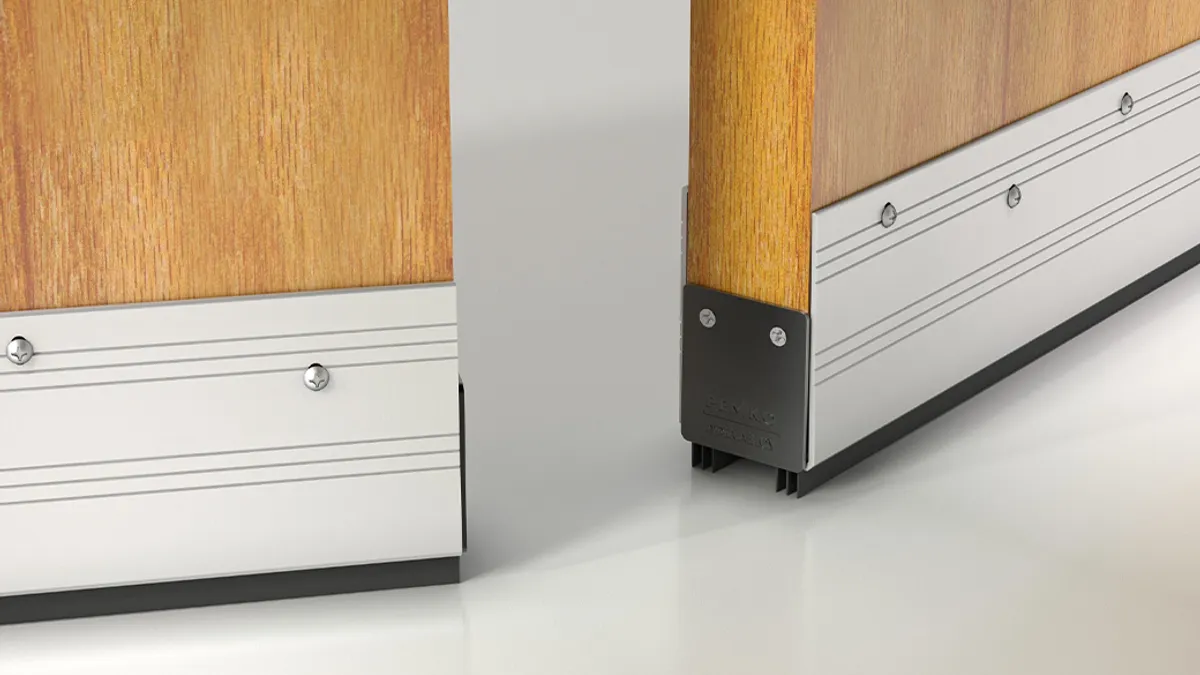
- Automatic door bottoms and door sweeps seal against the threshold, providing insulation the moment a door closes.
- Perimeter gasketing creates a comprehensive seal around the jambs and header of the door, blocking air, moisture, smoke, and sound infiltration.
- Astragals install between two doors, providing simple, seal with adhesive or surface-mounted hardware.
- Commercial thresholds close the gap at the floor. A common and often overlooked failure point, especially in high-traffic entries where door bottoms wear unevenly over time.
Pemko's product line includes options that are sound-tested, smoke-labeled, fire-rated, skid-resistant and ADA-compliant, making them suitable for facilities that need to balance energy performance with life-safety and accessibility requirements — a standard reality in institutional and commercial settings.
Making the Case Internally
For facilities directors who need to justify expenditures to ownership or finance, door sealing hardware is a rare combination: low capital, fast installation, no disruption to building operations and measurable ROI. A simple walk-through is often all it takes to identify the problem. Run your hand along the bottom and sides of exterior doors when the HVAC is running. If you feel air movement, you have a leak worth addressing. In a building with dozens of entry points, that test can reveal losses that add up fast.
The tools exist. The products are proven. And the data is there to back up the investment. For facilities teams looking to move the needle on energy costs without waiting on a capital budget cycle, the door opening is the right place to start.
For product specifications, explore Pemko's energy efficiency solutions.