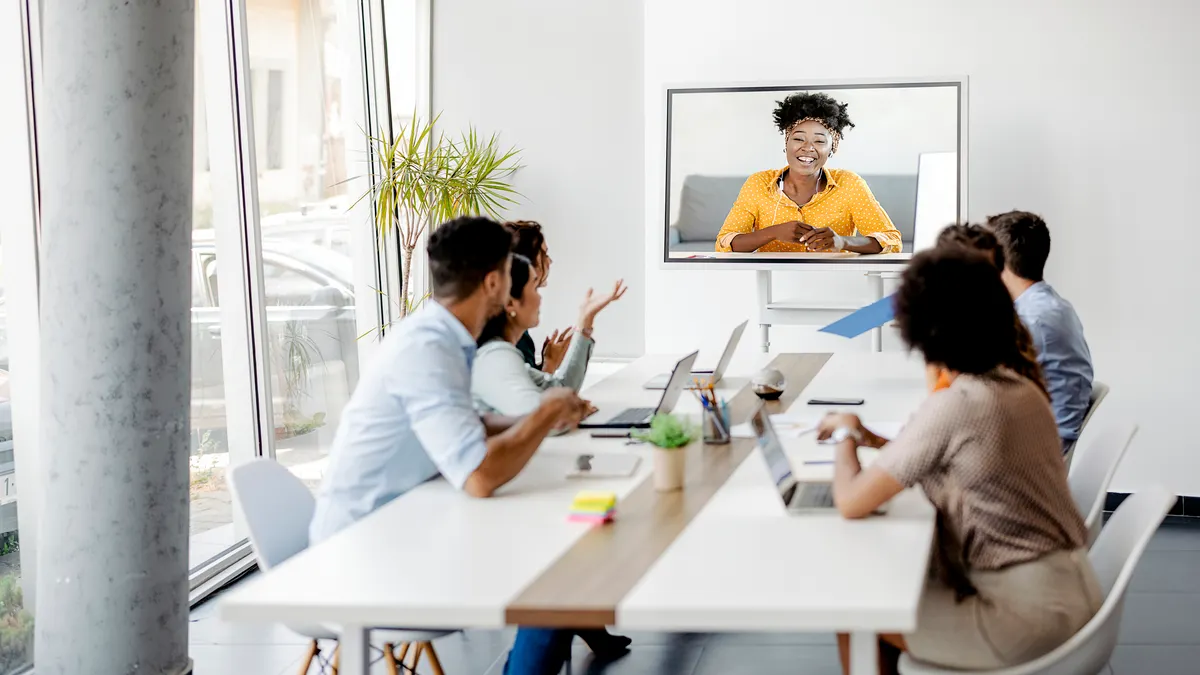
The digital work experience is becoming as important as the physical experience, driving organizations to rethink how they design and manage their workplaces, CBRE says in a report released Dec. 18.
“Workplaces that thrive enable flexibility,” says the report, published in partnership with Technology Architecture Design. “Most organizations view the workplace as the physical embodiment of their culture and a tool for employee engagement. [Organizations that know] how technology is going to integrate and reflect those priorities in the workplace will have … the greatest return on their investments.”
The trends the two companies have identified all relate to how technology integrates with physical space:
- Brand as digital experience
- Executive space that’s agile and strategic
- High-resolution displays that boost collaboration
- Workplace as curated experience
- Building data as intelligence
- AI as infrastructure
- Matching the simplicity of consumer technology at work
- Designing meeting space for equity
- Treating space as adaptive infrastructure
- Making sustainability standard
The firms break down each trend based on business impact, technology maturity and how use is trending in the workplace. For example, brand as digital experience — where organizations use technology for brand expression with high-impact displays, interactive installations and immersive environments — has high impact and maturity, but is trending down.
“The challenge is balancing bold brand statements with consistency across locations and the ability to evolve over time,” the report says.
To implement brand as digital experience, the report says, building operators can consider an immersive arrival experience with an interactive digital wall that displays recent press releases, on-site events for the week and wayfinding guidance.
Another trend is the change in executive spaces from traditional boardrooms to agile and strategic spaces, which means the space needs to be efficient and intuitive while advancing decision-making. This goal translates into circular and multi-orientation layouts, studio-ready environments and adaptive furnishings that can create “more flexible command centers for organizations,” the report says.
Building operators can accomplish this agility by adding facial tracking technology or multiple cameras and automated sound-masking to a boardroom. That kind of technology improves hybrid meetings, according to the report.
For employees, technology needs to be as simple as consumer technology, because that’s what people expect now. “The technology people use every day sets their experience at work,” the report says. So audio-visual platforms, for example, should have simplified interfaces, wireless casting, device compatibility and automation, according to the report.
To get more use out of “every square foot,” the report says, rooms should have reconfigurable layouts and orientations allowing a single space “to shift between lounge, presentation and conference modes with minimal friction.”
Facility managers will need to coordinate with other teams — AV, IT and others — while they look at ways to use floors and ceilings for housing power, data and AV connections, freeing up walls and furniture for mobile, reconfigurable equipment, according to the report.
“What is essential is understanding where you lie on the technology-maturity scale,” the report says.