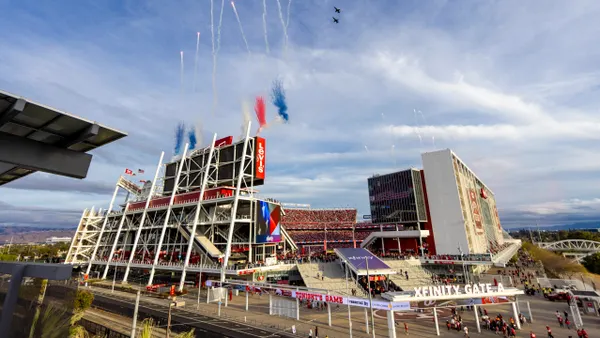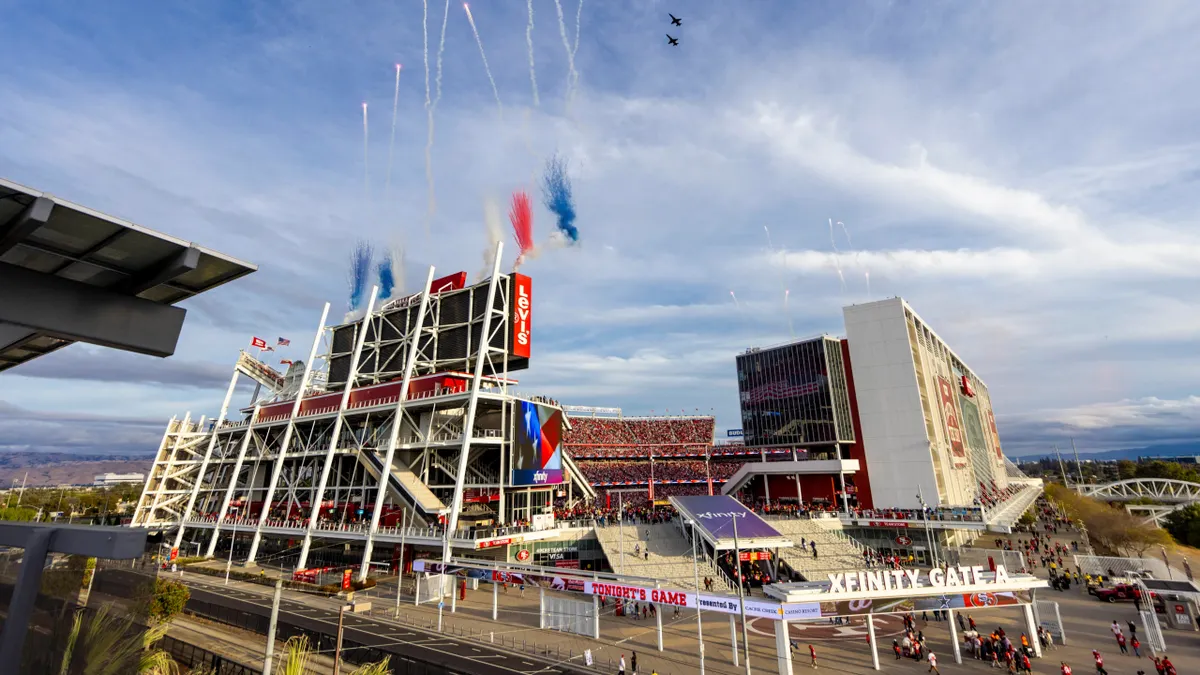
Those attending the Super Bowl on Sunday can expect an immersive experience from upgrades Levi’s Stadium has made to its digital signage, lightning and Wi-Fi connectivity, according to stadium and technology company executives.
The stadium last year completed $200 million in renovations that added 13,000 square feet of LED screens. Those screens include 4K video boards at the north and south ends of the stadium that are 70% larger and contain 300% more pixels than the earlier screens in those locations. The lighting system has grown to feature more than 55,000 square feet of LED ribbon boards. The sound and visual production room will help give fans “a brighter, louder, and more immersive gameday experience,” the stadium says.
“We now have the world’s largest outside 4K video boards,” Costa Kladianos, executive vice president and head of technology for the San Francisco 49ers, said this week while at the stadium’s on-site Cisco data center, which houses controls for the sound system, LED screens and production systems. “Just about everything that runs the stadium runs through here.”
These upgrades required network and security infrastructure that could handle “just about anything thrown at it,” according to Cisco, which said it overhauled the stadium with the first Wi-Fi 7 implementation of its kind.
Digital synchronicity
These digital capabilities are becoming increasingly important for venues that host events beyond their home team’s games, Tom Bingham, director of vertical market sales at LG Electronics, said in an interview.
“There [are] so many things that make [a] building operate seamlessly to create an experience,” Bingham said. “It’s no longer just telling me where my seat is or telling me how much my concessions cost. All that digital signage not only is informative and does all that stuff, but now it’s part of the show. It has to sync with the audio visual.”
The goal of digital upgrades happening at high-profile venues is to help make events something to be experienced and not just watched, he said. “There’s something that ties all that together … into one cohesive synchronized experience so that you feel you’re part of something,” he said.
In a partnership with America Fujikura, Levi’s Stadium added a 5G distributed antenna system, or DAS, that’s intended to help ensure fans have “the best connectivity of any building in the NFL,” according to a press release.
The DAS will help support cashierless concession stands on the main concourse, which are intended to offer a frictionless way for fans to buy food and beverages, the stadium said in an announcement when it launched them in 2024. Wireless connectivity and the solutions that rely on it, like the cashierless concessions technology, are top goals for venues, according to a 2025 white paper on stadium connectivity by Verizon and Stadium Tech Report.
“Every year we see more traffic, and that calls for more wireless network flexibility,” Matt Swartz, an engineer at Cisco, said in a statement. “It’s paramount at a large-scale sporting event, because people are live streaming from the second they walk into the stadium. It requires a very flexible and scalable wireless infrastructure.”
“Anyone that shows up to an event like a Super Bowl is taking pictures and wanting everyone to know that they're there,” said Anish Patel, director of stadium and wireless engineering for the NFL. “That puts a lot of weight on the uplink of the network.”
Heightened cybersecurity
All of this data, and the high profile of an event like the Super Bowl, draws the attention of cybercriminals, according to Cisco. For that reason, the company worked with the stadium and the NFL to implement extensive security measures, Cisco said.
“When we started, we were blind to a lot of what was going on, and we decided that this was not any way to do cybersecurity,” George Griesler, senior director of cybersecurity for the NFL, said during a stadium tour. “We … essentially put Cisco in front of inbound and outbound traffic. And this extended to networks that are used for back-of-house vendors, NFL staff, NFL control. We wanted to protect the confidentiality, integrity and availability of all networks.”
The work involved the use of technologies from Cisco affiliates including Splunk, ThousandEyes, Talos Intelligence Group, Umbrella, Secure Firewall and Meraki, the company said.
The technology and cybersecurity updates will have benefits to Levi’s Stadium beyond the Super Bowl; it and many other large venues around the country are working through changes they need to prepare for the World Cup, which starts in June.
For example, the stadium will be able to update branding around the venue with the click of a button, as opposed to wrapping or removing thousands of assets, like must be done at older stadiums, according to Cisco. Venues hosting the World Cup must remove all corporate branding from their facilities.
Levi’s Stadium did not provide comment for this story.