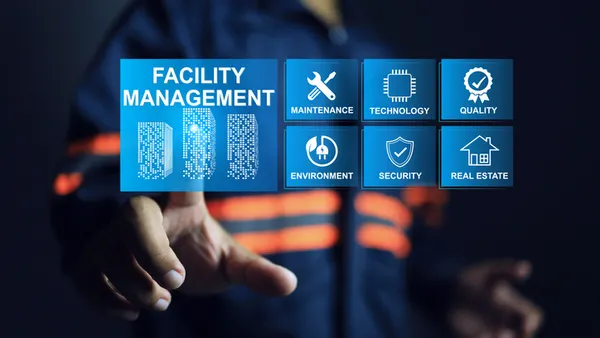
Organizations are adopting AI and other digital technologies to improve workforce productivity, reduce energy use and enhance the physical security of their building systems, according to a Johnson Controls report on AI and digitization in facilities management.
More than three-quarters of respondents to a survey the company conducted at the end of last year say they’re happy with the amount of time employees are spending in the office so they’re shifting their tech focus to how their buildings and workers perform, says Johnson Controls. Survey findings are based on responses from 760 U.S.-based business leaders representing companies of more than 200 employees.
Just under 70% of business leaders say they’re using workplace management technology, mostly for space planning. Among those who aren’t using it yet, many say they plan to adopt a space management solution or an integrated workplace experience platform.
For the most part, return-to-work-related actions have stabilized, the report says. Many organizations have landed on attendance models that balance flexibility with in-person collaboration.
Facilities leaders are shifting their focus to using technology to help them navigate risk with limited resources by investing in solutions that can prevent system failures, improve visibility into system health and enable teams to operate more efficiently, Johnson Controls says.
AI-driven predictive maintenance is the most popular planned investment for assisting in facilities operations, named by 51% of facilities managers, followed by integrated workplace experience platforms (38%) and environmental monitoring and indoor air quality solutions (37%).
Predictive maintenance is one of the most compelling use cases for AI — named as a key strategy by almost half of those already using or planning to use the technology. It’s also seen as an important lever for energy management. More than 60% of facilities managers with AI in place or planning to have it in the next year point to its role in optimizing energy efficiency and building system efficiency.
Physical security was listed as another primary AI use case, with half of respondents saying they’re using it to enhance safety and access control, but wider adoption is limited by cyber risk, the company says.
Almost a quarter of respondents cited data privacy and cybersecurity as their biggest obstacle to expanding AI use, outweighing concerns about budget constraints, lack of expertise and resistance to change.
Cyber attack risk is also the largest threat to maintaining equipment performance and uptime, cited by 22% of respondents, followed by budget limitations at 20% and aging infrastructure and deferred maintenance at 18%.
“Taken together, these findings reveal a critical tension,” Johnson Controls says. “Facility leaders are expected to protect increasingly connected, aging and mission-critical systems from cyber risk and failure while operating within tight budget and staffing constraints. As equipment performance, uptime and resilience become more dependent on connected systems and networks, this pressure is no longer confined to facilities teams alone — it spans both IT and OT domains.”
This dynamic makes reactive approaches “untenable” and increases the cost of unplanned downtime or security incidents, the company says in its report.