Dive Brief:
- A bill tightening restrictions on emissions from data centers’ onsite generators passed out of the Virginia legislature earlier this month and now awaits Gov. Abigail Spanberger’s signature.
- Beginning in July, the bill would prohibit the Virginia Department of Environmental Quality from issuing air quality permits for data centers unless their onsite generators meet or exceed federal “Tier 4” standards for high-powered stationary engines.
- It’s the latest example of state policymakers and regulators responding to data center host communities’ pushback on noise, air pollution, water use and other quality-of-life issues. Amid increasingly vocal opposition, experts say data center operators see a bigger role for quieter, non-emitting onsite power sources like batteries.
Dive Insight:
An earlier version of the Virginia bill included a requirement that data centers use batteries as their main source of backup power, but that portion was left out of the version that passed the state House of Delegates, News From the States reported last month.
Virginia is the country’s biggest state data center market. Other states with significant data center industries like Minnesota have also taken steps to regulate onsite generators. Local permitting authorities have pushed back on or outright rejected large-scale data center proposals over noise and air quality concerns, as well.
In power-constrained regions of the United States, already-built data centers may have the option to use generators intended for emergencies as their main source of power during periods of high need. For example, ahead of a cold snap this winter, the operator of the electric grid that covers Virginia and parts of 12 other states told data centers and other industrial facilities that it may need to tap their onsite power sources to ensure other customers had enough power.
While such measures may be needed in the short run, they don’t help alleviate neighbors’ concerns, said Ben Kaun, chief commercial officer of Inlyte Energy, a technology company working to scale production of an energy-dense, long-duration battery.
“These communities are increasingly pushing back against massive data centers, especially when they’re not clean-powered,” Kaun said in an interview.
Beyond neighborly benefits like lower noise and no operational emissions, batteries reduce logistical headaches like finding space for rows of outdoor generators and onsite fuel tanks, which Kaun called “a significant pain point” for large data centers. In power-constrained areas, batteries provide the same “islanding” capabilities as diesel or natural gas generators, and they’re adept at smoothing out the sometimes violent voltage fluctuations associated with AI model training runs that can prematurely age expensive computing equipment and power electronics, he added.
Those voltage fluctuations can affect homes and businesses nearby — another reason for data centers to manage them in-house, experts say.
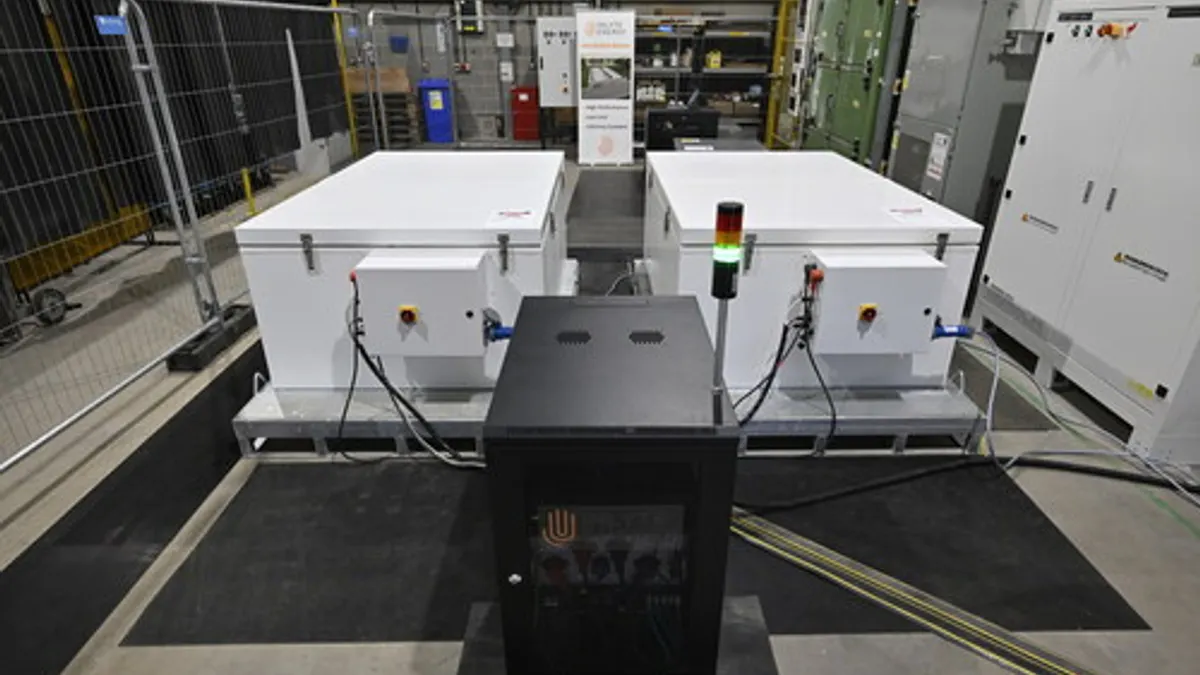
Inlyte’s sodium metal chloride battery technology differs from the lithium-ion chemistries found in most electric vehicle, grid-supporting and building backup batteries today. Originally developed in the 1980s, its high energy density and resistance to degradation make it “a premium [uninterruptible power supply] battery” that’s already widely used in critical facilities like data centers, Inlyte founder and CEO Antonio Baclig said in an interview.
The technology is also less prone than lithium-ion batteries to “thermal runaway” events that can lead to fires, which simplifies permitting and makes it more suitable for indoor applications, Inlyte says. And it can discharge economically at full power for 48 hours, longer than lithium-ion batteries. Current lithium-ion installations typically top out between four and eight hours.
Kaun said longer discharge durations mean a wider set of value streams for users like data centers.
“It seems clear that if someone can develop a 24-hour battery system that is capex-competitive with a diesel genset, there are so many things you can do with that asset to generate value,” he said. “Everything you can do with lithium-ion and more.”
“We are a Swiss army knife for the grid,” Baclig added.
On Feb. 26, Inlyte announced a partnership with NTS, a Swiss colocation data center operator, to deploy up to 2 megawatts of its batteries by 2028.
“We are building a diversified energy architecture that goes beyond traditional uninterruptible power supply and diesel generators,” Niklaus Hug, CEO of NTS, said in a statement. Inlyte’s technology “represents a promising missing layer, offering inherent safety, long duration discharge capability, and long asset life aligned with data center infrastructure,” Hug added.