Dive Brief:
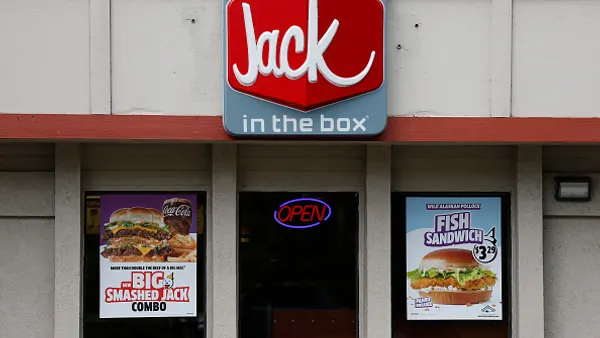
- Jack in the Box saw its same-store sales decline 6.7% in its fiscal Q1 2026, the chain said in its earnings release. On the bright side, the sales decline is less severe than the previous two quarters, when Jack posted 7.4% and 7.1% drops.
- To put itself on better footing, the company is working on closures and cosmetic updates to improve the performance of its system, although CEO Lance Tucker said the brand is not yet in a position to launch a full reimaging of its system. Instead, it’s triaging cosmetic changes that will make major changes in curb appeal for low costs.
- The changes — fresh paint, re-striped and sealed parking lots, and neater landscaping — can be done for between $10,000 and $20,000 per store, Tucker told analysts. Generalized across the rough 2,100-store system, such changes could cost the chain and its franchisees as much as $42 million. Tucker said the brand hopes to kick off a full-scale reimaging and remodel program toward the end of the year.
Dive Insight:
The cosmetic changes are part of Jack in the Box’s Jack on Track program, a series of changes meant specifically to strengthen the brand’s balance sheet, and its Jack’s Way initiative, which focuses on operational changes.
As part of the program, the brand is trying to improve its value proposition and food quality and will pull back on marketing of limited-time offers.
The core of Jack’s sales problem is weakness with key consumer demographics, namely low-income and hispanic consumers. Jack has seen no meaningful improvement with these groups in the last quarter, Tucker said, and broad-based price sensitivity remains an issue.
“Customers are still careful about where they spend,” Tucker said. “We remain committed to a strategy grounded in driving value for guests while protecting profitability for ourselves and our franchisees. You'll see us continue to feature price pointed value promotions that also drive our barbell strategy with add-ons and upsells.”
Jack will focus on improving product quality relative to competitors, since price-point value messaging has proven insufficient to reverse the chain’s traffic problems, said Ryan Ostrom, Jack’s chief customer and digital officer.
“It's not all just about price points, it's about improving the quality of our goods,” Ostrom said. “We've already executed some of that in our latest window with improving our core grilled chicken. Our next step is looking across our core platform and improving across our items.”
The brand is pulling back on marketing around limited time offers to simplify its messaging and improve the effectiveness of individual campaigns. Wendy’s — faced with similar sales issues — made similar changes to its marketing last year, but has continued to see significant declines in same-store sales.
Jack in the Box is slated to close between 50 and 100 restaurants, mostly franchised units, in fiscal 2026, per the earnings release. Dawn Hooper, the chain’s CFO, said that ongoing closures have helped strengthen unit economics at surviving units.
“We have generally seen a roughly 30% sales benefit to nearby restaurants,” Hooper said on the chain’s Q1 earnings call. “This element of JACK on Track is moving a little slower than we would have expected as franchisees are evaluating lease dynamics and sales transfer benefits on a case-by-case basis.”
The $115 million sale of Del Taco — the other major short-term goal of Jack on Track — was completed in the quarter, Hooper said. The proceeds were used to pay down debt, Tucker said.
“We are doing exactly what we committed to do by simplifying the business and bringing down debt levels,” Tucker said.
Hooper disclosed that the brand is still heavily-indebted, with $1.6 billion in total debt, and a 6.5-to-1 debt to adjusted EBITDA leverage ratio. Hooper said the chain plans to pay down another $200 million in debt over the duration of Jack on Track, partially through the sale of real estate assets.